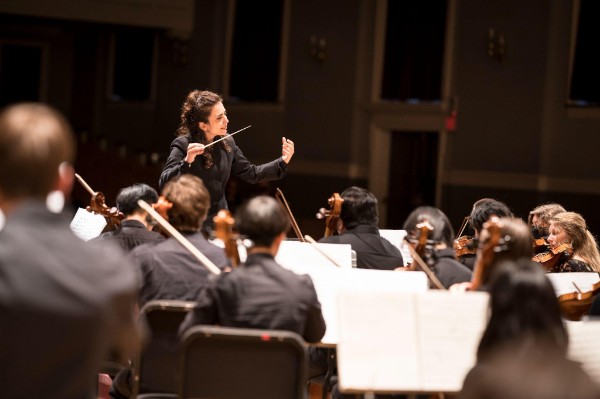
When the lights dim and the orchestra draws its first breath, the conductor’s baton becomes both compass and storyteller. For Asieh Mahyar, the new Director of Orchestras at the University of Texas at San Antonio (UTSA), each gesture is infused with a lifetime of resilience, artistry, and vision. We sat down with maestro Mahyar to learn about her inspiring path, one that spans continents, cultures, and countless hours off and on the podium.
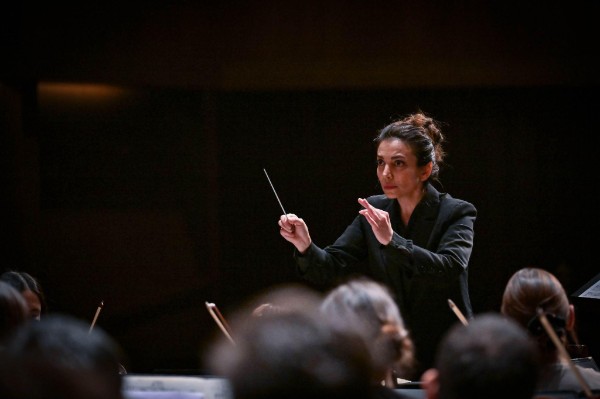
Asieh Mahyar
You were born and raised in Iran. How did your musical journey begin?
My connection to music goes back to childhood, when I would listen to Beethoven and Mozart recordings while spending time with my sister in her painting studio. Growing up in Iran, Western classical music was not widely accessible, and pursuing it, especially as a woman, was rarely seen as a viable career path. To meet societal expectations, I studied Computer Engineering in my hometown, Esfahan, while following my passion for music through private lessons. I started my musical journey by taking lessons on the Tanbur, a traditional string instrument, but later shifted to the piano and vocals, gradually devoting myself fully to classical music, which has always been my true passion.
How did you discover your passion for conducting, and what motivated you to follow that path?
My passion for conducting was sparked after attending my first live orchestral performance in Tehran, a powerful rendition of Loris Tjeknavorian’s Ararat Suite, conducted by the composer himself. Watching him on the podium, I was captivated by the electric connection he forged, not only with the musicians but with the audience and the entire space. It was as if the orchestra, the conductor, and the audience were all breathing as one. That profound moment awakened something inside me and set me on a path I could not ignore. I made the bold choice to leave Iran, move to Armenia, and immerse myself in formal studies, eventually earning my Bachelor of Music in Choral Conducting from the Komitas State Conservatory of Yerevan. That chapter was both intensely challenging and incredibly fulfilling, the start of my lifelong journey as a conductor.
Your career in the U.S. progressed quickly. Can you share some highlights?
In 2019, I moved to the United States and earned my Master of Music in Orchestral Conducting from the University of Massachusetts Amherst, followed by acceptance into the Doctoral degree in Orchestral Conducting at Michigan State University. Since then, I have participated in prestigious workshops and festivals across the country, including the Cabrillo Festival of Contemporary Music, National Music Festival, Eastern Music Festival, and Spokane Symphony International Conducting Workshop. I have served as Director of Orchestral Studies at Pacific Lutheran University, Symphony Orchestra conductor of the West Seattle Community Orchestras (WSCO), and guest conducted Northwest Mahler Festival, Marquette Symphony Orchestra, and Grand Rapids Symphony, among others. I am excited to begin my journey as the Director of Orchestral Studies at the University of Texas at San Antonio (UTSA) this Fall.
Asieh Mahyar, Conducting Portfolio
From premiering new music to advocating for inclusivity, you have been a strong voice for change in classical music. What drives that commitment?
Music is a living art form and a powerful force for connection. It bridges cultures, sparks dialogue and deepens our understanding of each other. In an increasingly interconnected world, I believe it is essential to embrace the richness and beauty that cultural differences bring to musical stages, much like adding new colours to a painter’s palette, where each hue broadens the possibilities and enriches the vibrancy of the painting. I have collaborated with living composers from diverse backgrounds, premiering, commissioning, and performing their works. I have found that audiences are not only receptive to new voices but genuinely enthusiastic about them.
Do you want to introduce any new compositions to our readers to add to their listening list?
There are countless composers whose music I have deeply loved, and I am always seeking more. The beauty of this journey of inquiry is that it never truly ends. As I mentioned earlier, Loris Tjeknavorian’s music holds a special place in my heart as it marked a turning point in my musical and conducting career. Tjeknavorians’s style is remarkably diverse; he masterfully and seamlessly weaves his rich Iranian-Armenian musical heritage with Western classical foundations he embraced as a conductor and composer.
One of his most remarkable compositions is his opera Rostam and Sohrab, based on the tragic episode from the 10th-century Persian epic Shahnameh by Ferdowsi. It captures the essence of Persian music and culture with extraordinary authenticity. I recommend beginning with the Rostam and Sohrab Symphonic Suite: I. Introduction.
Rostam and Sohrab Symphonic Suite: I. Introduction
What is your future artistic vision, and what performances are coming up?
My vision is to create performances that deeply engage both performers and the community, champion new music, and spark innovative collaborations. I see every orchestra as a living community, and the conductor’s role is to help it grow, evolve, and reach its fullest potential. Joining UTSA marks an exciting new chapter for me. This season, we have six upcoming concerts, including the Winterlude program, the New Music Festival, and collaborations with the UTSA Lyric Theatre.
To learn more about Asieh Mahyar, please visit her Website.
Recognised for her remarkable vocal versatility, Haniye Kian is a singer, vocal coach, ethnomusicology scholar, and emerging conductor. Throughout her career, she has performed across a wide range of genres on multiple continents. Her artistic vision is fueled by a deep passion for creating innovative and emotionally resonant work. Drawing on her diverse background in classical, jazz, rock, metal, and traditional Persian music, Kian seeks to bring a fresh perspective to the New Age genre, crafting a distinctive fusion that transcends musical boundaries and connects with contemporary audiences.
Since 2024, Kian has been privately mentored by Barbara Hannigan, whose guidance has been instrumental in shaping her development as a conductor. In 2025, Kian joined Equilibrium Young Artists as an apprentice conductor, marking the beginning of her promising journey on the podium.
See more at: https://hanikian.com/
For more of the best in classical music, sign up for our E-Newsletter