This set of world premiere recordings of music by the Danish composer Lars A. Bisgaard brings together his works for solo piano, guitar and piano, and piano and string orchestra.
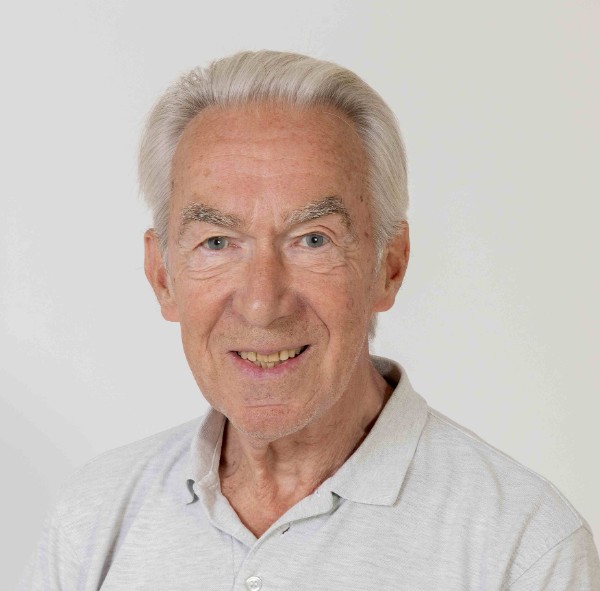
Lars A. Bisgaard (photo by C.P. Foto Hillerød)
The recording opens with his Triptych for piano and string orchestra, with movements that bear the interesting title of Walking, Passing, and Being. Written between 2014 and 2017, the works, originally for piano solo, were rewritten for piano and string orchestra. Although brought together under the title Triptych, each of the works can be performed separately. Walking was inspired by an essay by Henry David Thoreau about his pleasure at walking in nature, far away from the influences of man. Passing, which can include everything from crossing a border to passing away, is based on a theme (A–E–H (B-natural)–F–C) using the letters of the name of a friend. The final piece, Being, is about being alive in the cosmos, now and forever.
The Hassler Variations is a meditation on death and dying. Starting with a chorale by the Protestant composer Hans Leo Hassler (1564–1612), Umb ein seliges End (Prayer for a Blessed End), Bisgaard fashioned a series of variations. More than that, however, Bisgaard combines Hassler’s chorale with a Danish hymn Den klare sol går ned (The clear sun sets), written to a melody by Johann Schop (1590–1667). The final result is a set of variations on two hymn tunes, a difficult feat to carry off. He closes the variation with Schop’s hymn in the piano with Hassler’s chorale in the orchestra.
Lars Bisgaard: Hassler Variations – Conclusion / Coda
The wonderfully titled Easy-Going Variations on an Old Danish Folk Tune, here presented for guitar and string orchestra, was originally written in 1996 for the historic carillon at Frederiksborg Castle in Hillerød, Denmark. The old Danish folk tune of the title is from the Codex Runicus, ca 1300: Drømde mik en drøm i nat (Dreamed me a dream last night), the earliest non-religious song from Scandinavia. Beyond its age, it was also the break signal between works used by Danish Radio and would be familiar to all listeners. It’s played by Canadian guitarist Alan Liu, with Carl Petersson on piano.
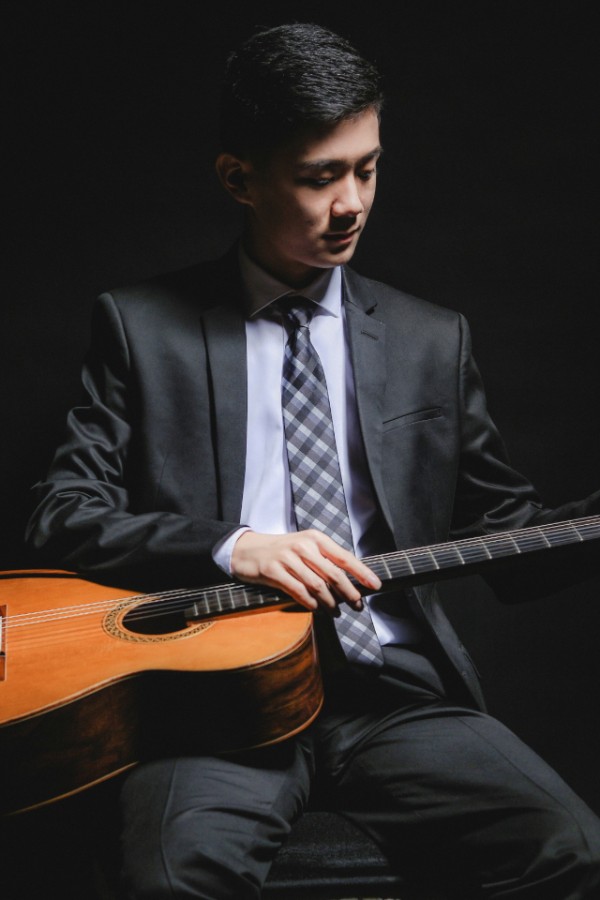
Alan Liu (photo by ZhiQuingChun Studio)
The work is a variation set, with each variation based on a different composer’s style: ‘Variation no. 3 was inspired by Brahms; no. 4 by Beethoven; and no. 6, with its ‘Bulgarian’ 5/8 rhythm, by Bartók’. Variation 5, a slow lullaby, was not part of the original carillon composition.
A unique piano sonata, written in 2019 and 2020, is his Piano Sonata in E flat major, based on fragments and sketches by Beethoven. It started with a 2018 recording by the pianist Carl Petersson of previously unrecorded works by Beethoven, many of a military or national character, plus some of the small works, such as marches, menuettos, and ecossaises, etc. As part of that project, the pianist also put together and recorded ‘a large number of unknown sketches, fragments and smaller pieces by Beethoven that appeared on the 90-CD collection of Beethoven’s works prepared for the 250th birthday celebrations of 2020. Petersson asked Bisgaard to write him a few pieces based on these sketches and sent him 56 musical fragments. Using a sketch of an abandoned piano sonata in E flat major, Bisgaard wrote his own piano sonata in the style of Beethoven. Even the composer declares this a work of ‘pure pastiche’, but it is an interesting exercise in style.
The last works on the album are three fugues, two on a theme by Beethoven and the last, Fughetta sopra E–D–B, written in 1993 for the 50th birthday of the computer-music pioneer Jøgen Mortensen. It was revised in 2021.
There are three bonus tracks included (not mentioned in the booklet), which are the original solo piano recordings of Triptych, and it’s an interesting comparison to see what the piano plus string orchestra version adds to the work.
This recording of Bisgaard’s works brings together a rarely heard exploration of a composer’s works and inspirations. The booklet notes, written by the composer, present the original music for the Hassler and Schop Chorales, which are a great aid in understanding Bisgaard’s compositional process. The Piano Sonata based on the Sketches and Fragments of Beethoven provides an exploration of not only the “nachlass” of Beethoven but also a contemporary composer’s exploitation of the scattered remnants of greatness.
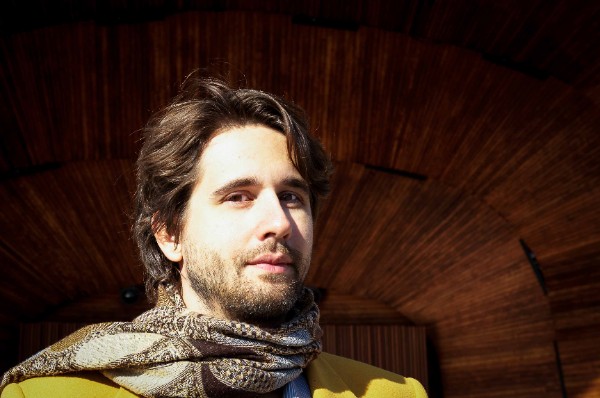
Carl Petersson
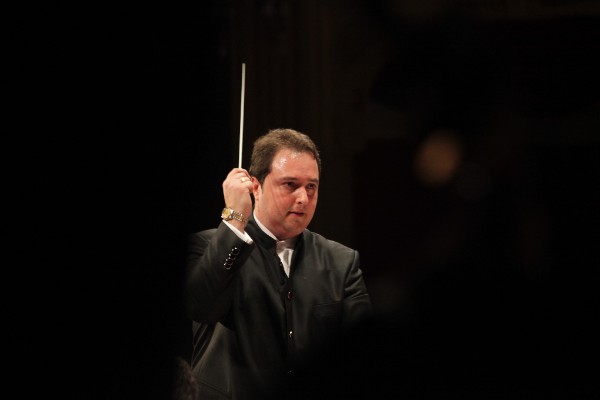
Melani Mestre
There’s a lot to explore here, and in the hands of Carl Petersson on piano, for whom many of these works were written, and Alan Liu on guitar, for the Easy-Going Variations, which had been requested by Carl Petersson, we hear Bisgaard in the hands of a master performer.
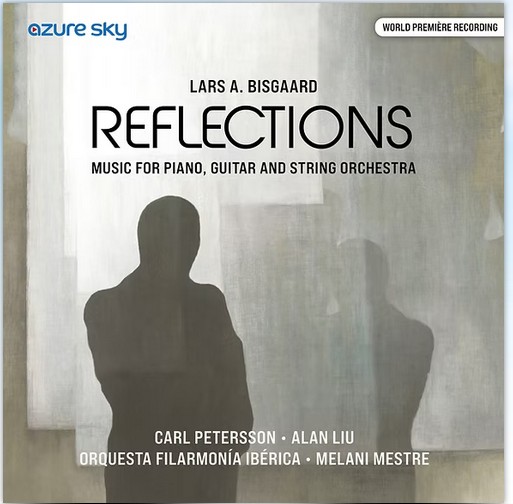
Lars A. Bisgaard: Reflections: Music for Piano, Guitar and String Orchestra
Carl Petersson, piano
Alan Liu, guitar
Orquestra Filarmonía Ibérica
Melani Mestre, cond.
Azure Sky AZ1003
Official Website
For more of the best in classical music, sign up for our E-Newsletter