Frédéric Chopin (1810–1849) took the Ballade from being a favourite kind of German poem to something much more eloquent. In the pens of Goethe and Schiller, it was a narrative poem, and the most familiar we know in music includes Goethe’s Erlkönig and, in a very different vein, his The Sorcerer’s Apprentice.
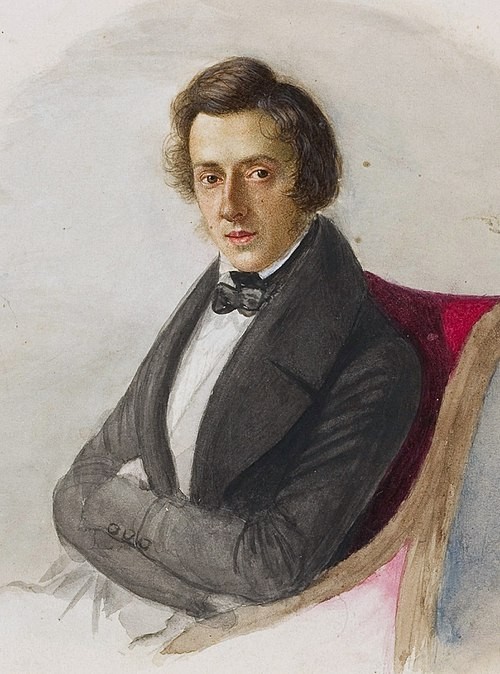
Maria Wodzińska: Chopin, 1836 (National Museum in Warsaw)
Chopin brought the Ballade to music. If the poetic ballades were romantic versions of imagined primitive verse, Chopin’s ballades, which unfold stories of passion through music, fed the Romantic imagination.
Chopin’s first Ballade was written in 1835 and published in 1836. As much as Ballades in the poetic vein were stories, so it is thought that Chopin’s first Ballades were inspired by poetry. The poem Konrad Wallenrod, by Adam Mickiewicz, is thought to be behind the first Ballade.

Władysław Majeranowski: Konrad Wallenrod, 1844 (National Museum in Warsaw)
The story, which involves a Lithuanian pagan adopted and raised as a Christian by his enemies, rises to head the Order of Teutonic Knights, but, reminded of his ancestry by the singing of a minstrel, leads the Knights into defeat. The Knights sentence him to death while his previously secret wife stands by his side. In the end, Konrad commits suicide with poison.
Konrad’s example came to be called ‘Wallenrodism’, for when one strikes (in a very Romantic vein) a treacherous, if not suicidal, blow against an enemy. In Chopin’s hands, the story became a ‘thinly disguised attack on the Russian domination of Poland’. Through the music, the intensity gradually increases, alternating moments of passion with moments of serenity, and the returning voice of the narrator who set the principal theme.
Frédéric Chopin: Ballade No. 1 in G minor, Op. 23
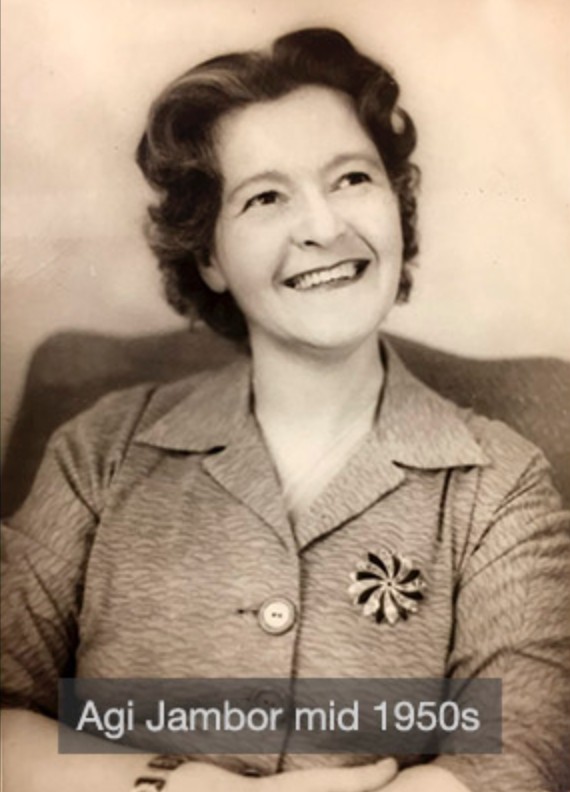
Agi Jambor in the 1960s
This recording was made in September 1957 in Capitol Studio A in New York. The Hungarian pianist, Agi Jambor (1909–1997), was a child prodigy who could play Mozart before she could read and made her debut with a symphony orchestra at age 12. She studied with Edwin Fischer at the Berlin University of the Arts and hit her peak popularity in the early 1930s. Half Jewish, she fled Germany for Paris, where she famously said that she would prefer to practice piano in a dance studio to performing on the concert stage.
Caught in the Netherlands by the German advance, she fled back to neutral Hungary. When the Germans invaded Hungary, she became a member of the resistance and refused any possibility of performing in Germany again. She came to the US in 1947. She recorded 5 albums for Capitol Records between 1955 and 1957 and then became the favourite soloist of Eugene Ormandy, who led the Philadelphia Orchestra. Bruno Walter also acclaimed her. She made a further 12 recordings for Capitol and was appointed piano professor at Bryn Mawr College. She died in Maryland, 1 day before her 88th birthday.
In 2022, the Liszt Academy and the Jambor family established The Jámbor Prize, a HUF 100,000 scholarship to support students in the name of Olga Jámborné Riesz (1879–1956) and her daughters Böske Jámbor (1904–1964) and Ági Jámbor. The award can be given primarily, but not exclusively, for an excellent Bach interpretation, excellence in music teaching, or an outstanding concert or performance performed during the school year.
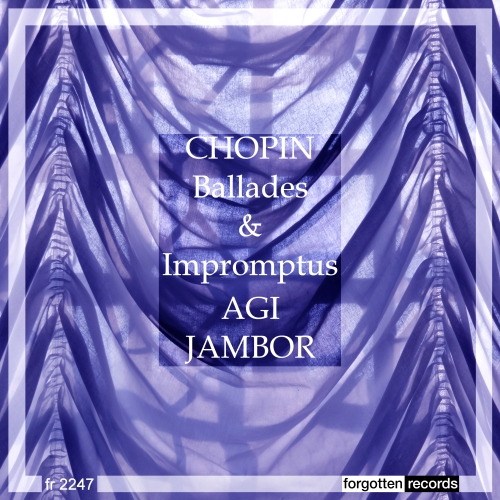
Performed by
Agi Jambor
Recorded in
1957
Official Website
For more of the best in classical music, sign up for our E-Newsletter