As an homage to their long-time designer Nikos S. Petropoulos, Greek National Opera staged a revival of his 1998 Tosca. Set in 1944 Rome, the opera opened as if it were a film, with the opening credits running on a screen and the sound of marching boots on the sound system. The designer said that one of his inspirations was Fellini’s neorealist war drama, Rome, Open City. Small changes were made in the libretto to reflect the change of time period, such as the phone call in the second act that announces that ‘Cassino has fallen’, which happened on 18 May 1944. Bonaparte is no longer poised to take Rome, and we are pushed forward into the 20th century by typewriters and telephones, and the voice of the shepherd passing the Castel Sant’Angelo is being replaced by a static-filled radio broadcast. One great detail is the shadowing of Cavaradossi’s torture through a back-list map of Rome, while a shadowy portrait of Mussolini looks down from above.
The sets were done in black and white, which makes the colourful San Andrea della Valle church just a backdrop, and it could have been a matching character. Cavaradossi is spending his time painting a black and white painting of Mary Magdalene – even though comments are made about the blonde hair and blue eyes in the work of the figure, and those details are a major contributor to Tosca’s jealous fit.
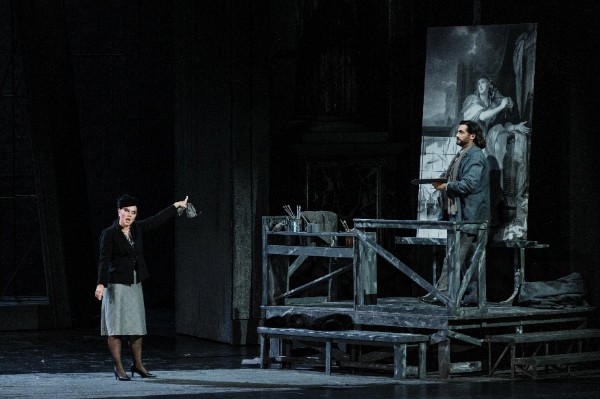
Tosca (Aleksandra Kurzak) objects to the subject of Cavaradossi’s (Marcello Puente) painting, 2025
(Greek National Opera) (Photo by Giannis Antonoglou)
We can’t comment on design decisions that were made over 30 years ago, but it does speak, unfortunately, to what appears to be GNO’s long-standing decision to use designers who ignore the libretto when it interferes with their ideas.
Watching this opera in a time of reckless force internationally brings back the idea of how helpless individuals are in the face of unprincipled power. Scarpia wants Tosca, and he doesn’t really care who he sweeps aside to achieve that goal. In the end, that desire proves to be his end, but then he carries so many others before him: the escaped prisoner Angelotti would rather suicide than go back, the painter Cavaradossi dies because he’s Tosca’s current lover (and had some hand in helping Angelotti after his escape). Scarpia dies because of his amoral use of power, and the audience rejoices.
Giacomo Puccini: Tosca, Act II: Vissi d’arte (Aleksandra Kurzak, soprano; Morphing Chamber Orchestra; Frédéric Chaslin, cond.)
Tosca is a jealous fool, and she is manipulated by the conniving Scarpia, so he gets what he wants: the hiding place of Angelotti and the body of Tosca. Cavaradossi is just someone who gets in the way and will be disposed of.
On opening night, Tosca was sung by Aleksandra Kurzak, Cavaradossi by Marcello Puente, and Scarpia by long-time GNO heavy Dimitri Platanias. In a way, he was the most disappointing. He’s often played the heavy before, being a most notable Canio in last season’s Pagliacci, a less-than-menacing Rigoletto in the summer 2025 season, and excellent Barnaba in last month’s La Gioconda. Here, he’s back to the less-than-menacing heavy, particularly in the first Act. It’s not until the second act, when he has Tosca in his power, that the slime beneath the veneer emerges. His physical positions threatening Tosca finally show us the concealed power we’ve been waiting for.
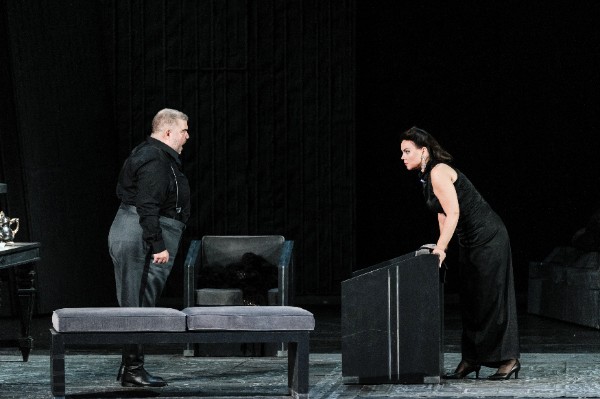
Tosca (Aleksandra Kurzak) faces off against Scarpia (Dimitri Platanias), 2025 (Greek National Opera) (Photo by Giannis Antonoglou)
Aleksandra Kurzak, as Tosca, was making her GNO debut and did a creditable job, although more histrionics, particularly in the first scene, would not have gone amiss. One misstep in the production was to have her begging Scarpia on her knees for Cavaradossi’s life, and that just seemed out of character. She might beg for Cavaradossi’s life, but never on her knees. Her Vissi d’arte was very well done, with her own stylistic innovations that brought it to life.
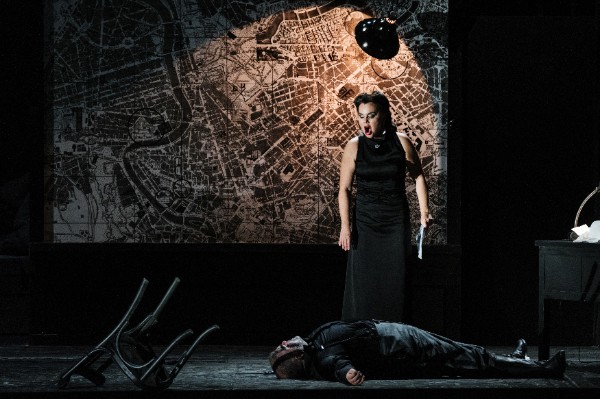
Tosca (Aleksandra Kurzak) victorious against Scarpia (Dimitri Platanias), 2025 (Greek National Opera) (Photo by Giannis Antonoglou)
Marcello Puente (Cavaradossi) has appeared on the GNO stage since 2017, but not in this role before. He inhabited it with ease and sang a beautiful E lucevan le stelle.
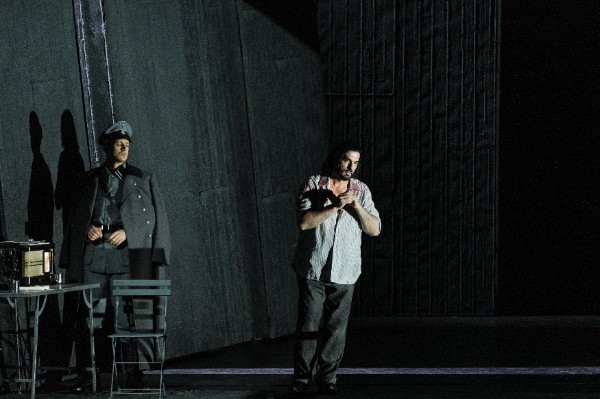
Cavaradossi waits for death, 2025 (Greek National Opera) (Photo by Giannis Antonoglou)
The GNO chorus and children’s chorus made their only appearance in Act I, and the constraints of the stage were enough that the children’s chorus seemed to overwhelm it with their numbers. The adult chorus kept well back and was less intrusive.
Early in Act II, we have one action on stage (Scarpia plotting with his henchmen) and another off-stage (the cantata sung by Tosca with the chorus). There wasn’t enough done to balance all the musical sounds. The orchestra was too loud, the chorus with Tosca was too loud, and Scarpia and crew on stage had to try to sing against a veritable wall of sound. The orchestra was too loud many times throughout, being able to drown out the chorus in Act I. It sounded as though certain instruments had been miked (there was a curiously loud flute line). The orchestra is in the pit for a reason: it’s not the soloist on stage, and increasingly through this GNO season in particular, the orchestra’s volume has been a problem.
The traditional end to Tosca is her own suicide off the Castel Sant’Angelo after she discovers that Cavaradossi hasn’t faked his death; it was the firing squad that was real. What made it even more frightening is that the firing squad was aimed at the audience – an unusual decision.
She may have the safe-conduct to pass the border, but first, she has to get herself and Cavaradossi to the border. In this version, Tosca doesn’t jump to her death but rather exits through the back curtain in an inexplicable blinding blaze of yellow light. Are we to assume that she uses the safe-conduct for herself?
The designer’s notes say that as Tosca walks ‘towards the light, she leaves the stage and, in essence, finds atonement’. Well, not really. What the audience is left with is nothing – we’ve been blinded by a very bright light on a dark stage and a heroine who just vanished. Ignore the fact that her killing of Scarpia has been discovered, and the police agent Spoletta is about to capture her when she jumps to her death – he doesn’t even get close when she sweeps away into the light. In a police state, you can’t just leave. You can’t just walk off. This was one of the most disappointing endings to a classic opera I’ve ever seen.
We titled this review The Opera with the Body Count, and all of them can be blamed on Tosca. She can’t keep her mouth shut about where Angelotti is hidden, she kills Scarpia and then counts on her sex appeal to ensure that the otherwise lying Scarpia keeps his word that her beloved is really going to be shot with blanks. By having her walk off the stage at the end, we miss the last body that could be blamed on her – her own suicide.
Tosca is a very important work at GNO. It was first put on in 1942 with the 19-year-old Maria Kalogeropoulos (you will know her later as Maria Callas) as Tosca in a most notable debut that garnered instant attention. It would become one of her signature roles, aided by Franco Zeffirelli’s film. Her final appearance at the Met in New York was in the same role in 1965. She also ended her career at the Royal Opera House in London as Tosca that same year.
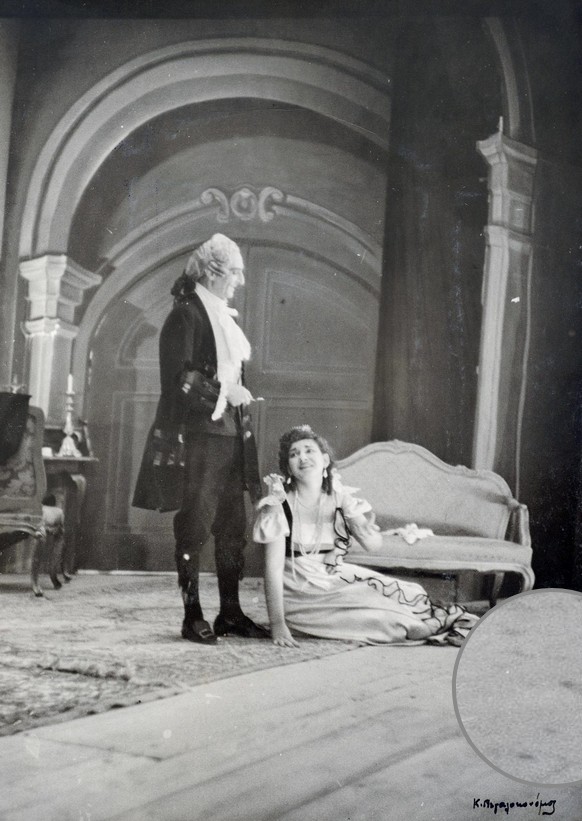
Maria Callas as Tosca with Titos Xirellis as Scarpia, 1942 (Greek National Opera)
GNO Tosca
Puccini: Tosca
Greek National Opera
27, 30 Nov; 02, 07, 20, 23, 27 Dec 2025; 04, 07, 09 Jan 2026
Floria Tosca
Aleksandra Kurzak (27, 30/11 & 2, 7/12/25), Cellia Costea (20, 23, 27/12/25 & 4, 7, 9/1/26)
Mario Cavaradossi
Marcello Puente (27, 30/11 & 2, 20, 23, 27/12/2025 / 4, 7, 9/1/2026), Roberto Alagna (7/12/25)
Barone Scarpia
Dimitri Platanias (27, 30/11 & 2, 7/12/2025 / 4, 7, 9/1/2026), Tassis Christoyannis (20, 23, 27/12/2025)
For more of the best in classical music, sign up for our E-Newsletter