If you’ve ever had a dog, you know firsthand the devotion, affection, and companionship they provide to humans.
Many of the great composers knew the joys of canine companionship, too!
Today, we’re looking at the amazing true stories of the great composers’ dogs…and the creative inspiration they provided. (Read more from Part I of The Dogs of the Great Composers)
Sergei Rachmaninoff (1873-1943)
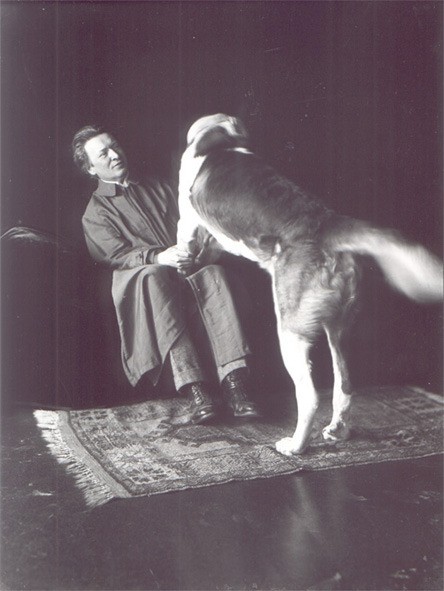
Levko
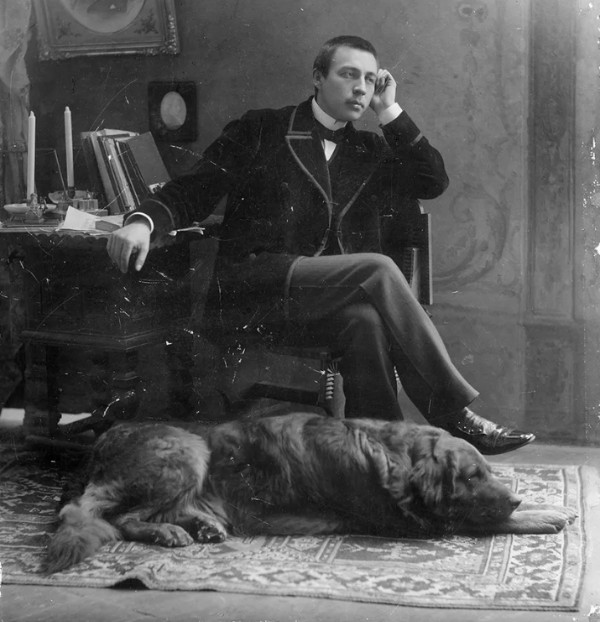
Rachmaninoff with his dog Levko
After the failure of his first symphony, Rachmaninoff became severely depressed, developing one of the most infamous cases of writer’s block in the history of classical music.
Two things helped him get through it: daily therapy sessions and the company of Levko, a massive Leonberger puppy.
Rachmaninoff taught Levko to sit in the corner of the dining room while he ate breakfast. After, he’d signal to Levko that it was time to work.
“All day long he puffs like a steam engine, does not find a place for himself anywhere, sticks to me terribly,” he wrote to a friend.
Rachmaninoff’s Piano Concerto No. 2
With Levko’s companionship, he returned to composing, writing his second piano concerto in 1900-01.
Levko turned out to be a good luck charm. Rachmaninoff’s second piano concerto was a triumph, and today it is one of the most famous pieces of classical music ever written.
Reynaldo Hahn (1874-1947)
Zadig
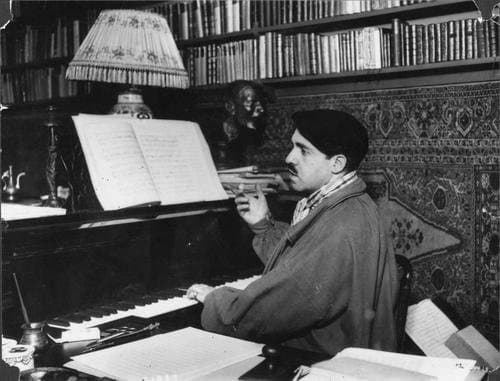
Reynaldo Hahn © cornucopia.net
In the 1890s, composer Reynaldo Hahn embarked on a romantic relationship with writer Marcel Proust.
As a testament to their love, Proust asked Hahn to pick out a dog he could buy for him. Hahn chose a black long-haired basset hound. They named it Zadig after the Voltaire character.
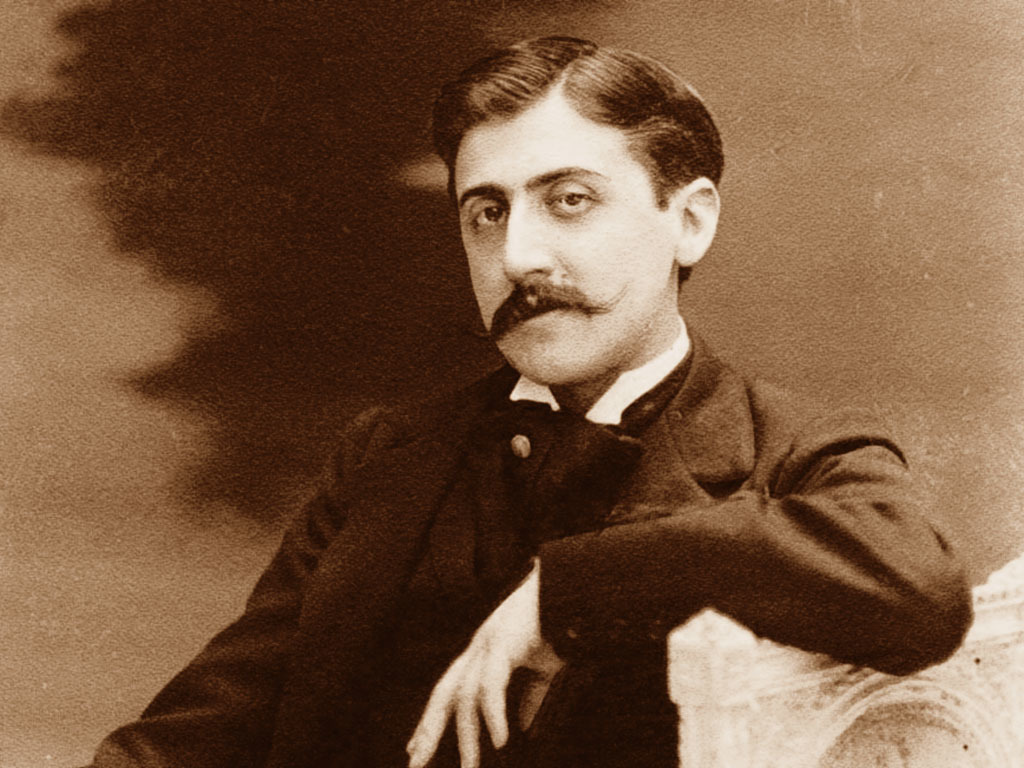
Marcel Proust © bookfans.net/
Hahn wrote to Proust:
“[Zadig] surpasses all that human imagination could have ever conceived in love, kindness, and Bunchtism. But he loves me too much and is wounded by anything he takes as a sign of indifference. As for me, I have metamorphosed into a nanny, a nurse, a papa, a mama, and my life is nothing but an endless procession of humble and precise tasks such as cleaning Zadig’s ears, examining Zadig’s stool, washing Zadig, feeding Zadig.”
Arnold Schoenberg (1874-1951)
Witz
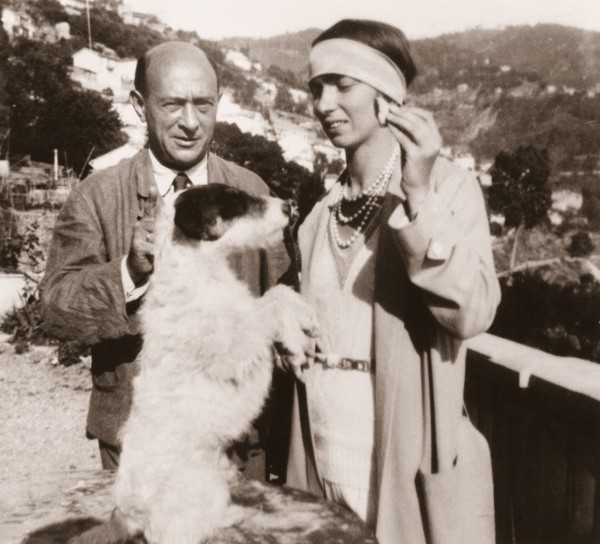
The Schoenbergs with their dog Witz
In a list dating from 1927, Schoenberg mentioned the idea of buying a dog. He and his wife Gertrud did indeed adopt a dog in April 1928.
Witz came with the Schoenbergs when they moved to America in 1933.
In English, the name “Witz” means “joke” or “jest” – a somewhat ironic name for a dog belonging to one of the most serious of all composers!
Alban Berg (1885-1935)
Max, Bella
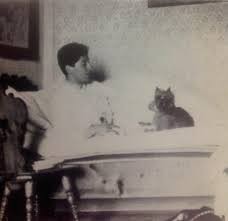
Alban Berg with his dog
Alban Berg had a terrier named Max (who made him laugh), as well as a greyhound-type dog named Bella, who slept at his feet while he composed.
George Gershwin (1898-1937)
Bombo, Tinker, Tony
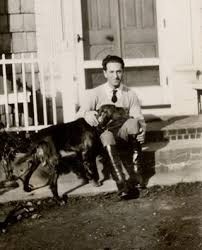
Gershwin with his dog Tinker
Gershwin had at least three dogs. Gershwin biographer Howard Pollack writes:
The [Gershwin brothers’] California homes became favorite gathering places as well, not only for old pals similarly working in Hollywood but for new friends as well, including members of Los Angeles’s growing refugee community…
Throughout, Gershwin often had a dog (usually a terrier) by his side, including Bombo, Tinker, or Tony; Edward G. Robinson once noted that George “made playing with his dog an enviable – lovingly enviable – pastime.”
Gershwin’s Promenade – Walking The Dog
Francis Poulenc (1899-1963)
Mickey
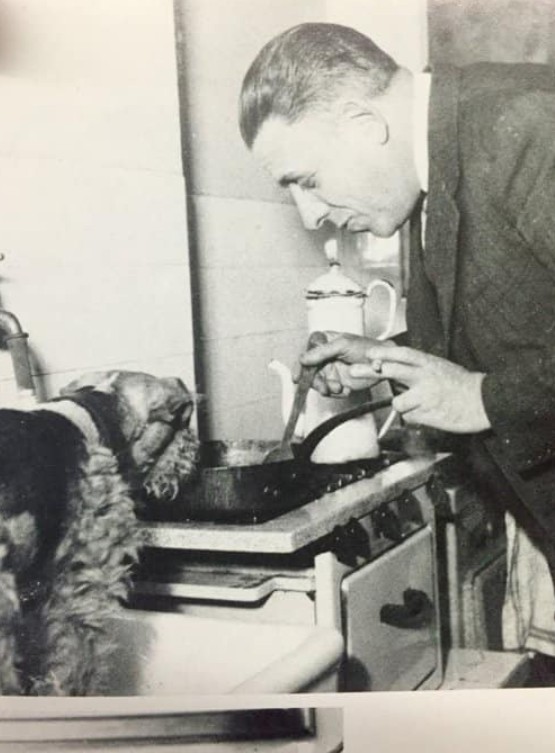
Francis Poulenc
Francis Poulenc’s favourite breed of dog to keep was wire-haired fox terriers.
One of his favourite dogs was Mickey. Multiple adorable photos of the two have survived, including one where Poulenc is frying something on the stove while Mickey looks on.
Poulenc wrote in his Diary of my Songs about his song “Souric et Mouric” from his Cinq poèmes de Max Jacob, “I cannot play this song without thinking of my dog Mickey, lying under the piano.”
Poulenc’s “Souric et Mouric” from Cinq poèmes de Max Jacob
Dmitri Shostakovich (1906-1975)
Tomka
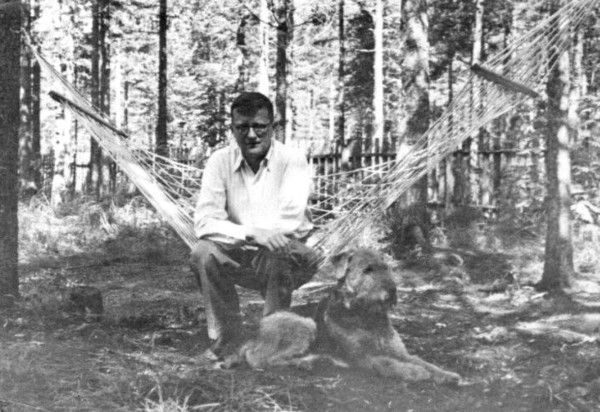
Shostakovich with his dog Tomka
In 1947, a journalist came to Shostakovich’s house to interview the composer. The family’s large Airedale terrier, Tomka, was unsettled, pacing and barking and whining. Shostakovich explained that he was uneasy because the family was packing to go on vacation. Apparently, Tomka didn’t like changes to his routine.
“I have a theory that dogs lead such short lives because they take everything so much to heart,” Shostakovich remarked.
Shostakovich enjoyed the company of animals throughout his life. For a while, he kept pet piglets for his young children. And in 1923, when he was seventeen, he wrote in a letter to his mother:
I just can’t wait till I get to Petrograd and see you and our apartment, and the dog… Oh yes! In your last letter, you said the kitten has been given away. That’s a real pity – he was so splendid.
Benjamin Britten (1913-1976)
Clytie, Gilda, Klithe, Jove, Snooks
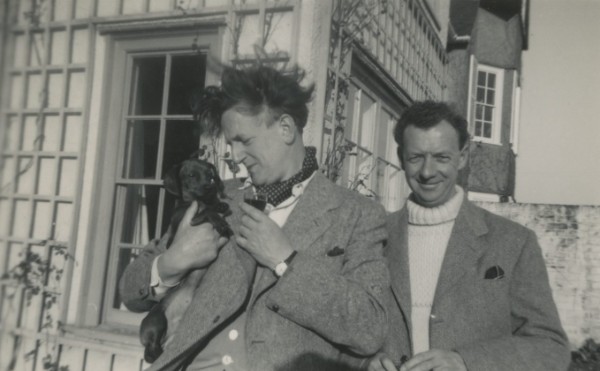
Britten and Pears with their dog
Composer Benjamin Britten and tenor Peter Pears became a couple in 1939. The following year, Pears began studying voice with soprano Clytie Hine Mundy. During his lessons, Britten would accompany him on piano, as a tribute to their lessons with Mundy, Pears and Britten named one of their dachshunds Clytie.
They kept a tongue-in-cheek sign up at their home: “Beware of the Dog, Bisseger Hund, Caveat Canem.” Rostropovich added another sign with the warning in Russian.
Britten would bring his dogs to rehearsals and on seaside walks. He was also a patron of the RSPCA (the Royal Society for the Prevention of Cruelty to Animals).
Leonard Bernstein (1918-1990)
Henry (multiple), Tookie, Honey
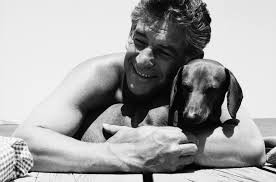
Bernstein with his dog
Like Britten and Pears, Bernstein loved dachshunds.
His affection for them began during a trip to Europe, when Bernstein met and adopted one, bringing it back home with him to America.
As the years went on, he kept a string of dachshunds, all named Henry. Once he even bought a plane ticket for his dog under the name Henry Bernstein.
Aside from his beloved dachshunds, Bernstein also had a Bichon-Frise named Tookie and a Shetland Sheepdog named Honey.
Bernstein’s dogs were spoiled and badly behaved. One enjoyed stealing salamis.
Bernard Herrmann (1911-1975)
Composer Bernard Herrmann found his beloved dog Twilight while scoring the legendary TV show The Twilight Zone.
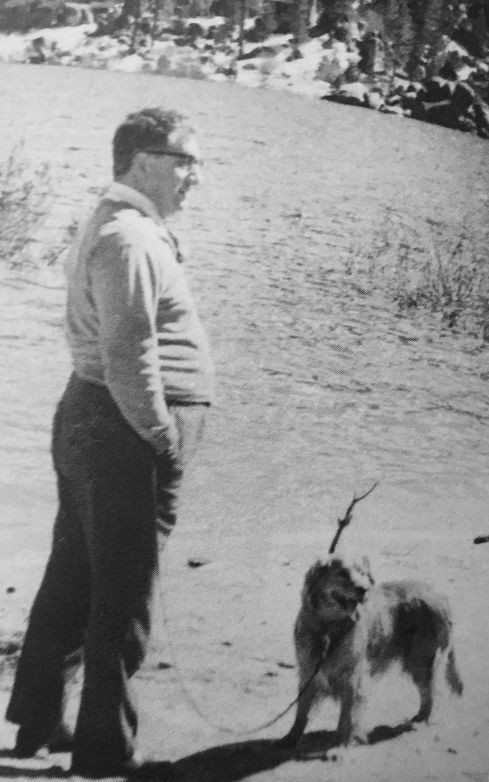
Bernard Herrmann with his dog
Herrmann’s score for The Twilight Zone
Herrmann’s daughter Dorothy writes on the Bernard Herrmann website:
“My father loved animals. ‘Someone has to take them in,’ he was fond of saying of dogs and cats. Most of his animals were strays. He found his beloved dog Twilight when he was doing some of the scores for the [first season of the] Rod Serling television series, Twilight Zone. And during his life, he also owned many cats, of the alley cat variety that were also foundlings.”
Karlheinz Stockhausen (1928-2007)
Sirius
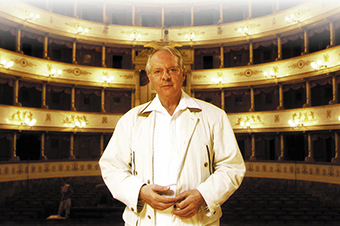
Karlheinz Stockhausen
When she was a little girl, composer Karlheinz Stockhausen’s daughter Julika asked her father for a dog. The Stockhausens adopted one and named it Sirius, after the star in the Canis Major constellation.
Around this time, Stockhausen ended up having a couple of formative dreams. The composer came to believe he’d come from Sirius and trained as a musician there.
The end result of the adoption of the dog was the 95-minute-long musical theatre piece Sirius.
For more of the best in classical music, sign up for our E-Newsletter