
For Japanese-English classical pianist and conductor Mitsuko Uchida, performing is not simply an aesthetic exercise but a moral discipline. Her interpretation is not an assertive personality but an ethical act, grounded in responsibility to the composer, fidelity to the score, and attentiveness to the listener.
Her artistry stands apart not because it is louder or more dazzling, but because it listens. Uchida has often spoken of listening as the core of her musical life. And that listening is not passive but a demanding practice that begins before a note is played and continues long after the sound has faded.

Mitsuko Uchida
To celebrate her birthday on 20 December 1948, let’s explore how listening became an ethical stance, essentially a refusal to dominate the music for personal display.
Mitsuko Uchida performs Mozart: Piano Concerto No. 20 in D minor, K. 466
Two Traditions
Her background offers an early clue to this orientation. Born in Japan and raised largely in Vienna, Uchida absorbed two musical cultures that value discipline, precision, and respect for tradition, yet she never became merely a custodian of inherited styles.
Vienna gave her immersion in the Classical canon, but it also confronted her with the weight of tradition itself. As we all know, reverence can easily harden into routine. Her response was not rebellion but inquiry.
Rather than asking how Mozart should sound, Uchida asked what the music requires in this moment, under these fingers, in this acoustic, for these listeners. This sense of obligation to the score, I believe, is central to her ethics.
Ludwig van Beethoven: 33 Variations on a Waltz by Diabelli in C Major, Op. 120, “Diabelli Variations” (Mitsuko Uchida, piano)
Listening between the Lines

Mitsuko Uchida
To be sure, Uchida does not treat the score as a battlefield where performer and composer struggle for supremacy. Nor does she regard it as a museum artefact to be preserved under glass.
Instead, the score is a living text that demands careful reading. Every articulation, dynamic marking, and silence carries moral weight. To exaggerate, to sentimentalise, or to smooth away difficulty is, in her view, a form of dishonesty.
Fidelity, however, does not mean rigidity. It means allowing the score to speak fully, even when its message is unsettling or ambiguous.
Claude Debussy: 12 Etudes (Mitsuko Uchida, piano)
Clarity without Apology
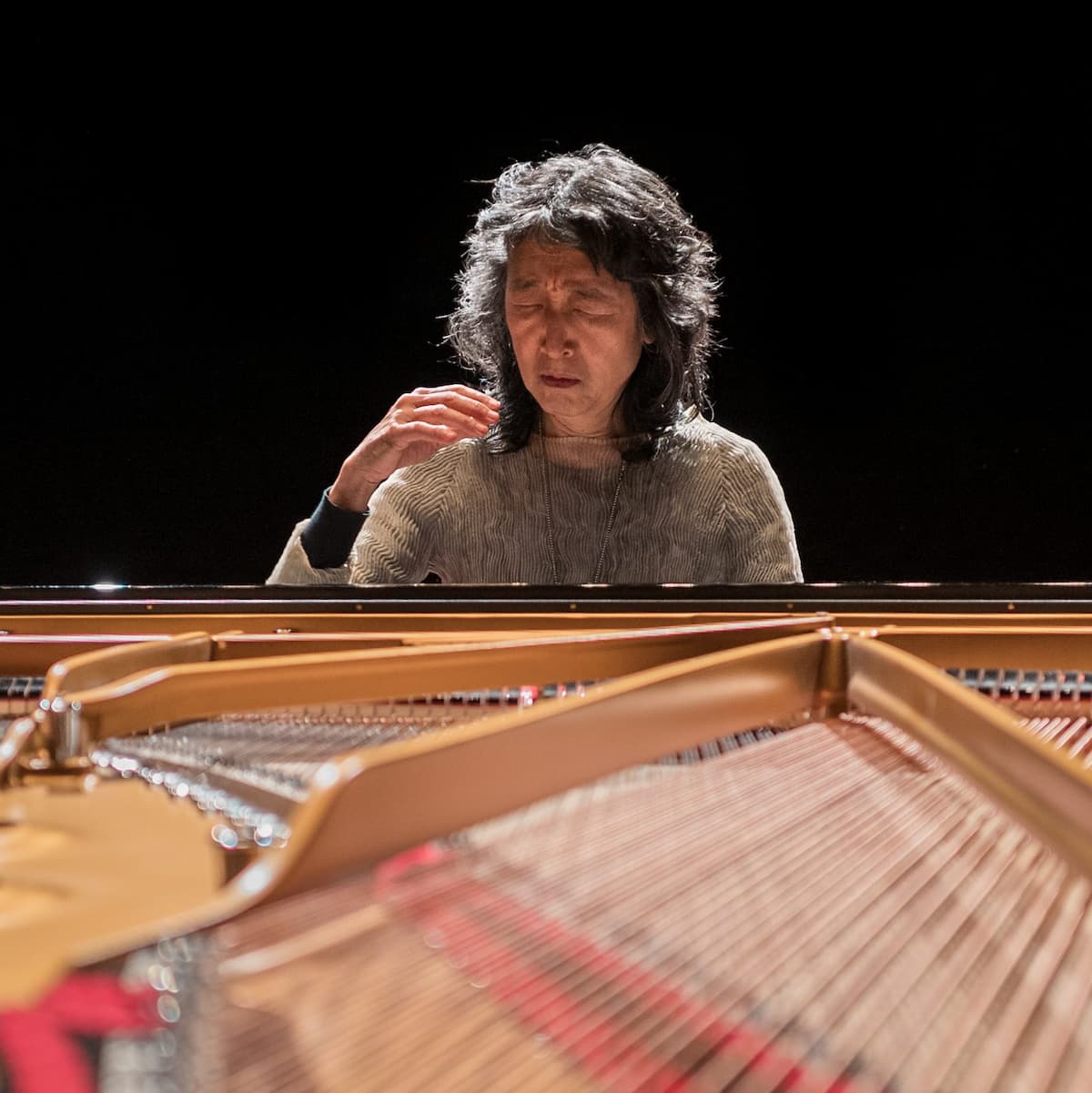
Mitsuko Uchida © Geoffroy Schied
Nowhere is this clearer than in her Mozart. Uchida’s Mozart has often been described as transparent, unsentimental, even austere. Yet this clarity is not emotional restraint for its own sake, but it is an ethical decision.
Mozart’s music, she seems to argue, is too intelligent to be manipulated. Its drama emerges not from imposed grandeur but from precise relationships between voices, harmonies, and time.
By refusing to inflate Mozart into something he is not, Uchida honours the composer’s trust in the listener’s intelligence. She assumes that the audience can follow complexity without being shouted at.
Mitsuko Uchida performs Mozart: Piano Sonata in D Major, K. 576
Restraint as Compassion
Her Schubert reveals another dimension of this moral listening. Schubert’s music tempts performers toward indulgence, leaning toward lingering, luxuriating, and turning introspection into bathos.
Uchida resists this temptation, not because she denies emotion, but because she recognises Schubert’s vulnerability. In her hands, Schubert’s silences feel exposed rather than padded, and his repetitions become existential questions rather than comforting refrains.
Here, ethical responsibility extends beyond the composer to the emotional truth of the music itself. To sentimentalise Schubert would be to falsify his fragile balance between hope and despair.
Mitsuko Uchida performs Schubert: Piano Sonata No. 21 in B-flat Major, D. 960
Listening is not a Product
In a concert culture that often treats audiences as consumers to be impressed or entertained, Uchida’s approach is strikingly different. She does not aim to overwhelm, but she invites attention. Her performances ask listeners to meet the music halfway, to participate in the act of listening rather than receive a finished product.
Uchida has been highly selective about repertoire, cautious about overexposure, and resistant to the relentless pace of the international concert circuit. These refusals are acts of preservation, of herself and of the music, and of the seriousness with which both should be treated.
Her advocacy for twentieth-century and contemporary music underscores this point. Uchida approaches Schoenberg or Kurtág with the same ethical seriousness she brings to Mozart. There is no attempt to soften modernism’s edges or to make it palatable through exaggerated expressivity.
Arnold Schoenberg: 3 Klavierstücke, Op. 11 (Mitsuko Uchida, piano)
Greatness without Conquest

Mitsuko Uchida
In a sense, Mitsuko Uchida embodies an alternative model of musical greatness. Not the conqueror of the keyboard, not the charismatic hero, but the attentive listener. Her artistry suggests that music-making, at its highest level, is an ethical practice.
One that balances fidelity and freedom, intellect and emotion, self-expression and self-restraint. By listening so intently to composers, scores, and audiences alike, Uchida reminds us that the deepest power in music often lies not in what is asserted, but in what is honoured.
For more of the best in classical music, sign up for our E-Newsletter






What a talented pianist and wonderful performer she is , an unique artist and human being, my full respect to you Mitsuko Uchida