Of all the senses one can attempt to evoke by means of the written word, sound may be the most complex. Words can easily call to the mind’s eye, landscapes, facial expressions, and all things visual. Taste, touch, and even smell are quite readily described. Sound, however, has a more intricate relationship with language. Words have their own sonic character, as we see clearly in poetic devices like sibilance, alliteration, and onomatopoeia. Phrases can even take on a musical quality through rhyme, metre, stress placement, and scansion. Many poets have thought of language as music’s illicit mistress, bringing a highly sonic approach to creating their own bodies of work.
This tendency for words, phrases, and sentences to have a musicality of their own, whether read aloud or otherwise, can support certain kinds of auditory devices in literature – sudden crashes, the creak of a door hinge, or the figurative quality of a spoken voice are all simple enough sonic phenomena to bring to life from the page. Alluding to actual musical compositions in literature is a different story. There is no musical equivalent of a pictorial illustration, no way of embedding musical snippets directly into the text, with only very contemporary exceptions in the forms of audiobooks and author-made playlists. For many writers in the literary canon, music was a particularly beloved art form, the power of which they desired to harness in their work. Each of these authors found ways around the fundamental problems of alluding to music in literature, despite the ineffable and difficult-to-describe timbral differences between instruments, the possibility that a reader may not have encountered a particular work, and the impossibility of transcribing or transmitting a melody in a literal sense through words. In this two-part article, we’ll take a look at some of the most renowned works of literature in which classical music plays an important part, observing the ways in which authors have centered music as narratively, thematically and aesthetically significant despite – or perhaps precisely because of – its ineffability.
The Kreutzer Sonata, Leo Tolstoy
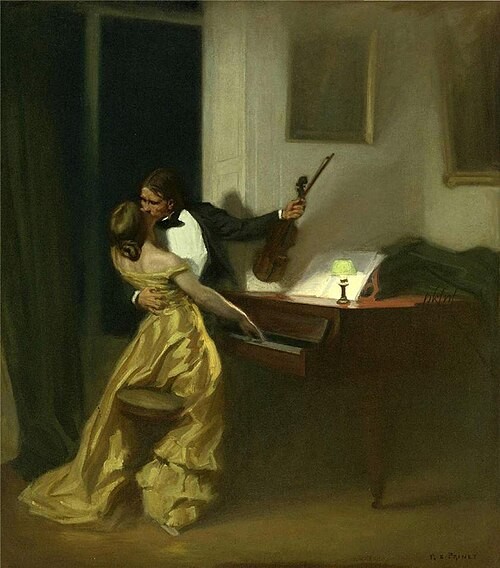
Kreutzer Sonata, inspired by the Tolstoy novel by René-Xavier Prinet
This strange novella, controversial in the years after its publication in 1889, is named directly after the sonata of the same name by Beethoven and was written by Tolstoy in order to espouse his view of romantic love as selfish and un-Christian. Tolstoy believed marriage to be an unworthy goal and the cause of jealousy and irrational behaviour, unlike love of God, one’s neighbour, and service to humanity. The novella is written from the perspective of Pozdnyshev, who watches as his pianist wife grows closer to – and performs the Kreutzer Sonata with – a violinist. Pozdnyshev speaks of music’s dangerous power to transform our feelings, and Tolstoy seems to imply that music is of the same irrational, passionate stuff as love, jealousy, and anger.
Augustin Hadelich and Orion Weiss – Beethoven Sonata No. 9 “Kreutzer” first movement (Live, 2024)
A Room With a View, E.M. Forster
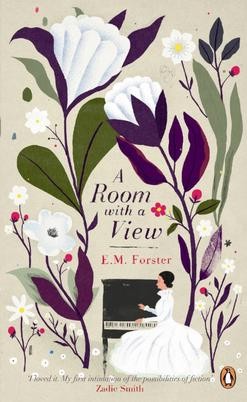
A Room with a View written by E. M. Forster. © Wikipedia
Novelist E.M. Forster took a keen interest in classical music, and as such, the subject crops up in his writings in a surprising variety of ways. In Howard’s End (1910), characters attend a lecture on Beethoven, described in detail. In A Room With a View (1908), the protagonist’s musicality serves as a dramatic signifier of her true character and disposition. The book follows upper-middle-class young lady Lucy Honeychurch and her older spinster cousin and chaperone Charlotte Bartlett as they travel in Italy, for all of the cultural education and entertainment provided by the tradition of a European tour. The book is set during a cultural crossroads, with Edwardian morality beginning to give way to greater independence for women and freedom of behaviour. Forster seems to ridicule the strictures of the Edwardians and instead lauds various ideals of Romanticism, such as openness of expression, closeness with nature, and strength and depth of emotion, all of which are embodied by a young man Lucy meets in Florence, George Emerson.
Lucy’s capacity for independent thought, passion, and freedom of spirit initially only finds an outlet in her piano playing: early in the novel, the vicar Mr Beebe recalls Lucy’s performance of the first movement of Beethoven’s Opus 111, remembering the “roar of the opening theme” and her “hammer-strokes of victory” at the movement’s end. Of this, he makes the memorable judgment that “if Miss Honeychurch ever takes to live as she plays, it will be very exciting both for us and for her.”
Ludwig van Beethoven: Piano Sonata No. 32 in C Minor, Op. 111 – I. Maestoso – Allegro con brio ed appassionato (Boris Giltburg, piano)
Marcel Proust, In Search of Lost Time
In Search of Lost Time written by Marcel Proust © Penguin Random House
This gargantuan novel from the early 20th century, consisting of over 1.3 million words and often published in seven parts, is famous for the idea of involuntary memory – for the narrator, a madeleine dipped in tea vividly evokes childhood recollections. The novel is a kind of autobiography, albeit made florid, vivid, and presented as an allegorical search for truth.
Certain real events are fictionalised or altered slightly – the “madeleine” was actually a rusk, a piece of twice-baked bread – and in the case of “la petite phrase de Vinteuil,” this fictionalisation has given rise to detailed attempts to pin down the true counterpart. In Proust’s novel, fictional composer “Vinteuil” has written “Vinteuil’s sonata,” a piece of music that Charles Swann encounters at various junctures. The sonata is said to have a “petite phrase,” a memorable and emotionally evocative melodic motif, which becomes a kind of leitmotif for Swann’s love for cocotte Odette de Crécy. According to Antoine Bibesco, Proust himself admitted that there were many musical ideas, amalgamated, that could stand in for the “petite phrase”: Saint-Saëns‘ Sonata No. 1 Op. 75 for violin and piano, the enchantment of Good Friday in Wagner‘s Parsifal and the prelude to Lohengrin, a sonata for piano and violin by César Franck, Fauré’s Ballade op. 19 for piano and orchestra, and Beethoven’s Sonata No. 32 in C minor, Op. 111. Whatever the inspiration, the sonata comes to represent Swann’s most private and recurring obsessions, as well as the immediacy and emotional forcefulness of music itself.
For more of the best in classical music, sign up for our E-Newsletter