Note: this article contains some very minor spoilers about the game.
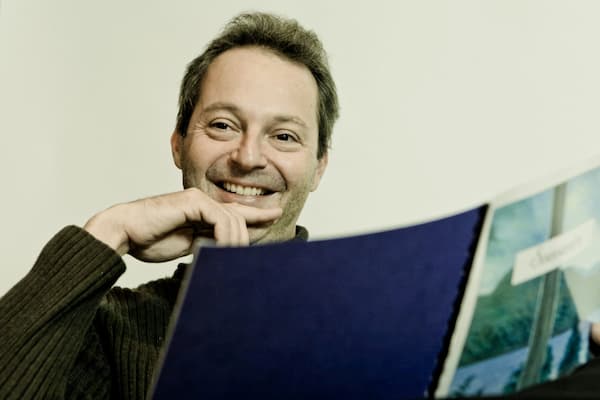
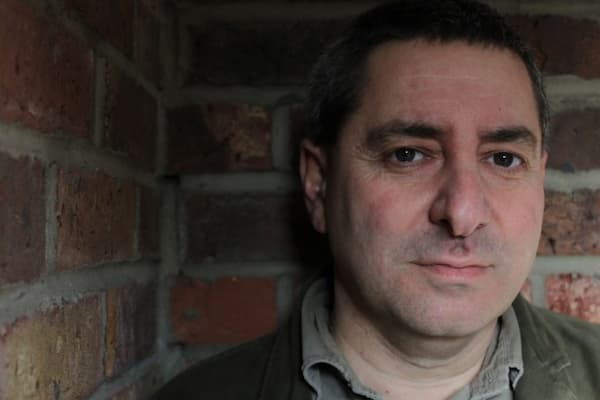
In a funny twist of fate, life has brought me to one of the spacious vintage leather armchairs of coffeecompany Delft, a cosy work-friendly café in the Netherlands that serves ferociously strong filter coffee. Opposite me sits Bart Knol – the “Trigg” of Trigg and Gusset, the “dark jazz and moody electronica” duo behind the soundtrack of indie breakout game Blue Prince.
Trigg & Gusset – Westwardly Winds (Blue Prince OST)
Erik van Geer, or “Gusset,” the other half of the musical project, is away, quite literally, sailing the world. Nonetheless, only a stone’s throw from where Knol and I sit is the pub, Tango, where the unique partnership was forged in the fires of an open jam session. The two men have very different musical backgrounds – Knol’s strengths are as a composer, pianist, and electronic musician (“Trigg” comes from the “trigger function” button he found on an old synthesiser), while van Geer is active as a performer and improviser in the jazz and world music scenes, his forte being bass clarinet and tenor saxophone. The duo’s strength – and edge – lies in the symbiotic alchemy between Knol’s knack for composition, production, and piano, and Erik van Geer’s ability to improvise fluttery, gorgeous melodies on bass clarinet and tenor saxophone.
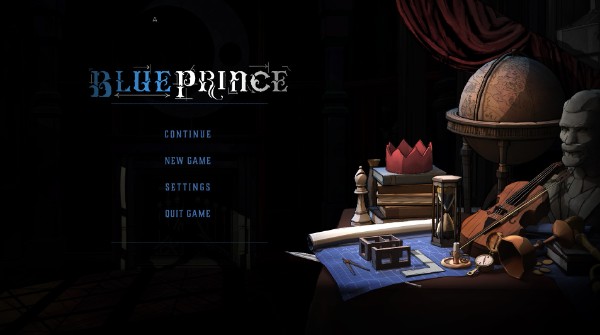
While sound and music are always important elements of a video game, with certain kinds of games, audio can become the make-or-break factor: the difference between comfortably spending hundreds of hours playing the game or giving up without completing the narrative or main challenges. In part, this can be explained by the potential for what we might call “auditory irritation”: fatigue, annoyance, or being distracted by grating sounds or overly repetitive motifs. With longer-form games where the player is expected to spend many hours exploring an open world or solving puzzles, the potential for auditory irritation becomes far greater. As such, the intricate Russian nesting doll of all puzzle games, Blue Prince, was quite possibly the most risky undertaking a composer could sign up for. Enter Dutch duo Trigg and Gusset, whose scoring for Blue Prince did not put a foot wrong, delivering a gorgeous, nuanced soundworld that continues to enhance gameplay and enchant well into a player’s umpteenth hour in-game.
L: Well, I’m so happy to be talking to you today about Blue Prince, because I was playing it, and I was just so fascinated by it, and thought the soundtrack was so good – and I also thought that it was a really difficult task that you were given! It’s a long game, and you spend a lot of time exploring, going through the house over and over… So, how did you get involved with a project like this? This was your first game soundtrack, right?
K: I’ve done some smaller projects, but this is my first major game release. I just got an email from Tonda Ros, the developer, the guy who created the whole thing… I think in October 2023. He’d already been listening to Trigg and Gusset on Spotify, so he was like, “okay guys, want to talk about doing a soundtrack?”
L: Oh, wow.
K: That’s where it started! At first, he was using some of our already existing tracks that he liked, like ‘Ominous Clouds,’ ‘Sea & Wind,’ ‘Dark Matter,’ bass clarinet and ambient stuff. So, I started making a lot of sketches, and from those, there were only one or two that Tonda liked. I really had to learn how game music works! Normally, for Trigg and Gusset, there are drums, noises, little tweaks – but now, the music had to be in the background. You don’t want any sounds where, like, people walk in a room and are like “what was that?! Oh, it was just the music!”
L: Ha-ha! No!
K: So the music had to be really “around.” Then, in around November 2023, we started to find the direction we wanted to go in. I then had some recording sessions with Erik [van Geer], because I knew he was about to go away to sail around the world sometime in early 2024.
L: Sailing around the world?
K: Yeah. He’s actually still doing that, at the moment. Yeah, so we really only had a few months to get those recording sessions and record as much material as possible, because after that – it was just me! We did a tour around Germany, and then had some days where all we did was record bass clarinet, all day long.
L: Wow.
K: Some ideas I’d already written, sometimes giving him a prompt like: “D minor – do whatever you want.” Then, again, the same thing, in C. But that’s the great thing about him, he can just play forever…
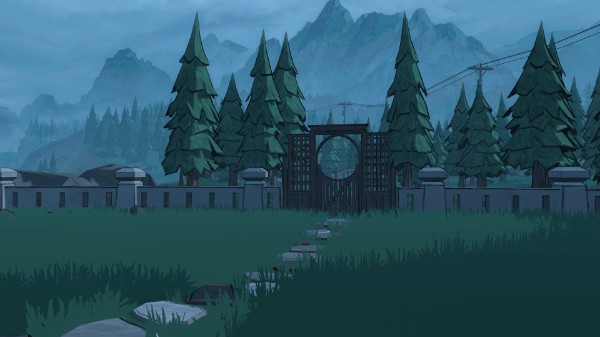
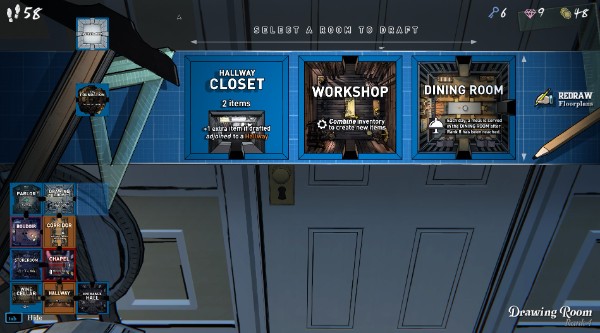
The 2025 release Blue Prince was the result of an eight-year labour of love by solo developer Tonda Ros, published by Raw Fury. In the game, you play from the first-person perspective of teenage boy Simon P. Jones, who has been bequeathed the manor estate of his deceased great uncle, Herbert S. Sinclair, with one essential stipulation to the will and inheritance – he must uncover the estate’s hidden forty-sixth room. A seemingly straightforward quest, the player soon discovers that the deck-building and roguelike elements of the game are vast and complex, and the game’s puzzle system and lore are impossibly deep. Each morning, the player must start almost from scratch and “draft” rooms of the house, essentially re-inventing the manor’s layout – and therefore contents – anew. Only by taking painstaking notes on the house’s many clues can the player begin to unlock permanent advantages, inching closer to the truth at the heart of the mysterious estate known as Mt. Holly.
L: Am I right in saying I heard some cello pizzicato in the opening track?
K: Ah, yes! Not a real one, it’s a Kontakt instrument. I remember making a lot of ideas for that opening, because it’s a bit different from the rest of the music.
L: It sets itself apart, but I understand why, because the player has to try again and is sort of starting over.
K: Yes, exactly! It’s more of a kind of reset! Like, okay, here we go again, and the camera whooshes up on the entryway.
L: Yes, the pan, the zoom.
K: I actually suggested replacing the opening cello track to Tonda, but he liked it. He played a really big part [in the music], in knowing what he liked and what he wanted to use. Sometimes he was really detailed, like, “can you remove that sound at 2:57?” But other times he would just say, great, extend this by three minutes, which was great. It went both ways.
L: I guess working with a solo developer, and it’s his project, of eight years…
K: Yeah, so the working process was really just him and I, talking. We didn’t need anyone else.
L: A very neat working relationship.
K: We’d work all the time of the day; he’s located in Los Angeles. Sometimes we’d talk super early in the morning, other times late at night.
L: Do you think you might work with him again?
K: Yeah, definitely. It was great. He knows what he wants to hear and has really good vision. And I wasn’t sure how successful the game would be, so I kept my expectations modest. But he was like, no, people are going to love this. I said, “yeah, yeah, sure.” But he was right!
L: He was right! I went on YouTube of the official soundtrack, and there are so many comments about the music, and about how much people enjoyed the gameplay in part, simply because of the music.
K: It’s unexpected but really nice. But yeah, I’ve been playing the game since the public release, but haven’t gotten very far yet.
L: It’s very difficult!
K: We didn’t even use all the material we had, and not everything could make it onto the official soundtrack, so we left out some variations. Tonda warned me that people would complain, and he was right.
L: Well, hardcore fans!
Trigg & Gusset – Southward Swan (Blue Prince OST)
K: Actually, in preparing the official soundtrack for release, I saw that Tonda is actually far more attached to the music than I am. From my perspective, I just made a lot of things! But when deciding what to include in the OST, I’d suggest removing two minutes, and he would say, “no, no way!”
K: Though it was the other way around for “Simon’s Theme,” which is a piano track. Tonda really liked and wanted to include the first part, but there’s also a bridge, leading to another theme, which needs to be included, because that’s how I wrote it at the piano.
L: Well, that’s lovely how much he liked the music!
K: Yes, definitely. But you know the English phrase, “kill your darlings?” I can work on something for two hours, but if it doesn’t work, I just throw it away and make something else.
L: So generally with music, would you say you take an experimental approach? You’re happy scrapping things?
K: Yeah. I saw a clip of Brian Eno saying something that holds true for me, about how if you ask an artist how something came to be, it’s mostly a mess. Things just exist in a certain way. For some tracks, I remember certain bars and details, but for others, I don’t really know anymore how they came to be. Sometimes I was at the piano, or combining sounds electronically… Following your intuition, knowing that this is good, or that. The essence is always important, finding the essence of each piece. Sometimes it’s drone, or melody… That’s what it should be about.
Although there are no other characters to interact with directly in-game (the estate’s remaining staff make themselves mysteriously scarce!), in traversing the game and unlocking new kinds of rooms, the player gets to know the intricate web of family dynamics through photographs, journals, letters, and even a surprising system of “checking out” books from the estate’s library. Through these, we learn about Simon’s mother, Mary Jones, and the political meaning behind the game’s key colour symbolism of blue and red. With further gameplay, the mansion’s complexity and secrecy at turns delight and infuriate, the opulence and convolution resonating with recurring narrative themes of blackmail, betrayal, mistaken identity, wealth, and power.
L: And so, the bass clarinet in Blue Prince – have you always loved this sound? Is it because of Gusset? Where does that come from?
K: Well, it’s Tonda – I mean, I love the bass clarinet, I think it’s one of the most beautiful sounds. But usually on Trigg and Gusset we also have soprano and tenor saxophones, trumpet, but Tonda was like, “I want the bass clarinet.” And I’d offer and say, we could also have trumpet? And his response would be “no, just bass clarinet.”
[We both laugh].
K: So, that was really the sound for him, and the sound he associated with Blue Prince. So I said sure, we can do it without drums – I mean, there are some percussion lines in there, but we mostly stuck to bass clarinet.
K: Also, a question I’m asked a lot is, how did you make the music for this room, or that room. Well, I didn’t know anything about the rooms! Tonda just said, compose a lot of material, and he picked and chose what went in what room. Then, further into the project, he’d say to me: “I need some more dark stuff,” things like that. We also worked a lot on the end music, the music for the final room. But I didn’t see many in-game things! In the one-and-a-half-year period that we worked on the game, it was maybe three or four times that he’d send me some screenshots, or a short video, saying, “it looks a bit like this.”
L: What was that like for you? It must have been nice, in a way, but also a bit… mysterious?
K: Yeah! Both! Because I was kept in the dark – I didn’t know how the music was being used! I see YouTube comments asking me, why this music for this room, and it’s like, “I don’t know!” But it was also nice for me to just be in the music. I was completely in the music.
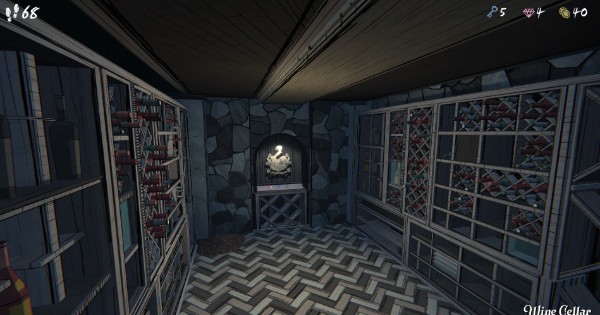
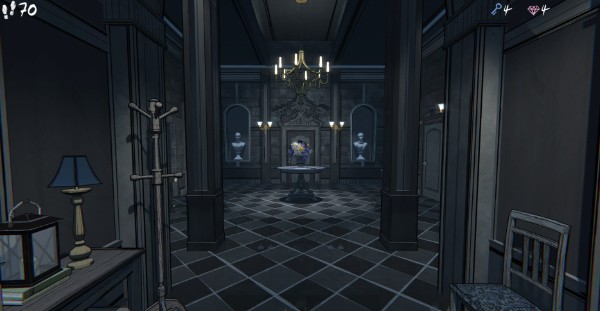
In a game with a restricted setting and powerful sense of place – the game is effectively “all about” Mt. Holly – sonic ambience becomes particularly important. The player moves through environments as varied as warm, cosy studies, eerie underground cellars, peaceful outdoor “green” rooms, and industrial boiler and pipe rooms. In every space, the sound profile is intelligently calibrated, with appropriate sense of echo or dampening, coolness or warmth, mechanical white noise or soothing birdsong. Despite navigating a new labyrinth of drafted rooms each day, this sonic richness promotes immersion and prevents fatigue.
L: Did you learn anything new making this soundtrack, any new effects or techniques?
K: Well, I really learnt how to avoid having anything sound too “close” to the player. So, I worked a lot with room simulators, putting sounds in specific simulators for rooms like the chapel.
L: So that wasn’t the audio engineer, that was you?
K: Sometimes, yeah.
L: It’s so well done in this game. There are so many different environments in this game, there’s the outdoors, marble hallways, entranceways…
K: Well, let’s have a peek at the classified files…! [Gesturing to his workstation] So, for the different tracks, there are different versions. Like, this piano theme also has a ballroom version, only for the ballroom, and feels much more spacious, it echoes… That’s where I used room simulators. But the OST only uses the original versions.
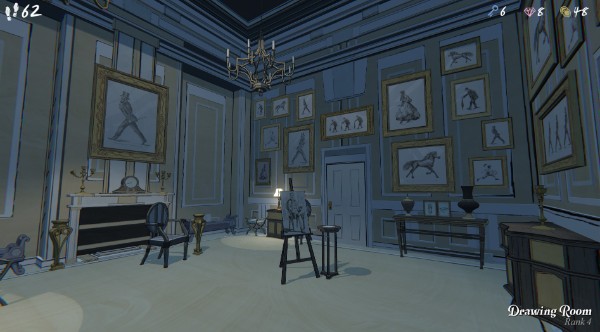
In the world of video game audio, Trigg and Gusset’s score for Blue Prince stands out as genre-defying and timbrally inventive, a wholly original entry. No other game soundtrack boasts a thoughtful mixture of ambient, synthesised sound, piano, and bass clarinet. The duo describe their main project Trigg and Gusset, under which they release music and perform, as inspired by noir jazz, electronica and ambient, contemporary slow jazz, classical music, and minimalism.
A salient aspect of the success of the Blue Prince soundtrack lies in its nuance and emotional ambiguity. There are moments of real uplift, and moments of real tension, but much of the score lies in a nuanced, ineffable middle ground, revealing no secrets and leaving the player to discover a path for themselves – rather like the manor itself and its mysterious proprietor, Herbert S. Sinclair.
L: [Speaking about a particular track] This one’s very melancholy, almost detuned in a way…
K: Well music-wise, my inspirations vary a lot… I can go straight from, say, Chet Baker, to Radiohead, to Philip Glass. It just needs to touch your soul, and for me, lots of music can do that.
Trigg and Gusset’s new dark jazz single, ‘Faded Corners’, is now out on all major streaming services in anticipation of their upcoming album.
For more of the best in classical music, sign up for our E-Newsletter