One of my favourite memories of all time is of snorkelling in Fiji on a school trip in my late teens. The beaches were light and sandy, the water somehow both bright turquoise and perfectly translucent. Equipped with flippers and a snorkel mask, I could float in effortless safety above a world of endless, kaleidoscopic colour. There was so much richness, variety, beauty, and movement – leaving myself behind, I became an almost-fish, a strange visitor to a peaceful, otherworldly ecosystem of darting tropical fish and elegant coral limbs. Despite experiencing such an aesthetic high, I had not thought about that moment for years when, leaving the Concertgebouw of Amsterdam on the 28th of July, I realised that Wooden Elephant’s performance of Björk’s Homogenic had elicited the exact same strange, transcendent joy.
Björk: Jóga / Unravel arr. WOODEN ELEPHANT
When the five-piece string ensemble first got together to create an immersive, hour-long, live-acoustics-only performance of Björk’s Homogenic for the PODIUM Festival Esslingen in 2017, they expected it to be a one-off, as remarked by the group’s frontman and arranger, Ian Anderson. The fundamental concept behind the group was that the pop album was, in Anderson’s view, “the modern-day equivalent of the symphony,” and that these hour-or-so-long sonic journeys could be brought to the concert hall to powerful effect. Much to the violist’s surprise, the idea took flight, and the group has now recorded, arranged, and performed Radiohead’s Kid A, Beyoncé’s Lemonade, Aphex Twin’s Drukqs, and will be revealing their version of Frank Ocean’s Blonde in collaboration with the Equinox Festival Copenhagen.
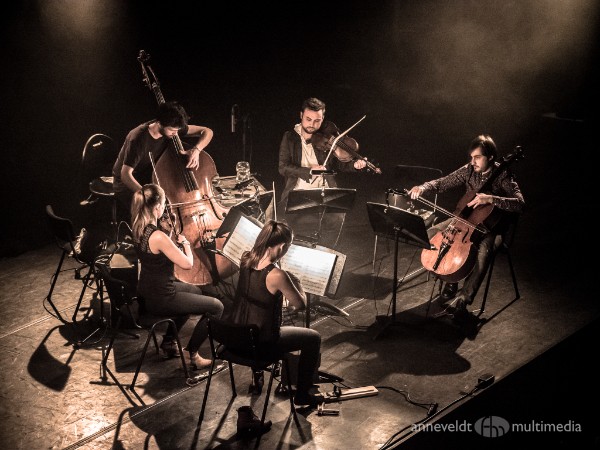
Wooden Elephant live performance © Anneveldt Multimedia
This is far from the first time that the musicality of the likes of Radiohead and Björk has been responded to – with arrangements, remixes, and improvisations – by non-popular or “classical” musicians. Noted jazz pianist Brad Mehldau has often interpreted Radiohead, and one of the most popular versions of Everything In Its Right Place on Spotify is by his trio. What sets Wooden Elephant apart from these other tributes is their commitment to realising entire pop albums as a single, cohesive, and arguably theatrical experience, and their commitment to doing so using only organic and live means – no electronics or pre-recorded material whatsoever.
I entered the Concertgebouw slightly unsure what to expect. On stage, there were glasses of wine, toy pianos, mics, and other varied sonic paraphernalia. One began to wonder how five musicians, albeit talented and internationally renowned, could convincingly bring the idiosyncratic voice of Björk to life. On stage strode the quintet, Aoife Ní Bhriain (violin), Hulda Jónsdóttir (violin), Ian Anderson (arrangements and viola), Stefan Hadjiev (cello), and Nikolai Matthews (double bass). The lights dimmed, and the so-called sonic snorkelling began.
As a composer, it is somewhat in my nature to be fascinated by extended techniques and sonic inventiveness. Like being hypnotised by endlessly swirling schools of colourful fish, I was entranced by the wealth of timbre, by simply trying to discern who could possibly be making that particular sound and how, all of this interspersed with the most heart-rendingly gorgeous, melodic string performances and gut-punch harmonies. It was a joy to see the sonic capacities of a string quintet taken so far in service of music that is popular, beloved, and reasonably accessible – to see harmonic glissandi, string scrapes, overpressure, and ricochet responded to by an audience with such visceral pleasure. Anderson’s use of extended technique in these arrangements was always in service of overall musicality, interest, and emotional impact, and at key moments, rhythmic and textural effects were left behind in favour of heartfelt moments of traditional string playing.
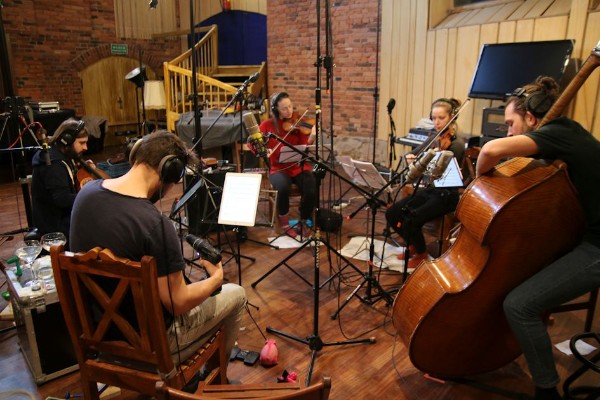
Wooden Elephant’s studio recording © Dan Abbott
This feast was enriched by a variety of non-string sound-making devices. The group used tuned wine glasses, plectrums, percussive shakers, toy pianos, chains, kazoos, party blowers, and more, sometimes subtly, sometimes to recreate a particularly important sound that simply was not string-adjacent, and at other times as a kind of mad tribute to the joy and variety of the whole undertaking.
Wooden Elephant’s project is to be admired and praised for so many reasons. Firstly, this is simply excellent chamber music-making – I have never seen a small group of musicians, especially classical ones, given so much licence to groove, contribute to the living energy of the music, solo, and try wacky new things. The musicians’ engagement, agency, and total commitment to the experience made for an electrifying performance. Secondly, Anderson’s “arrangements” go so much deeper than the word implies – these are new creations for string quintet, of otherworldly timbral power. At the same time, by bringing these albums to the concert stage and visibly demonstrating just how much sonic invention is required to bring them to life, Wooden Elephant contribute to erasing any unnecessary and classist genre divides between “classical” and “popular” music that may still linger in audiences, subconsciously or otherwise. Further, as wonderful as hearing any pop album may be on vinyl, in concert, or through great headphones, hearing it brought to life for a resonant string quintet, with virtuosic players, is a wholly new experience, the chords more richly spaced, the melodies able to soar in new ways.
I clearly wasn’t the only one who felt this way, as the group received a triple standing ovation and was cajoled into doing not one but two encores. The second, a particularly sweet and saucy rendition of Beyoncé’s Sandcastles, was the standout, ending with lovely hummed harmonies from the ensemble – the first time they used their voices.
For more of the best in classical music, sign up for our E-Newsletter