
Born into scandal as members of musical royalty, Richard Wagner and Cosima Liszt’s three children – Isolde, Eva, and Siegfried – carried not only the Wagner name, but the weight of the entire family legacy.
From bitter feuds and courtroom battles to the founding of dynasties and even entanglements with Nazi ideology, the lives of the Wagner children were nothing less than operatic.

Richard Wagner and his daughter Eva in 1867
Today, we’re looking at the stories of the Wagner children and how they carried their famous father’s legacy into the twentieth century.
How Richard and Cosima Fell In Love
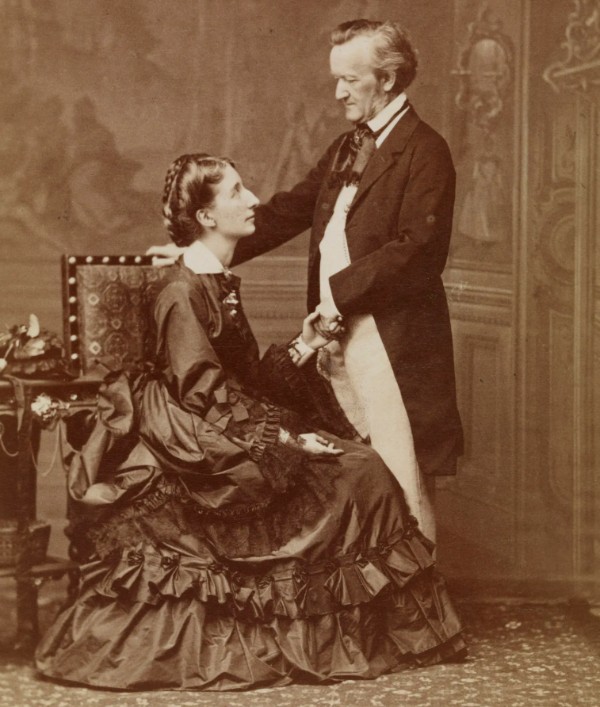
Richard Wagner and Cosima Liszt
Cosima Liszt herself was born to musical royalty in 1837: her father was Romantic era piano star Franz Liszt, and her mother was Countess Marie d’Agoult. The two were unmarried, and their relationship was a scandal.
After having three children together, Liszt and d’Agoult went through a lengthy and acrimonious breakup.
In the end, Liszt kept d’Agoult apart from Cosima and her siblings, and Cosima ended up being raised primarily by governesses and Liszt’s mother. Every aspect of her and her sister’s lives was rigidly controlled.
A month before her twentieth birthday, Cosima married Hans von Bülow, one of her father’s best students. Her marriage to von Bülow made sense on paper, but she hadn’t matured fully as a person, and the union was never particularly passionate.
By 1862, she and von Bülow had two children together. That year, she and her husband went to stay at composer Richard Wagner’s home. At 25, she found herself falling in love with the 49-year-old Wagner…and Wagner soon fell in love with her, too. In November of 1863, they officially professed their devotion to each other.
In 1864, Cosima began working as Wagner’s secretary. That summer, they spent a week together on the scenic shores of Germany’s Lake Starnberg before von Bülow arrived to join them. Before her husband’s arrival, she became pregnant with Wagner’s child.
A documentary about the Wagner family
Isolde von Bülow Beidler
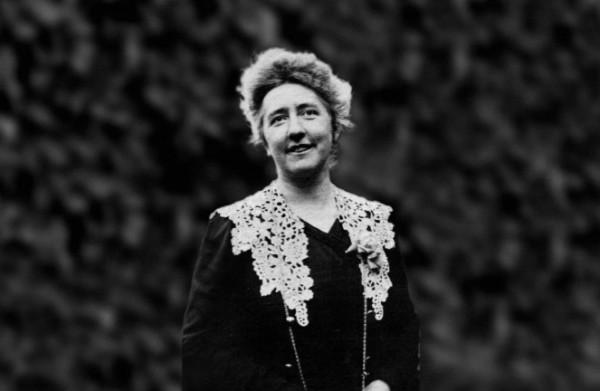
Isolde Wagner
In April 1865, nine months after their lakeside vacation, Richard and Cosima had a baby named Isolde.
Although he knew about his wife’s affair, Hans von Bülow accepted Isolde as his own, a decision that would have later legal and financial consequences.
Unfortunately for von Bülow, he was in awe of Wagner’s talent. He even conducted the premiere of Wagner’s opera Tristan und Isolde that June. That said, according to legend, he also remarked, “If it had been anybody but Wagner, I would have shot him.”
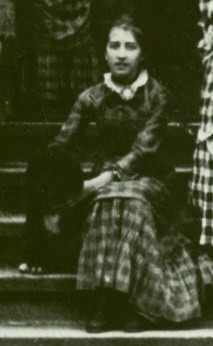
Isolde Wagner from the group photo of Wagner’s family in 1881
In 1896, a Swiss conductor named Franz Beidler started working at Bayreuth as an assistant musical director. Isolde fell in love with him, and they were married in December 1900.
Less than a year later, Isolde gave birth to Richard Wagner’s first grandchild, Franz Wilhelm Beidler.
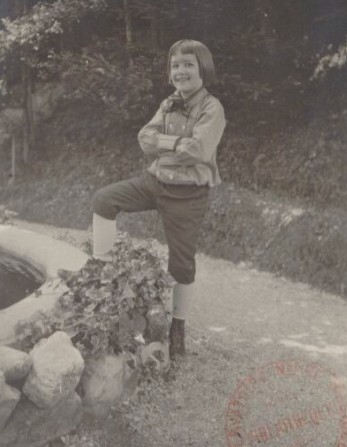
Franz Beidler
Beidler never made much money, but Isolde was able to get Wagner family funds from Cosima to subsidise a lavish lifestyle. Cosima soon began resenting Beidler, and she disliked the substandard work he did at Bayreuth. She even wanted Isolde to divorce him.
Matters weren’t helped when Beidler had an affair with a singer and had a child with her. (This wouldn’t be the only illegitimate child he’d father.) Still, Isolde refused to abandon him.
After 1913, the Wagner family’s income was decimated when various copyrights expired, and Cosima began sending less money to the Beidlers. Isolde responded by taking her family to court.
The Wagners’ (factually false) counter-argument was that Isolde was not biologically Richard’s, with no right to his money. In return, Isolde threatened to expose the secret of her brother Siegfried’s homosexuality.
In the absence of DNA testing, Isolde lost her case, and she was forced to pay the legal expenses of the case.
To add insult to Isolde’s injury, despite his homosexuality, Siegfried got married and had four children starting in 1917. Consequently, Isolde’s standing within the family, which had relied on her being the parent of Richard’s only grandchild, collapsed.
Isolde died of tuberculosis in 1919. The family was so completely estranged at this point that, unbelievably, Cosima only found out about her daughter’s death a decade later.
Eva von Bülow Chamberlain
https://en.wikipedia.org/wiki/Eva_Chamberlain
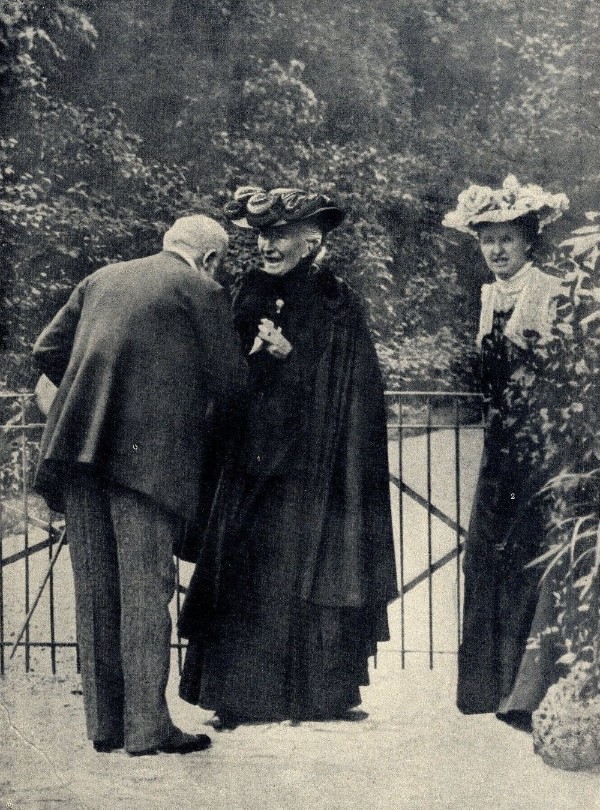
Cosima and Eva Wagner, 1906
Eva Wagner was born in February 1867, two years after her sister Isolde.
The years between Isolde and Eva’s births had been full of tumult. Wagner had become close with King Ludwig of Bavaria to the point where Ludwig was discussing Wagner’s political ideas with his advisors. Those advisors pushed back, and Ludwig was forced to dismiss Wagner from his court in 1866.
Even so, Wagner and Ludwig stayed close. In June 1866, to help shield Cosima from scandal, Wagner asked Ludwig to issue a proclamation stating that the von Bülows had always been faithful to one another. Ludwig obliged.
The problem? Richard and Cosima were still sleeping together. In fact, a few weeks before the proclamation was issued, they had just conceived Eva.
Somehow, despite this second pregnancy, Hans von Bülow still found it within himself to advocate for Wagner’s music, and in 1868, he premiered Wagner’s opera Die Meistersinger von Nürnberg. A few months later, Cosima finally asked him for a divorce.
Richard Wagner died in 1883 when Eva was sixteen. Cosima was completely devastated, hoping she’d die herself. But she eventually recovered by working to burnish her husband’s legacy and establish the long-term importance and relevance of the Bayreuth Festival. Eva played her part by serving as the family’s archivist.
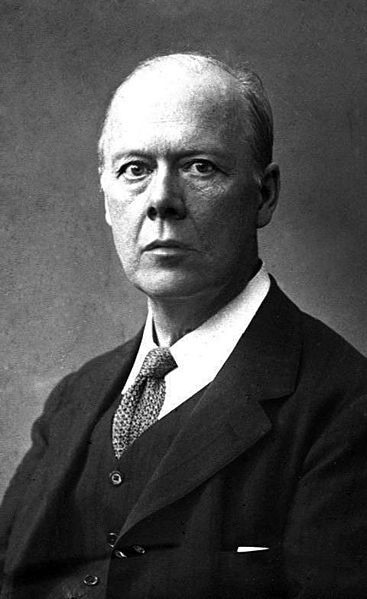
Houston Stewart Chamberlain
In 1908, per her mother’s recommendation, Eva married Houston Stewart Chamberlain.
Chamberlain was an extreme figure. He was born in Britain in 1855 but moved to Germany as a young man because of his all-consuming obsession with Richard Wagner and Wagnerism. Even as early as the 1880s, he ingratiated himself with Cosima, who began viewing him as a son. He also began writing Wagner commentaries – and, absurdly, advocating for the idea that Richard and Cosima hadn’t been intimate until after Hans von Bülow’s death.
After his marriage to Eva, Chamberlain’s anti-Semitism became more and more virulent and horrific. He ended his life as a mentor to Hitler.
Meanwhile, Eva was advocating for her preferred vision of her father’s legacy, becoming the head of a group called the Altwagnerians, who protested the modernisation of Wagner’s operas.
She died a celebrated member of the Nazi Party, having helped to cement the links between Wagnerism and Nazism. She died of cancer in 1942.
Siegfried Wagner
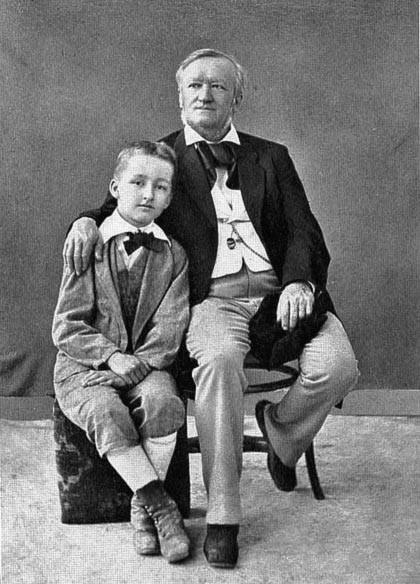
Richard and Siegfried Wagner
Siegfried Wagner was born two years after his sister Eva, in June 1869.
Like her, he was named after a Wagner opera: Siegfried, the third entry in the Ring Cycle, which had been written in the 1850s but would not be premiered until the 1870s.
He received early instruction in music from his grandfather, Franz Liszt, and composer Engelbert Humperdinck.
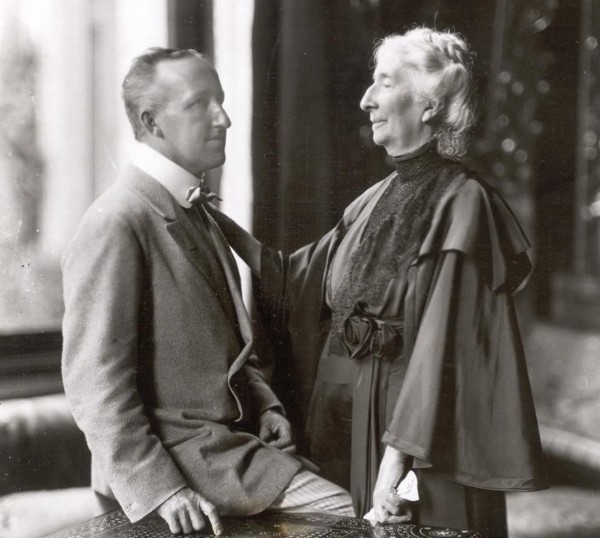
Cosima and Siegfried Wagner
As a young man, there was a period of time when he decided to pursue architecture instead of following in the family business.
However, in 1892, he took a round-the-world trip with a composer named Clement Harris, with whom he fell in love. When he returned home, he decided to become a conductor and composer, like his father.
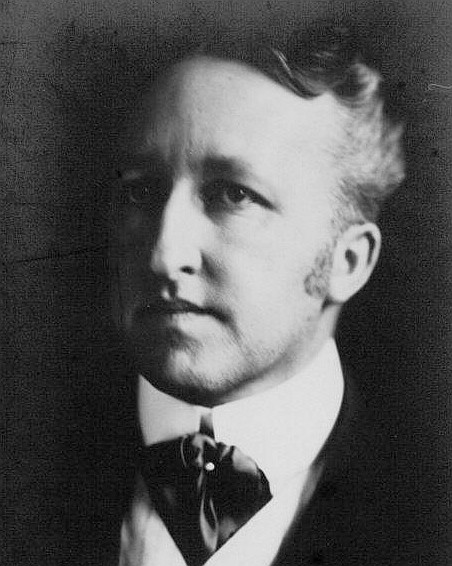
Siegfried Wagner
He became increasingly involved with the Bayreuth Festival, but his family viewed his gay relationships as major liabilities.
At their direction, in 1915, when he was in his mid-forties, he married an eighteen-year-old Englishwoman named Winifred Klindworth. They had four children in quick succession.
His family was hopeful that this new marriage would quiet rumours about his love life. Siegfried’s marriage also had the benefit of sidelining Isolde, as until 1917, she was the only Wagner child who had had a child of her own.
He died at the age of sixty-one in 1930, just four months after his mother.
Since Siegfried’s children were still young, Eva and her husband never had children, and Isolde had been shunned, Winifred stepped up to take control of the Bayreuth Festival. Unfortunately, like her sister-in-law, Winifred became enamoured with Adolf Hitler…which is a whole other story.
For more of the best in classical music, sign up for our E-Newsletter








Your articles are fascinating!