After interviewing Aristo Sham about his album Timeline, I gained a deeper appreciation for the artistic vision that underpins this remarkable recording. What first appears to be a program tracing Western music’s evolution from Bach to Grieg soon reveals itself as a more profound reflection on time, transformation, and human experience. Sham approaches this concept not through chronology alone, but through emotional and philosophical continuity. As he explains,
“Music is played out in time; it is the use of time that gives music its language. Music also exists in time; it belongs to the period of time of its creation, but also reveals something of the temporal continuum – a blend of foresight and tradition – a timeline.”

Aristo Sham © Universal Music Limited
This understanding informs his interpretation throughout the album, giving each piece a sense of both historical rootedness and timeless resonance.
The repertoire of Timeline unfolds like a carefully constructed arc, beginning with the C minor Toccata of J.S. Bach and concluding with Grieg’s Holberg Suite, with Busoni’s transcriptions and original works serving as a bridge between eras. In Bach’s Toccata in C minor, BWV 911, Sham opens with clarity and simplicity, drawing the listener in through poise and restraint. The music unfolds naturally, soon blossoming into passages of increasing complexity and depth. In the fugue, Sham performs with certainty, articulating each voice with precision while maintaining strong direction and momentum.
Where the Toccata is precise and energetic, Wachet auf, ruft uns die Stimme, BWV 645, offers warmth and sweetness, highlighting Sham’s expressive range. He shapes each phrase gently and naturally, allowing the hymn-like lines to sing with intimacy. The result is serene and reflective, providing a lyrical counterpart to the intricate Toccata while preserving the integrity of Bach’s contrapuntal writing.
The Bach-Busoni’s Chaconne is performed with refinement and thoughtfulness, as Sham explores its vast emotional and structural landscape with deliberate control, balancing intensity with clarity. He captures both the architectural grandeur of the piece and its deeply personal, expressive qualities, bringing out the layered textures of Bach’s original while embracing Busoni’s expansive pianistic vision.
Brahms-Busoni: Six Chorale Preludes – Es ist ein Ros entsprungen
The sequence of Brahms-Busoni’s Six Chorale Preludes represents a more introspective chapter of the album. These late works of Brahms meditate on mortality, gratitude, and reflection. Busoni’s transcriptions enhance harmonic depth while maintaining the simplicity and dignity of Brahms’s voice. Among them, Es ist ein Ros entsprungen stands out for its sheer charm and beauty, with Sham’s delicate touch and expressive phrasing bringing out the piece’s lyrical sweetness and enchanting character. By contrast, Herzlich tut mich verlangen, Op. 122, No. 10 conveys a deeper, more shadowed emotional world, and Sham draws out its darkness with subtlety and intensity, revealing the introspective depth of the set. His playing throughout is tender, thoughtful, and deeply human, embodying the quiet contemplation that pervades these works.
This album also introduced me to Busoni’s Variations on a Theme of Chopin, a work of remarkable imagination that Sham interprets with both intellect and heart. Busoni transforms Chopin’s C minor Prelude into a vast and dramatic journey, expanding the original’s harmonic and emotional landscape. Sham navigates its shifts between turbulence and lyricism with poise, revealing the work’s architecture without sacrificing spontaneity. His pacing feels organic, each variation flowing naturally into the next, culminating in a conclusion that feels both inevitable and transcendent.
Ferruccio Busoni: Variations on a Theme of Chopin
The album concludes with Grieg’s Holberg Suite, returning to a neoclassical perspective “from Holberg’s time.” Originally composed for piano, the suite reflects Baroque forms through a Romantic sensibility. Sham performs it with clarity, warmth, and rhythmic vitality. The Air is particularly affecting, poised, and radiant, while the final Rigaudon dances with joyful energy, bringing the album to a satisfying close that celebrates continuity, history, and human expression.
What makes Timeline compelling is not merely its programming but its coherence of thought. Every work reflects on time, on how it changes us, and on how art preserves memory. Sham’s curatorial sensibility draws connections between Bach’s disciplined architecture and Grieg’s affectionate retrospection, and between Busoni’s intellectual modernism and Brahms’s late simplicity. Through these relationships, Timeline forms an emotional and philosophical continuum that transcends stylistic boundaries.
Following his victory at the 2025 Van Cliburn International Piano Competition, where he won both the Gold Medal and the Audience Prize, Timeline stands as both a culmination and a declaration of Sham’s artistic identity. It highlights the clarity, elegance, and technique for which he is admired worldwide, while revealing a more personal and mature voice. Timeline feels less like a recital and more like a meditation, inviting listeners to experience transformation as something deeply human. Aristo Sham reminds us that the essence of music, like time itself, lies in continuity: in Timeline, past and present meet, sound becomes memory, and each note reflects the quiet beauty of passing time.
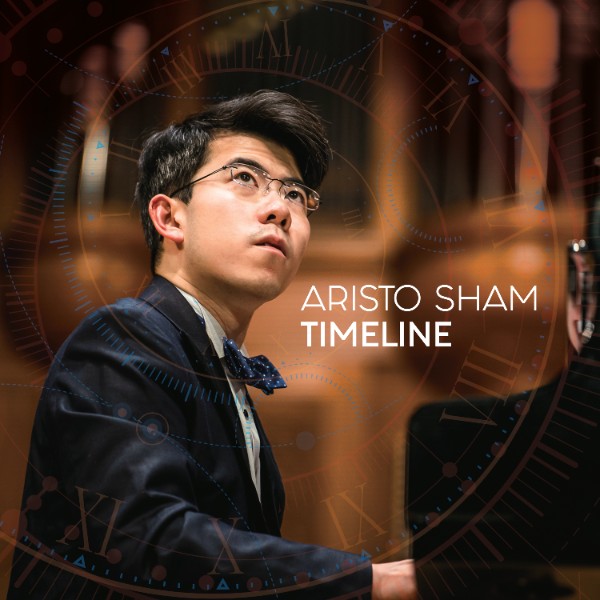
Timeline
Aristo Sham, pianist
Label: Universal Music Limited
For more of the best in classical music, sign up for our E-Newsletter