For Franco-Hungarian pianist Suzana Bartal, her new album, Grieg & Saint-Saëns: Piano Concertos, marks an important milestone in her artistic life. Released by Channel Classics, the recording pairs Edvard Grieg’s Piano Concerto in A minor with Camille Saint-Saëns’s Piano Concerto No. 2 in G minor, two cornerstones of the Romantic repertoire that happen to share the same birth year, 1868.
“I was fascinated when I discovered that both concertos were written in the same year,” Bartal explains. “Each is deeply Romantic and virtuosic, yet they reveal completely different worlds. The Grieg has a Nordic lyricism and poetry, while the Saint-Saëns is brilliant and French, full of vitality and elegance.”
It is a pairing that reflects Bartal’s dual artistic identity, rooted in the French piano tradition while drawn to the expressive warmth of Romantic music. “These are concertos I have performed many times in concert,” she says. “I am a little old-fashioned in that I like to record music I have lived with for a long time. Every recording, for me, is a testimony of a particular stage in my artistic life.”
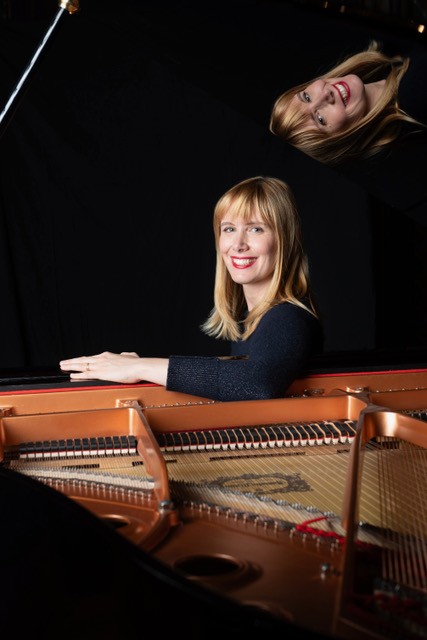
Suzana Bartal
Although Bartal has released acclaimed recordings before, including her complete set of Liszt’s Années de pèlerinage, she waited until now to record concertos. “It felt like the right moment,” she reflects. “In recent years, I have been performing regularly with orchestras, and I realized it was time to document that part of my musical life. I also had the right partners.”
Those partners were conductor Sébastien Rouland and the Saarländisches Staatsorchester, with whom Bartal had already built a strong rapport through several concert collaborations. “This kind of recording only works when there is a true encounter,” she says. “We had performed the Grieg concerto together before, and over time our collaboration deepened. When the opportunity came to record both works, it just made sense.”
The sessions took place in Saarbrücken, Germany, a city Bartal now associates with both intensity and camaraderie. “Recording with an orchestra is a huge logistical project,” she says with a smile. “Everything has to run on an exact timetable. The musicians are state employees, so if the session is three hours, it is exactly three hours, not a minute more. That means everyone must arrive extremely prepared and focused.”
Bartal often describes the concerto dynamic as a triangle among the soloist, conductor, and orchestra, a delicate balance of leadership, sensitivity, and trust. “As a soloist, you have to project and lead, but you also have to listen constantly,” she explains. “It is like chamber music on a large scale. The conductor represents the orchestra’s voice, yet the orchestra itself is full of strong personalities. The Saarländisches Staatsorchester has this beautiful roundness to its sound that I found very inspiring. You listen, adjust, and suddenly something new is born in the moment.”
For Bartal, this fluid exchange of energy is what keeps live music and recording alive. “You do not simply impose your idea,” she says. “You react to the sound that comes back to you. When the chemistry is right, it is almost magical.”
Unlike many modern recordings that rely heavily on short takes and edits, Bartal and the production team chose longer sections to preserve musical continuity. “Our artistic director, Jared Sacks, and I shared the belief that maintaining the musical line is essential,” she notes. “We did not want to chop everything into fragments. The playing had to breathe.”
Among the most memorable moments of the recording week was the arrival of her trusted piano technician, Maxime Millet, who traveled from France to prepare the instrument. “He listened for just a few minutes and immediately understood how to adjust the piano to my sound,” Bartal recalls. “Everyone was amazed at how the tone transformed. That kind of collaboration is invaluable. It is another example of the teamwork that makes a recording special.”
Even with such preparation, the process was physically and mentally demanding. “I was completely exhausted when it was finished,” she laughs, “but when you hear the result and feel that energy captured, it is the best reward.”
After this large-scale orchestral project, Bartal plans to return briefly to solo work. “I have several concerto ideas I would love to record,” she reveals, “but these projects take years of planning. So, my next album will likely be solo again, simpler to organise but artistically just as rich.”
As for choosing her repertoire, she follows her instincts. “The proposals always come from me,” she explains. “Of course, the label has to agree, but I am lucky because they have always supported my choices. I do not believe in selecting pieces only because they are obscure or avoiding them because they are famous. What matters is that the music speaks to you. When it does, you give your best.”
With Grieg & Saint-Saëns: Piano Concertos, Suzana Bartal captures the essence of Romanticism, not as nostalgia but as a living, breathing conversation between composer, performer, and orchestra. It is a testament to artistic maturity, collaboration, and the enduring vitality of music that continues to move audiences more than a century later.
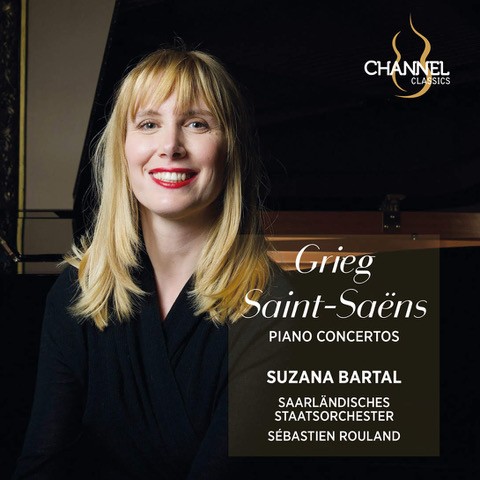
Grieg & Saint-Saëns: Piano Concertos
Suzana Bartal, piano; Sébastien Rouland, conductor; Saarländisches Staatsorchester
Catalogue No: CCS47825
Label: Channel Classics
Release date: 10 October 2025
For more of the best in classical music, sign up for our E-Newsletter