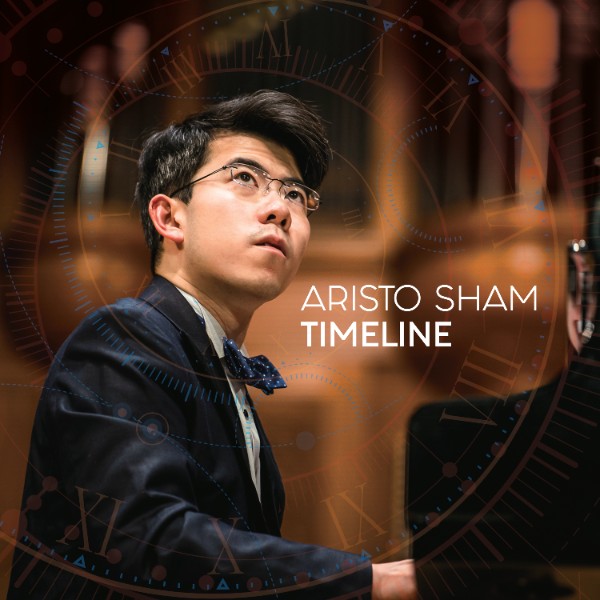
Fresh from his victory at the Van Cliburn International Piano Competition and the release of a new recording titled Timeline, pianist Aristo Sham reflects on a period of extraordinary growth. Preparing for one of the world’s most demanding competitions and recording a major album immediately afterwards transformed both his artistry and his outlook on time, change, and creative freedom.

Aristo Sham © Universal Music Limited
“The competition was such an important experience,” he recalls. “I learned so much during every single moment of it. At the competition, we are constantly trying to push our own boundaries to become the best possible version of ourselves.” That process, he explains, only came together toward the end, when he began to feel entirely in control of his playing. “It was the first time I felt truly free on stage. I could communicate exactly what I wanted with sincerity and express the music to its fullest.”
J.S. Bach: Toccata in C minor, BWV 911
When he entered the studio this early October, that sense of confidence and clarity remained. “The actual recording felt a little bit like the competition again,” he says with a laugh. “I wanted to see how much I could refine everything; how much I could polish each phrase to make it the most convincing possible.” After each take, he would walk to the control room, listen carefully, and think about what could be improved. “I loved the process,” he adds. “I came more prepared than for anything I have ever done before.”
Although most of the repertoire on Timeline was not new to him, the concept of the album stands apart from his competition program. “Now that it is not a competition, I have much more freedom in programming and creativity,” he says. “I performed this program seven or eight times in the United States before recording it, so I could experiment in different concerts and really get to the core of my ideas.”
Brahms-Busoni: Six Chorale Preludes – Schmücke dich, o liebe Seele, Op. 122, No. 5
The album spans from Bach to Grieg, with Busoni at its center. That structure was carefully designed. “I wanted to record several Busoni pieces, including some that are less known,” he explains. “Of course, the Bach–Busoni transcriptions are famous, but works like Brahms-Busoni’s Six Chorale Preludes and Busoni’s Variations on Chopin Prelude in C minor deserve more attention. They show a fascinating mixture of time periods, a meeting between Baroque structure and Romantic colour.” This dialogue between eras naturally led to Grieg, whose music also balances Romantic expressiveness with Baroque-inspired clarity. “Starting with Bach sets the tone for the idea of transformation,” he continues. “His Toccata takes a single theme and reshapes it seventeen times, creating a miraculous emotional journey. That became the foundation for the album’s concept of time and transformation.”
The title Timeline came to him unexpectedly during a flight. “I rarely sit by the window, but this time I did,” he says. “I was looking down at the sunset in Texas as we were about to land. You are sitting there in this metal tube, watching the world go past, feeling separate timelines unfold. There is nostalgia, anticipation, anxiety, and gratitude all at once. I wanted to capture that sensation, the passage of time that we all experience but can never fully hold on to.”
When asked how he preserves such fleeting moments, Sham reflects that music itself becomes the diary. “I do not usually write things down, but I try to capture those feelings through music. Performing helps me understand them better. Each piece becomes a way to reflect on emotions and keep them alive.”
Edvard Grieg: Holberg Suite, Op. 40 – IV. Air
Winning the Van Cliburn marked a major turning point in his life. “It has been less than half a year since the competition, and I am still adjusting,” he says. “Things are starting to settle into a new rhythm, but now I feel there is never enough time in the day. There are so many things I want to do, so many people I want to see, and so many experiences I want to have. I almost want to slow time down.”
Despite a hectic schedule, 17 concerts in September alone, Sham tries to find small moments of rest and peace. “I love traveling,” he says. “Not just for concerts, but for the culture, the food, the languages. Last month I tried to take a short vacation in Portugal, which ended up being only one and a half days because I had to return to Paris early. But even that brief escape was wonderful.”
The idea of movement through space and time runs throughout Timeline. Each work represents a transformation, stylistic, emotional, or personal, and invites listeners to trace their own path through sound. “The music itself contains all the emotion and experience I want to share,” he says. “With this focus on time, I hope listeners find their own version of it. Everyone experiences time differently, and through this album, I want people to embrace that special feeling of its passage.”
Since winning the Cliburn, Sham’s life has become a whirlwind of performances and opportunities, yet he remains grounded. “I take life as it comes,” he says. “Of course, there are more concerts now and more chances to experiment on stage, but I am still myself. Winning should not change how I treat people or how I live. I see it as a gift, an opportunity to do more of what I love.”
Through all the music-making, travel, and reflection, what stands out most is Sham’s ability to turn introspection into art. Timeline does more than just gather works from various eras; it shows an artist profoundly connected to the essence of time itself. His playing transforms personal memory into universal emotion, reminding listeners that in music, as in life, time flows forward, but its beauty lingers.
For more of the best in classical music, sign up for our E-Newsletter
Timeline
Aristo Sham, pianist
Label: Universal Music Limited
The full album will be available on November 7, while the first single has already been released.