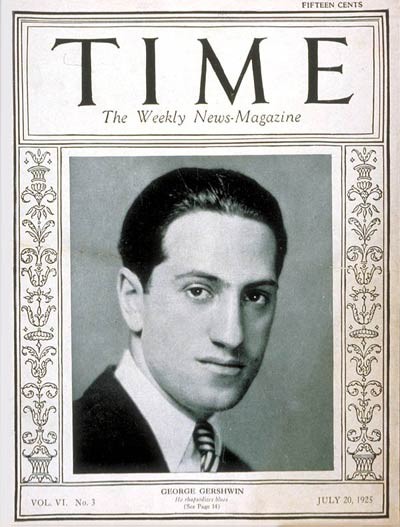
Composed in 1925, following on the success of ‘Rhapsody in Blue’, George Gershwin’s ‘Concerto in F’ is one of the most celebrated works that straddles the worlds of classical music and jazz. Commissioned by Walter Damrosch for the New York Symphony Orchestra, it was Gershwin’s largest and most complex work for the concert stage he had yet undertaken – a fully-fledged concerto in the classical three-movement format – and the first work he scored entirely by himself, thus signalling his determination to be taken seriously by the classical establishment. The work showcases his signature blend of rhythmic vitality, blues-inspired melodies and sophisticated orchestration and, like ‘Rhapsody in Blue’, it captures the energy and spirit of 1920s America, from bustling urban life to lyrical introspection. It stands as a landmark in American music, demonstrating Gershwin’s ability to fuse popular idioms with symphonic tradition.
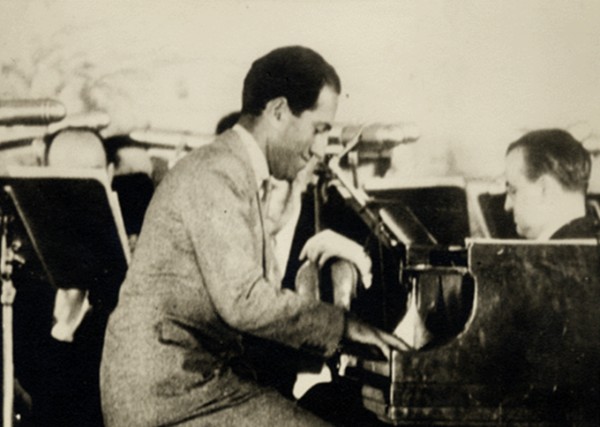
George Gershwin
‘Many persons had thought that the Rhapsody [in Blue] was only a happy accident. Well, I went out, for one thing, to show them that there was plenty more where that had come from’ – George Gershwin speaking about the birth of his Concerto in F.
The Concerto’s premiere took place at Carnegie Hall on 3rd December 1925, conducted by Damrosch with Gershwin at the piano. The concert was sold out, and the Concerto was very well received by the general public. But the reviews were mixed, with many critics unable to classify it as jazz or classical. There was a great variety of opinion among Gershwin’s contemporaries too: Prokofiev found it “amateurish”, while The New York Times called it “a new kind of symphonic jazz,” acknowledging Gershwin’s growing maturity as a composer beyond the success of his earlier ‘Rhapsody in Blue’. Arnold Schoenberg, one of the most influential composers at the time, praised Gershwin’s concerto in a posthumous tribute in 1938:
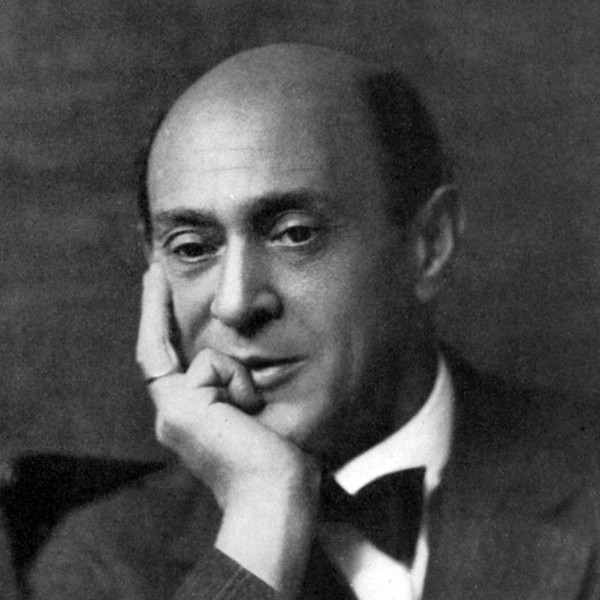
Arnold Schoenberg
‘Gershwin is an artist and a composer – he expressed musical ideas, and they were new, as is the way he expressed them.… Serious or not, he is a composer, that is, a man who lives in music and expresses everything….by means of music, because it is his native language. … What he has done with rhythm, harmony and melody is not merely style. It is fundamentally different from the mannerism of many a serious composer [who writes] a superficial union of devices applied to a minimum of ideas. … The impression is of an improvisation with all the merits and shortcomings appertaining to this kind of production. … He only feels he has something to say and he says it.’
Yuja Wang plays George Gershwin’s Piano Concerto in F major
The concerto’s lasting legacy begins with its role in legitimising jazz as a component of “serious” music. Gershwin didn’t simply sprinkle jazz harmonies over a classical structure: instead, he successfully integrated syncopations, bluesy melodic contours and the raw energy of urban life into the concerto’s DNA. This helped shift attitudes in concert halls, expanding the notion of what orchestral music could or should contain. It also paved the way for later composers such as Leonard Bernstein and Aaron Copland to continue exploring the crossover between jazz and classical idioms.
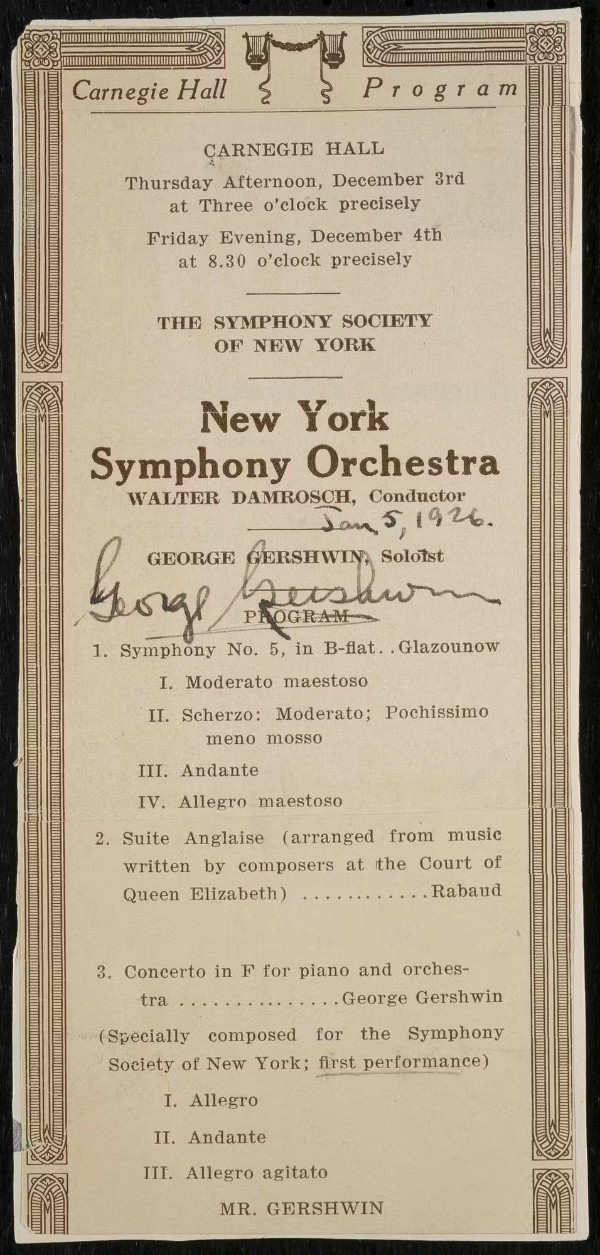
Carnegie Hall program
Leonard Bernstein: Prelude, Fugue and Riffs – Riffs (Benny Goodman, clarinet; Columbia Jazz Combo, Ensemble; Leonard Bernstein, cond.)
Aaron Copland: Piano Blues No. 2 (Andrew Willis, piano)
In addition to its historical importance, the Concerto in F is a beloved staple of the piano concerto repertoire because of its sheer musical appeal. Pianists relish its virtuosic demands, from crisp syncopations to sweeping, lyrical lines. Orchestras enjoy its colourful writing, which includes inventive writing for percussion and dynamic interactions between soloist and ensemble. And audiences continue to be captivated by its buoyant spirit and its ability to convey both exuberance and introspection. Few works capture the optimism, swagger, and complexity of early 20th-century America as vividly as the Concerto in F.
For more of the best in classical music, sign up for our E-Newsletter