I was back in Europe. I was back in Russia. I was back in Japan. I was back in Thailand. The year 2025 marked my return to a life I had grown accustomed to before 2020: being a jetsetter, listening to music around the globe.
Thanks to my hosts, donors, and sponsors, in 2025 alone I flew nearly 120,000 kilometres, spending 159 hours airborne across 59 flights. Those journeys took me to more than 25 cities in nine countries and regions, across two continents. Some may wonder why I travelled so much, given that China has increasingly become a favourite destination for touring musicians.
2025: A Year Written in Music and Miles
True enough. China’s major venues now regularly host the Berlin Philharmonic, Vienna Philharmonic, Bayreuth Festival, Mariinsky Orchestra, New York Philharmonic, Philadelphia Orchestra, and musicAeterna, to name just a few. Cities like Shanghai and Beijing are pushing aggressively to be not only internationally visible but globally competitive in music, while generous spending by tourists and authorities alike is driving the cultural industry upward.
Wuxi, a city of 7.5 million just 40 minutes by high-speed train from Shanghai, was designated a City of Music by UNESCO’s Creative Cities Network in 2025, the first in China. Chinese audiences have seen a lot and heard much.
Rather than sitting comfortably at home, I chose to keep moving for three reasons.
First, a creative mind thrives in unfamiliar surroundings. Travel feeds storytelling. Towards the end of December, just as I was preparing to wrap up the year, I seized the chance to visit Russia. Visa-free travel for Chinese nationals had come into effect the previous December, and I was eager to take advantage of it.
Direct flights still operate between the two countries, but travelling from Shanghai to St Petersburg via Moscow remains something of a logistical ordeal. My luggage had to be collected and rechecked in Moscow, rendering the connection almost pointless. Mobile and data coverage were unstable. Flights were repeatedly disrupted, and my return to China was delayed by more than two hours. None of my bank cards worked, and I was desperately short of cash. I lived in a state of near-constant anxiety, forced to navigate uncertainty at every turn.
In the end, it was the music and the kindness of friends that made the trip worthwhile and memorable.
Second, music cannot be separated from the culture that produces it. I knew almost nothing about Sámi culture until a trip to Norway in March for the Borealis Festival. One evening, in a mountaintop cabin on Fløyen above Bergen, sheltered from the rain and warmed by a campfire, I listened to We Who Live Between Worlds by Norwegian composer Sondre Närva Pettersen, played through two loudspeakers.
Had it not been for Sámi composer Herborg Rundberg guiding me through the history of cultural assimilation in Norway and its long path toward reconciliation, the moment would not have carried the same weight. What I experienced there felt like a personal reckoning.
Third, sound and space are inseparable. When the Bavarian State Opera travelled to Shanghai in early October for its residency at the Shanghai Grand Theatre, the house not only constructed a makeshift prompter’s box in the pit, but also transported the acoustic panels used in Munich. Orchestras radiate differently in their home spaces, something that simply cannot be replicated on tour.
So, without further ado, here are my top concert picks of 2025, from one to ten.
Ye Xiaogang: Song of Farewell
Song of Farewell (詠·別), a four-act opera by Ye Xiaogang (葉小綱), was revived in Hangzhou on 14 October at the Hangzhou Grand Theatre by the Hangzhou Philharmonic Orchestra under its Music Director, Yang Yang (楊洋). Presented in concert form, the performance featured the China National Opera Chorus from Beijing, alongside leading soloists including tenor Xiahou Jinxu, baritone Hong Zhenxiang, and soprano Yu Guanqun.
Loosely inspired by Farewell My Concubine (1993), the opera revisits a forbidden love between two male performers in a Peking opera troupe in Republican-era Beijing, tested by the arrival of a woman. Across four acts — Meeting, Promise, Wander, and Farewell — loyalty, jealousy, suppressed desire, and unrequited love unfold as art and life blur on and off the stage.
Ye’s orchestration fuses Western operatic grandeur with a live Peking opera ensemble and traditional vocalists, whose stylised voices and distinctive timbres add ritualistic colour and layered resonance, intensifying the tension between private longing and public performance.
The last great opera studio recording, episode two
Shui Lan Conducts the CNSO
The China National Symphony Orchestra appeared in Shanghai on 2 May under the baton of its newly appointed Artistic Director, Shui Lan (水藍). Held at the Shanghai Symphony Hall, the concert marked the orchestra’s first appearance in the Symphony of the Era – National Excellent Orchestra Invitation Exhibition.
The programme featured Ravel’s Ma mère l’Oye Suite and Daphnis et Chloé, Suite No. 2, Mahler’s Lieder eines fahrenden Gesellen with baritone Liao Changyong, and Fauré’s Pelléas et Mélisande. As encores, the orchestra offered Dvořák’s Slavonic Dance in E minor, Op. 72 No. 2, followed by the rousing conclusion of Ravel’s Boléro, all delivered with radiant clarity under Shui Lan’s baton.
Shui Lan conducts Sibelius, highlights
Ye Xiaogang: Symphony No. 5 “Lu Xun”
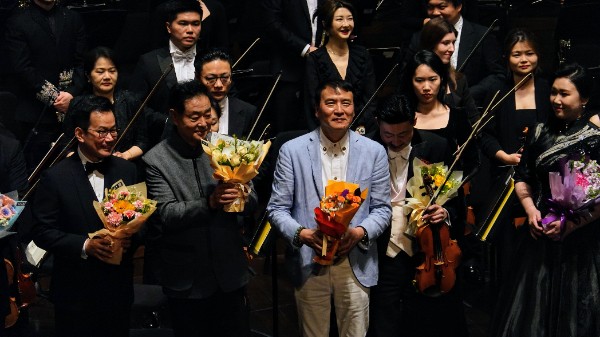
Ye Xiaogang’s Symphony 5 curtain call
Arguably Ye Xiaogang’s most powerful symphonic statement, his Symphony No. 5 “Lu Xun” was performed by the Shenzhen Symphony Orchestra under Lin Daye (林大葉) on 28 March at Shenzhen Concert Hall, with a second performance the following night at Guangzhou’s Xinghai Concert Hall.
Inspired by the novels and letters of Lu Xun (魯迅), Ye channels the writer’s uncompromising spirit into a symphony of equal intensity, transforming literary force into musical urgency.
Revival of Ye Xiaogang’s Symphony No. 5 “Lu Xun”
Beijing Impressions
When Li Changjun, the newly appointed President of the Beijing Symphony Orchestra, announced his plan to commission an orchestral suite from composers across five continents, some dismissed it as an ambitious dream.
Several months later, that dream materialised in resounding form. Beijing Impressions received its world premiere on 12 November at the Forbidden City Concert Hall under Yang Yang, the orchestra’s new Music Director.
The six-part suite draws inspiration from the city’s history, people, and evolving identity, bringing together composers from Thailand, Germany, Russia, Argentina, Nigeria, and the United States. Five attended the premiere: Narong Prangcharoen, Sven Daigger, Danil Sevostyanov, Ariel Pirotti, and Onche Rajesh Ugbabe, each stepping forward to thunderous applause. Their works formed a kaleidoscopic portrait of Beijing, seen through diverse cultural lenses, and affirmed music’s power to transcend geography.
Beijing Symphony Orchestra calls out to Berlin Philharmonic
Wagner: Tristan und Isolde
Bayreuth in Shanghai, a three-year residency programme bringing productions from the Green Hill to the Shanghai Grand Theatre, opened in July with Wagner’s Tristan und Isolde. Directed by Roland Schwab, this 2022 Bayreuth staging is arguably the most radical and enigmatic Tristan ever presented in China. In the pit, Xu Zhong conducted the Shanghai Opera House Orchestra.
Lise Lindstrom, making her role debut as Isolde, sang with striking agility and composure. Her glass-shattering voice cut cleanly through the dense orchestral textures, imposing in presence and utterly convincing in sound.

The Tristan und Isolde drink
Even the theatre café joined the spirit of the occasion, offering a drink inspired by the opera — perhaps the closest one can come, taste-wise, to the Elixir of Love.
Katharina Wagner, who attended the first two performances, announced she would return to Shanghai in April to direct a new production of Die Walküre, created specifically for the residency.
Lise Lindstrom champions Bayreuth in Shanghai
Yin Chengzong on Kulangsu
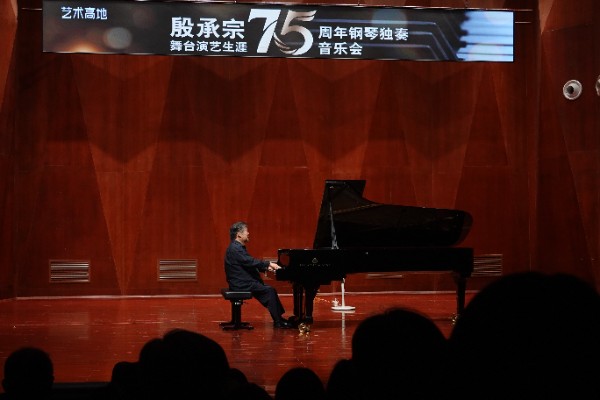
Yin Chengzong on Kulangsu
On 7 June, Yin Chengzong, widely regarded as a towering figure of Chinese pianism, marked 75 years on stage with a landmark recital at the Kulangsu (Gulangyu) Concert Hall. The 700-seat venue was filled to capacity, the audience fully aware they were witnessing a living legend.
Tickets were offered free of charge and disappeared within minutes.
The concert celebrated two milestones: the 55th anniversary of the Yellow River Piano Concerto, which Yin co-composed, and the 75th anniversary of his debut on Kulangsu. That debut came when he was just nine years old, during a turbulent period in Chinese history, when the island still bore traces of civil war.
Performing entirely from memory, Yin played works that have accompanied him since the beginning: Scarlatti, Mozart, Beethoven, and Schubert. He concluded with two encores: one by Schumann, the other his own composition.
Yin Chengzong Celebrates 75 Years on Stage with Historic Recital in Kulangsu
Benjamin Britten: A Midsummer Night’s Dream
On 24 August, Japan’s Seiji Ozawa Festival transformed Matsumoto into a citywide celebration. A grand parade brought together 39 brass bands and some 1,500 musicians from across Nagano Prefecture, from students to community ensembles. For more than two hours, music filled the city’s main pedestrian streets under brilliant sunshine.
That afternoon, attention turned to the Matsumoto Performing Arts Centre, where Nodoka Okisawa led the Saito Kinen Orchestra in a vibrant performance of Britten’s A Midsummer Night’s Dream. Directed by Laurent Pelly and sung by an international cast, the production blended wit, fantasy, and musical spontaneity, offering audiences one of the festival’s most memorable experiences.
Festival Spirit in Full Swing at Seiji Ozawa Matsumoto Festival
Stockhausen: Stimmung
On 14 September, I was invited by the Ultima Oslo Contemporary Music Festival to the home of Christel Stockhausen, daughter of Karlheinz Stockhausen. Her fjord-facing house outside Oslo doubles as a private archive, lined with manuscripts, paintings, and the Grotrian-Steinway grand piano her father purchased in 1951.
After an introduction by Ultima’s Artistic Director, Heloisa Amaral, a young Norwegian pianist performed selections from Stockhausen’s piano works on the instrument, turning breakfast into a living homage. Christel spoke of her childhood, her father’s fascination with harmonics, and the genesis of Stimmung, each anecdote blending scholarship with intimacy.
Later that morning, Stimmung was performed in the Emanuel Vigeland Mausoleum, whose extraordinary 17-second reverberation created a panoramic sonic effect. Six singers from Nordic Voices sustained overtone chanting for more than an hour, the resonance so profound that some listeners described it as spiritually uplifting. Christel attended with her son, completing a powerful circle of legacy and ritual.
Stockhausen’s Stimmung with Christel Stockhausen
Debut of the Asian Modern Symphony Orchestra
Co-founded by Wilson Ng and a group of Hong Kong’s emerging musicians, the Asian Modern Symphony Orchestra (AMSO) made its debut in late July at the Hong Kong Cultural Centre.
Presented by Music Lab, the first of two inaugural concerts featured a programme bridging Western classics and contemporary Asian works. Highlights included Ye Xiaogang’s Scent of Green Mango, Unsuk Chin’s subito con forza, Stravinsky’s Firebird Suite, and Ravel’s Piano Concerto in G major, with KaJeng Wong as soloist. The evening closed with Ravel’s Boléro, a demanding test of orchestral stamina and finesse.
AMSO was conceived as a platform where Asian composers stand alongside Western repertoire, not as novelty, but as canon.
Wilson Ng on Founding the Asian Modern Symphony Orchestra and Championing Asian Composers
Wagner: Siegfried
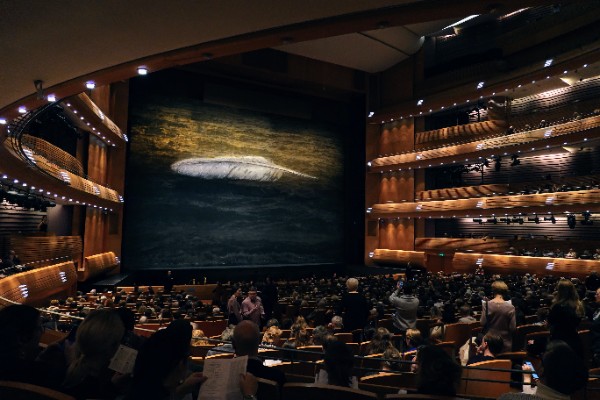
Wagner’s Siegfried at Mariinsky
The Mariinsky Theatre in St Petersburg is not a single building but a vast complex of three venues: the historic Mariinsky Theatre, the Second Stage, and the Concert Hall, together housing up to nine performance spaces.
On 27 December, I embarked on a self-imposed musical marathon. At two in the afternoon, I began at the Concert Hall with a piano festival concert. Xenia Bashmet, daughter of Yuri Bashmet, was at the keyboard, with Fyodor Khandrikov conducting the Mariinsky Orchestra in works by Bach, Haydn, Britten, Tchaikovsky, and Joaquín Turina, whose Rapsodia sinfónica was a delight to discover.
From there, I crossed to the Second Stage for Siegfried, conducted by Valery Gergiev, the third night of the Ring cycle. This reimagined production had premiered at the Shanghai Grand Theatre in October 2023 and was now being staged at the Mariinsky in consecutive nights for the first time. Khandrikov, who had conducted the matinee, was on timpani. Mikhail Vekua sang the title role with formidable strength.
By the time it ended, it was nearly 11:30 p.m. It felt less like a night at the theatre than a full-scale musical pilgrimage.
Twelve Hours at Mariinsky
For more of the best in classical music, sign up for our E-Newsletter