As creative as the human mind gets, it seems we constantly find situations in which we repeat what has been done in the past. In fact, in art, one could question how much new there really is and how much repetition exists. Perhaps all artists are doing is repeating what their predecessors have done. Let’s look at a very modern producing device, such as sampling, for instance. The process of isolating a musical moment and editing it, reworking it, and repeating it until a new work emerges. Whilst its process is no more than a hundred years old and could not exist without the rise of recorded music — and perhaps the recording industry too —, it seems that musicians have approached it, conceptually, for centuries.
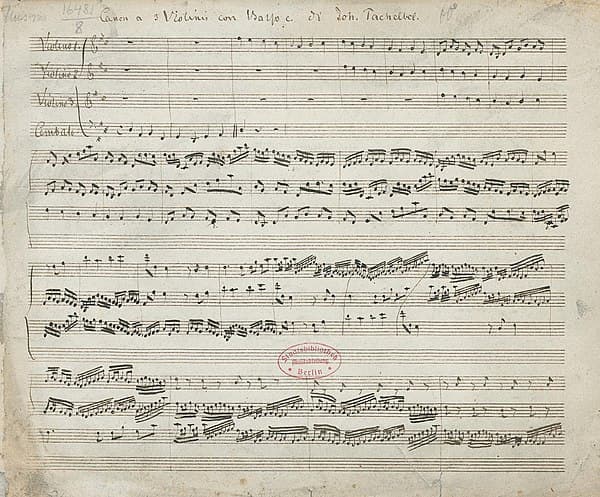
Johann Pachelbel’s Canon
One of the earliest forms of an ancestor to sampling can probably be traced back to one of the first basso continuos of Baroque music. Or at least one of the most well-known. Pachelbel’s “Canon”, composed in 1680, is a great, and perhaps the most evident, example of that, to the point where it could actually even be considered the first minimalist work ever created. It certainly influenced Eno, and a few centuries later, when he was designing his own ambient music and looking at his own approach to sampling music. Here, Pachelbel provides an early example of musical repetition through repeating the same harmonic progression over and over.
Pachelbel Canon in D Major
Before Pachelbel, and somewhere between, in the middle of the fifteenth century, was written “La Folia”, another early example of a repeating structure over which evolves the music. The harmonic sequence is now well-known across the classical repertoire, and has been used by Lully, Corelli, Scarlatti, Vivaldi, and even recently by Richter in his Woolf Works — a ballet which makes great use of sample structures and repetitive formats.
Another interesting work to look at, composed in 1928, during the awakening of the recording industry, is Ravel’s “Boléro”. A work which, through the repetition of a cellular motif, builds layers and layers of sounds. It is, in its essence, very similar to Pachelbel’s “Canon”. If the composer himself was not a great admirer of the piece, it is nevertheless the one that brought him so well to the forefront of his (contemporary) public. The format under which much of computer-based music is created today follows an almost identical approach, in a perhaps even more simplified structure. The idea of overdubbing, for instance, and building music in cells, over time, can be traced back to this.

Ravel’s Bolero rhythmic pattern
One last example, “Vexations”, by Satie, is perhaps the first intended work which plays so heavily on the repetition of a motif and makes it a central focus. The piece, composed by the composer but left undated and unpublished during the time he was alive, was brought back to the public’s ears when Cage published it again in 1949 alongside some of his works. Repetitions are to happen 840 times, in succession. In 2025, Igor Levitt performed it in its entirety, alongside an installation by Marina Abramovic.
Igor Levit – Erik Satie – Vexations – short edit
Of course, the act of sampling music is interconnected with the development of the recording industry and tape recordings. Through this, the works of the minimalist and particularly Reich’s approach to repetitive music have been one of the most important factors in the evolution of sample music. However, one should not forget the influence and importance of musique concrète and the works of Henry, Schaeffer and later Stockhausen, who have allowed the process of cutting and pasting to exist.
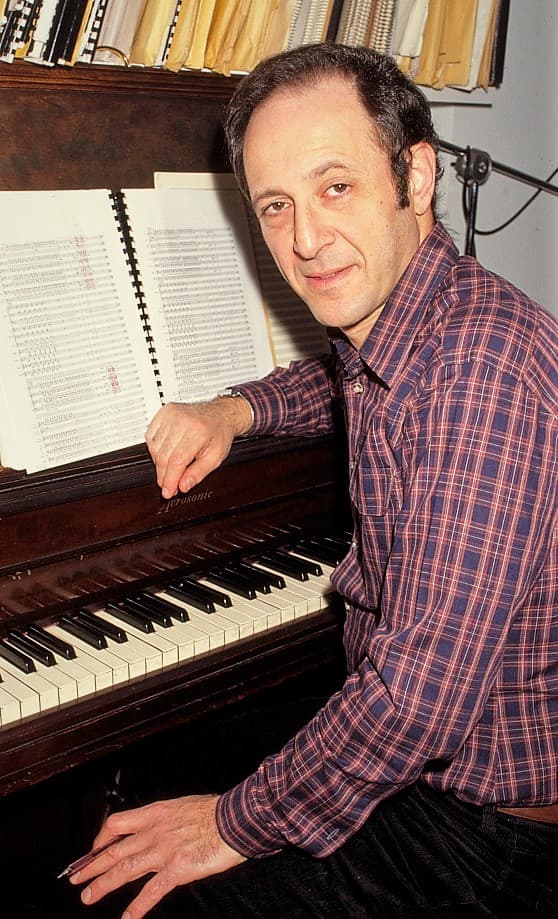
Steve Reich © Wikipedia
Today, a lot of music is constructed in a cellular way, and this is through the approach of creating musical fragments and repeating them, moving them over and slightly changing them. This process, however, as we have seen, is nothing new, and is the result of centuries of development, at times on pen and paper, and at others through the computer screen.
For more of the best in classical music, sign up for our E-Newsletter