A spectacular musical event took place from May 9 through May 18 this year. The Royal Concertgebouw, founded in 1888, hosted their 3rd Mahler festival ever in their history, featuring all of Mahler’s symphonic works and songs. The performances took place in their gorgeous hall, the Concertgebouw, in Amsterdam. The concerts were also available to everyone for free, broadcast live with video at the city’s Vondelpark in the Mahler Pavilion and on the radio. That’s my kind of paradise, Mahler heaven.
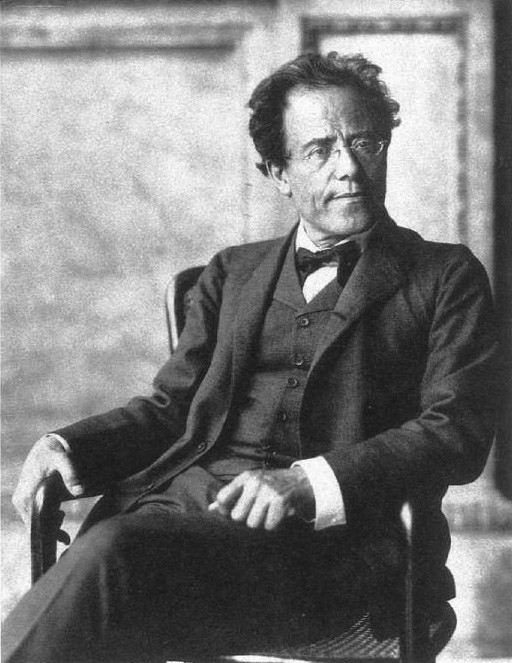
Gustav Mahler
The event featured the Concertgebouw Orchestra with Klaus Mäkelä, their newly appointed maestro, the Chicago Symphony with Jaap van Zweden, the Berlin Philharmonic with Kirill Petrenko, their principal conductor, the NHK Symphony of Tokyo with Fabio Luisi, and the Budapest Festival Orchestra led by Iván Fischer. Gustav Mahler himself stood on this stage and conducted! No pressure.
Not content with this nirvana, the festival was carefully curated to include documentaries, lectures, and small group recital performances. These included:
Julia Drake Meets daily recitals featuring one of the leading lieder pianists with solo vocalists.
Mahler Talks with Morten Solvik, the eminent Norwegian musicologist and Mahler expert introducing the symphony each evening before the concerts.
Mahler Walks with Hermann Reinken percussionist with the Concertgebouw— a very colorful character, escorting attendees on outings to the places Mahler resided and to the homes of friends and colleagues of Mahler during Mahler’s visits to Amsterdam.
Late Nights with musicologist Vrouwkje Tuinman leading conversations after the evening concerts with the conductor, an orchestra member, or a guest held in the Recital Hall of the Concertgebouw.
One of the greatest symphony conductors of the 20th century, Dutch conductor William Mengelberg (1871-1951), appointed principal conductor of the Concertgebouw in 1895, became friends with Gustav Mahler in 1902 and championed his music.
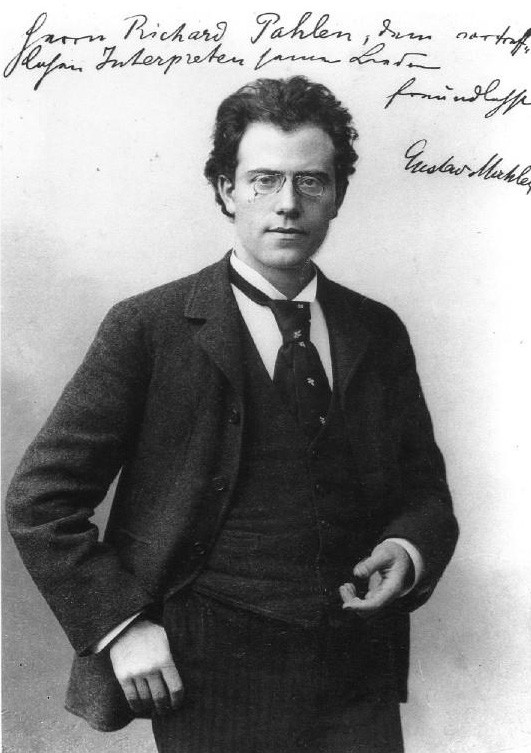
Gustav Mahler
In 1903 Mahler was invited to conduct his 3rd Symphony with the Concertgebouw, and subsequently, his 4th, 1st, 5th, and 7th Symphonies. Mahler enjoyed working with the musicians of the Concertgebouw and was known to have edited his music during rehearsals to suit the orchestra.
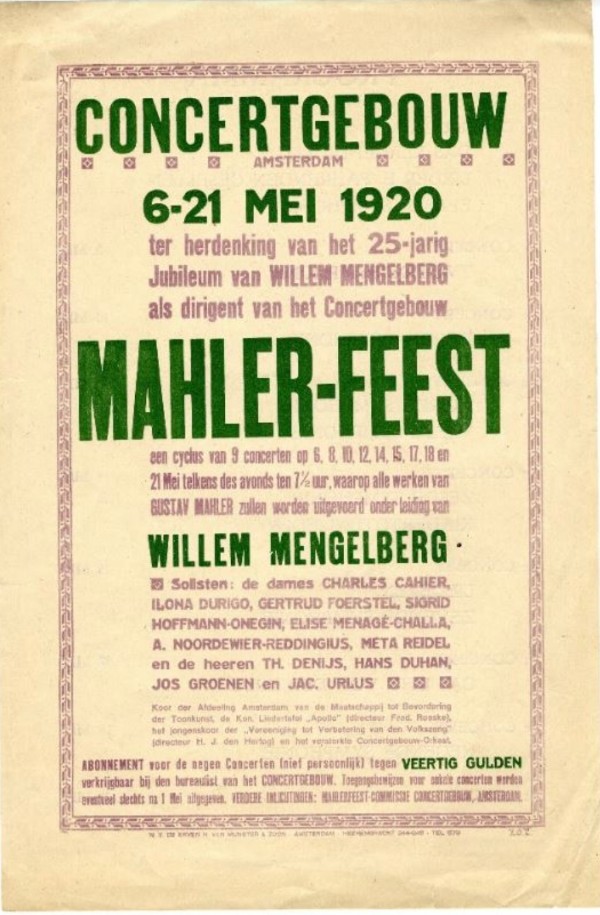
Mengelberg initiated the first festival in 1920 and presented the entire oeuvre of Mahler Symphonies. In preparation, when he worked with the orchestra, Mengelberg marked the sheet music parts in blue pencil with his own instructions and interpretations. It is difficult to believe that these parts still exist, with his markings, and are used today.
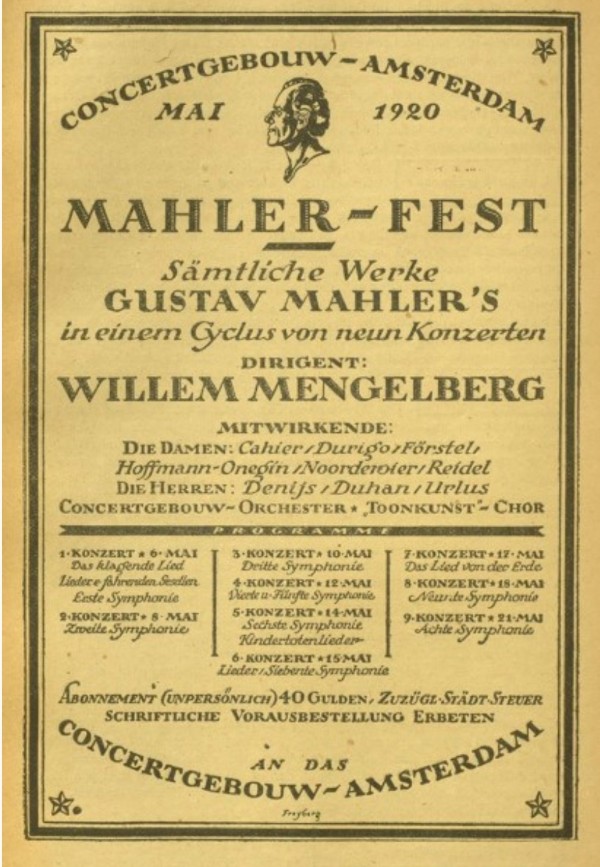
Mahler Festival 1920 poster
The 2025 festival began with an introduction to Mahler the man and his music. Dear Mahler! Using Mahler’s letters as a springboard, conductor Lorenzo Viotti and the Netherlands Philharmonic Orchestra, Baritone Florian Boesch, and actors Bran Suijker and Charlie Chan Dagelet, opened Mahler’s world to the audiences— with excerpts from his greatest works, and with his reflections and meditations, sometimes compelling and humorous, other times troubled and heartbreaking.
The following evening, Mahler Symphony No. 1 was performed by the Concertgebouw Orchestra conducted by Mäkelä. In 1899, audiences in Vienna hissed when they heard the symphony. It was much too different from symphonies they were used to. The “Titan” as it is also known, is dramatic and powerful utilizing huge orchestral forces. It also includes a funeral procession, and folk music such as the “Frere Jacques” melody played by a solo double bass at the beginning of the third movement. Dominic Seldis principal bass explains why the double bass solo is so difficult.
#MahlerMemories – Dominic Seldis – principal double bass
Here is a brief excerpt from the Mahler Symphony No. 1 performance.
Mahler: Kräftig bewegt, doch nicht zu Schnell – Klaus Mäkelä & The Concertgebouw Orchestra
Mahler Symphony No. 2 was performed by the Budapest Festival Orchestra with Iván Fischer conducting. Sometimes entitled the Resurrection Symphony it is a monumental and dramatic work of 5 movements approximately 90 minutes long, with choir, and vocal soloists, the first to pair voice and language with the orchestra.
Consider this—Mahler conducted the symphony with this orchestra on this stage using the same sheet music from 116 years ago. The brass writing is exceptional in the 2nd Symphony. One of the most beautiful moments is the resplendent trombone chorale. Trombonist Martin Schippers explains.
#MahlerMemories – Martin Schippers – tenor/bass trombone
While other symphonies have defining moments, this one does too—the “Death Shriek.” During the third movement charming music gives way to a huge crescendo building to a triple forte chord depicting a cry of despair (8’25”.) Another shriek occurs at the opening of the fifth movement.
Gustav Mahler: Symphony No. 2 in C Minor, “Resurrection”: I. Allegro maestoso – III. In ruhig fließender Bewegung (Vienna Philharmonic Orchestra; James Levine, cond.)
The following short, glorious fragment features the full brass section.
Mahler: Symphony 2 – Resurrection (5th movement) – Iván Fischer & Budapest Festival Orchestra
Mahler Symphony No. 3 was performed on May 11th, day 4 of the festival, by the NHK Symphony with Fabio Luisi conducting and the women of the National Radio Choir, the National Children’s Choirs and Mezzo-soprano Olesya Petrova.
The symphony, in six movements, is known for being very long, 90 minutes, and incorporates a huge number of percussion instruments. The monumental symphony expresses Mahler’s spiritual quests about the human condition. The first movement is powerful and turbulent, and an entire world unto itself. Twenty minutes in, Mahler introduces a fugue with the cellos alone. It seems to come undone until snare drums enter with a military rhythm and the horn theme returns, but so does the menacing funereal rhythm. The movement concludes in triumph.
Gustav Mahler: Symphony No. 3 in D Minor – I. Kräftig – Entschieden (New York Philharmonic Orchestra; Leonard Bernstein, cond.)
This symphony is nonetheless, one of Mahler’s sunniest scores. Nature and the world are represented in all its guises, in birdcalls, in Bavarian folk music, in military marches, with sleigh bells, in dances, and with the angelic voices of children. Playing or listening to this piece is a journey through the gamut of emotions.
There’s an offstage post horn solo and it’s sublime. Principal trumpet Omar Tomasoni explains.
#MahlerMemories – Omar Tomasoni – principal trumpet
And here’s a tantalizing taste of this symphony.
Mahler: Symphony 3 – Pan Awakes, Summer Marches In – Fabio Luisi & NHK Symphony Orchestra
The performance of Mahler Symphony No. 4 on May 12 also featured Des Knaben Wunderhorn with Fabio Luisi and NHK Orchestra, soprano Ying Fang and Baritone Matthias Goerne.
Bells permeate Mahler’s music. Bence Major, one of the percussionists, discusses Mahler’s unique use of bells and percussion effects.
#MahlerMemories – Bence Major – percussionist
The pairing with Das Knaben Wunderhorn is deliberate as both works draw inspiration from a collection of German folk poetry that portrays innocence and is full of flowers and birds, and youthful dreams of heaven. A soprano emerges in the last movement with childlike statements. This symphony is scenic, charming, and lyrical and there are lovely woodwind lines one would say gemutlich, not the impressive brass we have previously experienced.
Mahler: Symphony No. 4 Bedächtig. Nicht eilen – Fabio Luisi & NHK Symphony Orchestra
Day 6 featured the beloved Mahler Symphony No. 5 and Kindertotenlieder with the Budapest Festival Orchestra and Iván Fischer.
The fifth symphony marked a turning point in Mahler’s life. The opening is a trauermarch, (funeral march), beginning with a motif portraying a traditional military ritual—a solitary bugle playing at the gravesite. This is soon followed by a melody of lamentation with heartrending emotion. The famous Adagietto, a love letter to Alma, is quite breathtaking but also permeated with aching and longing.
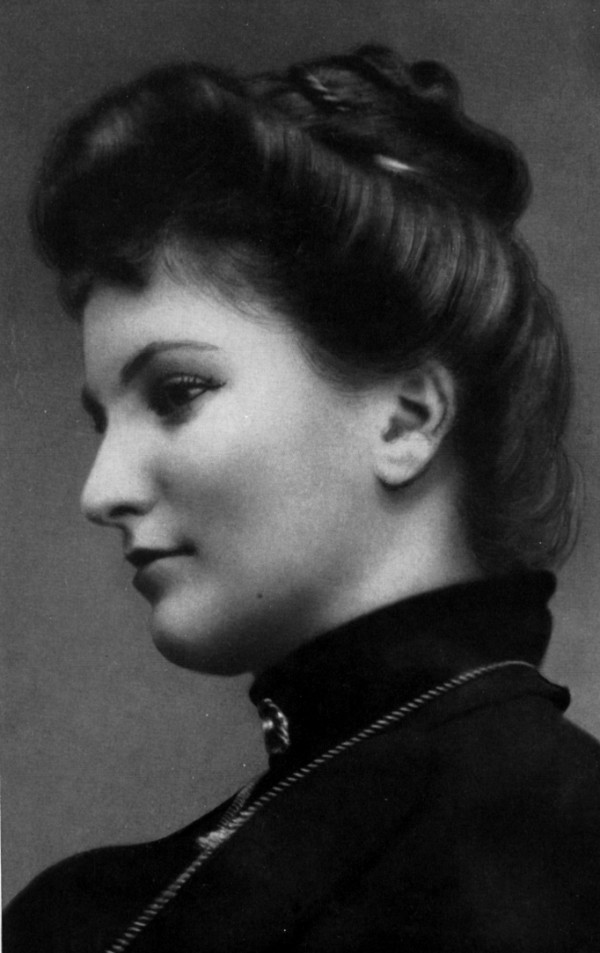
Alma Mahler
You may be astonished to learn the many interpretations of this movement vary widely regarding tempo. The longest recordings of the Adagietto, with Klaus Tennstedt and London, as well as Bernard Haitink with Amsterdam, are 18 minutes in length! Mengelberg conducted the Adagietto in 14’13.” Our performance here with the Minnesota Orchestra and Osmo Vänskä was 13 minutes, while Claudio Abbado with Berlin 9:00 minutes. The quickest I found was Bruno Walter’s rendition at only 7’35.” Sometimes, depending on the orchestra, the time in the conductor’s life, or the idiosyncrasies of the hall, a conductor might vary in their own interpretation like this lovely version of Tennstedt with the London Philharmonic.
Gustav Mahler: Symphony No. 5 in C-Sharp Minor: IV. Adagietto (London Philharmonic Orchestra; Klaus Tennstedt, cond.)
Next, audiences were treated to Mahler Symphony No. 6 with Jaap van Zweden and the Chicago Symphony.
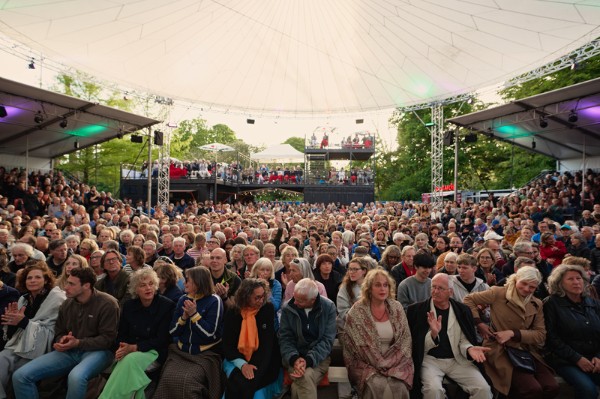
Mahler Festival outdoor audience © Milagro Elstak
The piece, sometimes called The Tragic, arguably his darkest and mostly pessimistic, depicts “mighty blows of fate” in the earsplitting hammer strikes in the last movement that also represent tragedies in Mahler’s own life—the death of his older daughter, the heart condition that leads to his death, and being ousted by the Vienna Opera. Orchestras have experimented to produce the sound that will bedazzle audiences. Here’s a version of the hammer with the Boston Symphony.
A hammer blow in Mahler’s Symphony No. 6, Andris Nelsons and Boston Symphony at Suntory Hall
The opening of the symphony begins with decisive and brusque fortissimo notes in the cello. We know what might lie ahead!
Mahler: Symphony 6 – Allegro energico, ma non troppo – Jaap van Zweden & Chicago Symphony Orchestra
Mahler Symphony No. 7 with Jaap van Zweden and the Chicago Symphony once again, was another high point.
Mahler’s music is not all tragic and dark. The composer described the work as joyful, and this symphony is full of optimism and humour. A question you might ask is about the concertmaster’s role in preparing the Mahler sound.
#MahlerMemories – Vesko Eschkenazy – concertmaster
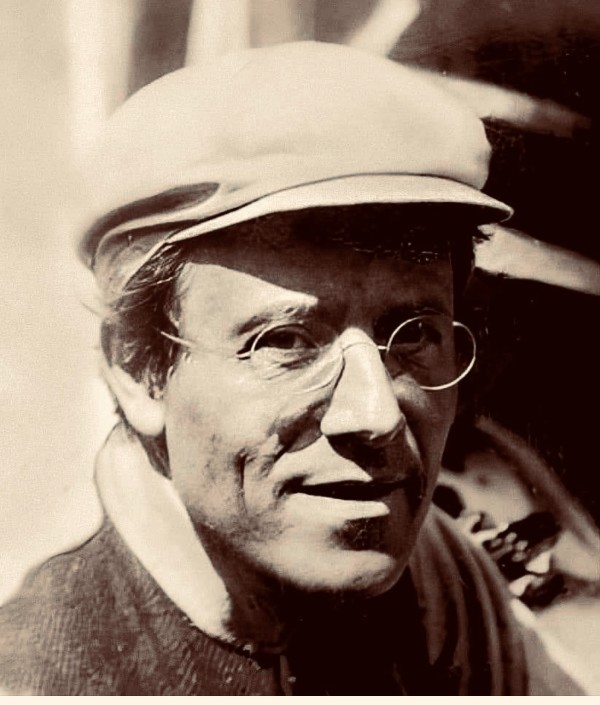
Gustav Mahler
Mahler began composing this five-movement symphony with the middle movements, then added the huge bookends of the first and last movements. The 2nd and 4th are entitled Nachtmusik (night music) separated by a menacing, mischievous, but virtuosic scherzo.
Gustav Mahler: Symphony No. 7 in E Minor – III. Scherzo: Schattenhaft (Bavarian Radio Symphony Orchestra; Bernard Haitink, cond.)
The hair-raising ending instructs the horns to lift their bells. Watch!
Mahler Symphony No. 7 – Jaap van Zweden & Chicago Symphony Orchestra
Friday May 16 the performance of Mahler Symphony No. 8 featured Klaus Mäkelä and the Concertgebouw Orchestra.
The Symphony of a Thousand in two colossal movements, calls for massive numbers of performers. Four-hundred and twenty musicians participated in this performance. (In the 1912 performance with Mengelberg, apparently two thousand musicians and singers performed.)
Listen to the last 8 minutes of the piece. The long-held silence at the end followed by the several minute ovation attests to the moving impact of the performance.
Concertgebouworkest en Klaus Mäkelä in Mahler 8 – eindspel (laatste 8 minuten) + 4 minuten bravo’s
Mahler Symphony No. 9 with Kirill Petrenko and the Berlin Philharmoniker is, according to Mahler, his farewell. Throughout his life Mahler was plagued by the superstition of symphonic composers not living beyond their 9th symphony and indeed he perished before he completed his 10th symphony.
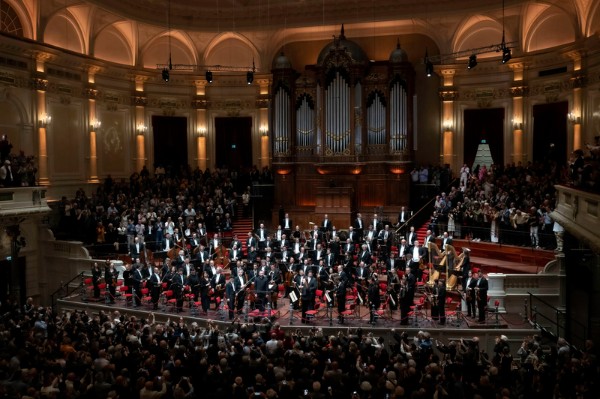
Berliner Philharmoniker with Kirill Petrenko © Monika Rittershaus
On Sunday May 18th, the final day of the festival, Sakari Oramo and the Berlin Philharmonic performed Mahler Symphony No. 10 Adagio (completed) and Das Lied von der Erde. In texts inspired by Chinese poems, Das Lied and the adagio explore man’s mortality. It’s breathtaking.
Mahler Symphony No. 10 – Sakari Oramo & Berliner Philharmoniker
Fifty-six thousand visitors attended the 23 concerts and the 11 sold out open-air broadcasts from 56 countries. National radio and television attracted hundreds of thousands more listeners. A total of 1,100 musicians performed all the songs and symphonies What a triumph.
The granddaughter of the composer, Marina Mahler, was the guest of honor giving interviews and introductions to several concerts. Her reaction to the 10-day celebration: “The festival was truly extraordinary. It was one great crescendo of music, emotion, friendship, love, and exchange. You could feel the deep affection for Mahler’s music everywhere!”
This brief journey through the Mahler symphonies is as close as we could get to being in Mahler Heaven. Perhaps the next time we might attend in person!
For more of the best in classical music, sign up for our E-Newsletter