Trust, Diplomacy and Kind Cruelty
Travel to the right part of the UK’s rural Devonshire region on the right day at the right time, and you might just see a farm vehicle trundling along with some logs in tow. Nothing remarkable, perhaps, until you glance at the man in the driver’s seat and see James Baillieu, the internationally-acclaimed pianist, at the wheel.
This part of the world is James’ happy place, and is relatively easy to get to from his base in London – an easier commute, at least, than from his childhood home in South Africa. As a child, James began learning the piano at the behest of an occupational therapist, who recommended lessons to ameliorate a persistent hand-eye coordination problem. James fell in love with the instrument and never looked back, continuing his studies in South Africa and scooping some major competition wins along the way.
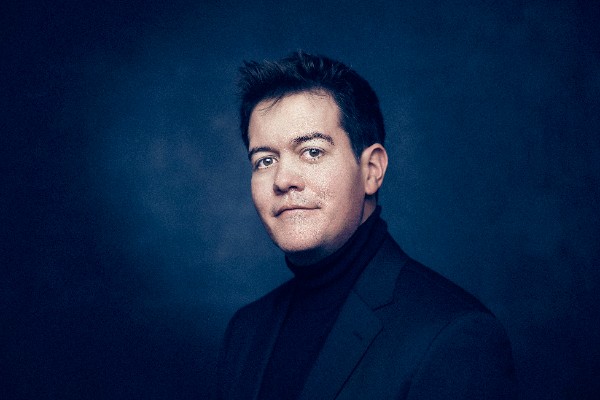
James Baillieu © https://james-baillieu.com/
Despite this success as a soloist, James always felt the pull of the world of collaborative piano – of chamber music, rather than solo performance – and it was into this world that he dived, discovering whole universes of song and duo repertoire opening up to him with his collaborative partners. Whilst James is particularly passionate about song, he is equally at home on stage with trombonists, violinists, or clarinettists – indeed, it is this flexibility that has earned James the reputation as one of the most sought-after pianists of his generation.
James has been described as ‘an exceptional accompanist’ (The Guardian) whose playing brings ‘a gorgeous variety of tone and natural freedom’ (New York Classical Review). He is Senior Professor of Ensemble Piano at the Royal Academy of Music and has performed all over the world, as well as recording critically-acclaimed albums with collaborators including clarinettist Julian Bliss, violist Timothy Ridout and flautist Adam Walker.
James’ recent visit to Hong Kong with baritone Benjamin Appl earlier this year was the continuation of a long-term musical partnership, the pair having recorded several previous albums together. We talk about his approach to collaboration and how, in his own words, a series of happy accidents led him to where he is today.
Benjamin Appl, Edvard Grieg, James Baillieu – An das Vaterland, Op. 58, No. 2
How did you find your way to the piano?
I grew up in South Africa, and was decidedly unsporty and had issues with holding pencils, that sort of thing. An occupational therapist suggested to my mum, ‘Why doesn’t he have piano lessons?’ My mum thought that was a bizarre suggestion given that I was so malcoordinated, but weirdly, because of the physicality of it, it helped to strengthen my coordination, and everything else kicked into place.
It was a very happy mistake. I still couldn’t catch a ball, but I could do other things so much more easily. I became kind of obsessed with the piano. I would just play and play.
When I started lessons, my piano teacher didn’t think it would be anything I would pursue, so she gave me things that were hugely ambitious, and I ploughed through them. It just clicked. I went through hours and hours of playing – I remember my mum saying, ‘We live in beautiful sunny South Africa – why don’t you go outside and play in the sunshine?’ I would just be at the piano, going through reams of repertoire.
That also meant that I taught myself to sightread and learn things very fast, which, in this field, because you’re doing so many different things all the time, is a big skill.
Did you feel any resistance to learning the piano at first? How quickly did it click?
I think what potentially sets me apart from other people is that it was all largely self-driven. I remember when I wanted to do piano competitions, my mother hated it. She was more nervous about it than I was, so it really came from me really loving it and wanting to do it.
It’s a very different way of life in South Africa. There’s a lot of music on offer, but it’s not the fabric of society that it is in Europe. I had the space to be naive.
Right the way through my training in South Africa I was lucky because the teachers weren’t overwhelmed with students, so I had a lot of time, especially at university, with my principal teacher there.
Because I started relatively late – I was 9 or 10 when I started lessons and 12, 13, when things started clicking into place – I needed that catch-up time, so I was grateful to be in a small place with a lot of time and attention.
Was it a shock moving to London after that?
London was also kind of a strange mistake. I’d always had my sights set on going to New York, I guess, just from Hollywood and seeing all the movies about Juilliard. I was enrolled at Juilliard, but New York was too much for me. In my final year of university, I did a competition in the States, and I won a prize, which was a solo recital at Carnegie Hall. I hated the loneliness of practising and performing alone.
Even with an orchestra, you’re quite isolated. New York was also too much. Nowadays I love it, but back then on the way home, I came via London, and I went to Madame Tussaud’s, as you do as a young tourist. I got lost and walked the wrong way out and ended up outside the Royal Academy of Music – I just walked in and said, ‘Can I play for someone?’, and it just happened.
Michael Dussek, who became my teacher, said that I could come here to study song and chamber music – so that’s what happened! They organised an audition there and then. I was very lucky. Everything is now so official that I think things like that probably don’t happen as they did.
It just felt right; it was a gut feeling. I’d always played with singers, but when I was a student in London, I really honed that skill. There’s such a big tradition of song pianists in the UK, and I love the fusion of text and music. I was just lucky that I found the place I should be.
What’s the difference for you, if any, between working with singers and instrumentalists?
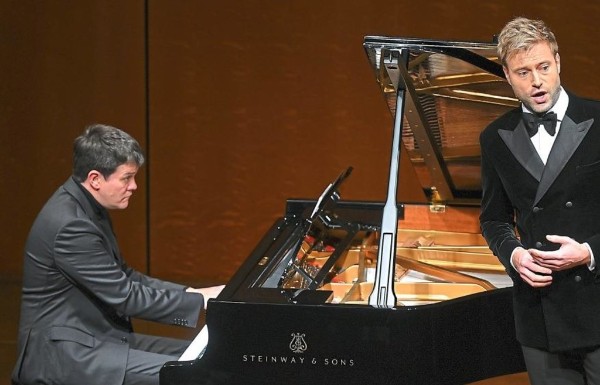
James Baillieu performing with Benjamin Appl
I love the challenges of both. With singers, there’s the whole added element of the poetry, and then I think there are other attributes that you bring to the table.
You travel quite intensely with these partners and colleagues, and their instrument is within them, and they can’t get away from it. I think it’s also in my personality to enjoy supporting, being a calm, supportive presence, someone that people can trust, which is different to instrumentalists because they can just put their instruments away and go out and do whatever they want.
When you work with singers, you have to be very diplomatic and very kind. Sometimes it’s kind to be cruel as well, but you have to do that in a diplomatic way. I think that is something I really enjoy.
Voices are so susceptible to any sort of change – so are instruments, in a way, but it’s far more personal. I really value the fact that I have a handful of really close singing partners whose voices I know really well, so I can help them through various hurdles in different environments.
A lot of what we do is making people sound their best, and sometimes that’s by challenging them, not just always being subservient. It’s knowing which button to push when.
I think the keyword is trust, and if you get that both musically and personally, it forms a very strong partnership. Then you both have the space to suggest things – and also to be cruel sometimes!
Maria Bayankina & James Baillieu perform Puccini’s “Un bel dì vedremo” at the Verbier Festival 2021
Do some people enjoy being challenged more than others?
It depends on the personalities and the regimes of training, things like that. That’s what I always find takes a bit of gear-shifting: when you go from being with a singer, being all diplomatic, into, say, a string quartet rehearsal where everyone is so brutal to each other. It’s all for the common good, for the music, but no one’s got their gloves on!
Does a difference in rehearsal technique necessarily translate into a different experience of the performance itself?
I think it’s always very interesting to see when things get heated in rehearsals, when people have very specific ideas. You realise that every stage is different, every room is different, every day is different, so you learn not to hold on to these things. My philosophy is just to see what happens.
A lot of rehearsing, I find, feels like housekeeping from my side. You’re working things out, not giving too much in the rehearsal, just analysing, and then on the stage being free to take energy wherever it goes and see what comes.
I’ve found that the more people come with a set idea, the less satisfying the experience is, in a way, rather than being just something free and unique. I think sometimes you discuss things in rehearsals and then in the moment, you both end up doing something that is the polar opposite, and it feels great.
Are there any pieces you feel are particularly true that it’s best left to the concert?
I think not so much specific pieces, but I think if you’re open to being surprised, then anything can. It’s always fun.
I think that’s also something I feel enormously grateful to have been in the song world because there’s such a vast repertoire, and you cover so much of it. Every composer wrote songs, and you get to discover that. Some people will never play Britten or Tippett, for example, and I really feel like I get to the core of many composers’ worlds through their songs.
So you feel like you’re almost getting the distilled ‘essence’ of a composer?
I think so, and I think the text element really helps with that. You understand the sound worlds or characters that they’re trying to portray, and each one is so specific.
Someone like Schubert managed to capture humanity somehow, and I think he just ‘gets’ people. He would be some sort of genius psychotherapist if he lived today, because he understood people and, in 12 seconds, could write down exactly what a certain character should sound like.
With song, you get to see singers being themselves, rather than playing an opera character. It’s distilled into someone’s personal thing, and it’s a privilege to be part of that journey. It’s a very naked exposure, in a way.
All the costumes and everything are gone, and it’s just about being honest and sharing personal stories. I always talk about this ‘triangle of song’: the composer, the poet, and then the personal experience of the people doing it. When those are in balance, you get something super interesting, and that’s why everyone’s performance of the same song will be different.
You are Senior Professor of Ensemble Piano at the Royal Academy of Music. Is the ‘triangle of song’ something you try and impart on your students?
A lot of my philosophy is encouraging people to be as real, genuine, and honest as they can be through their playing or singing. All the technical challenges or whatever are just going into channelling personal stories through the medium of the composer and the poet in song.
How much of it can be taught, and how much of it is down to sheer experience?
You learn so much from teaching, and you learn so much from performing, and I love the fact that I can do both. You learn from each experience.
What do you do in your spare time?
I spend a lot of time in London, but I’m very lucky that we have a place in the countryside, down in Devon, which is in the middle of nowhere, and I spend a lot of time just building fences, chasing cows and sorting out countryside sort of things. It feels a bit like going back to my youth, going from deep dark Africa to deep dark Dartmoor. I like hiking, being outdoors, and all the things that come with it.
For more of the best in classical music, sign up for our E-Newsletter