When Yvonne Loriod (1924-2010) was born on 20 January 1924 in Houilles, near Paris, few could have predicted that this prodigious young pianist would come to define the sound of Olivier Messiaen’s piano music.
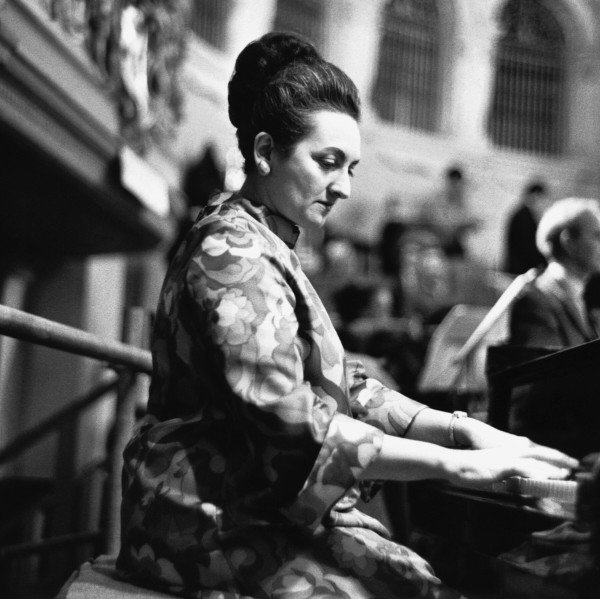
Yvonne Loriod
A visionary interpreter, a technical giant at the keyboard, and later the composer’s wife and muse, Loriod’s artistic identity became inextricably entwined with Messiaen’s output. One of the most formidable pianistic voices of the twentieth century, her recordings remain touchstones for listeners.
To celebrate her birthday, let us explore her approaches to Messiaen’s uniquely demanding language and delve into comparisons with later generations of pianists.
Yvonne Loriod performs Messiaen: Regard de l’Esprit de joie
A Prodigy Becomes a Muse
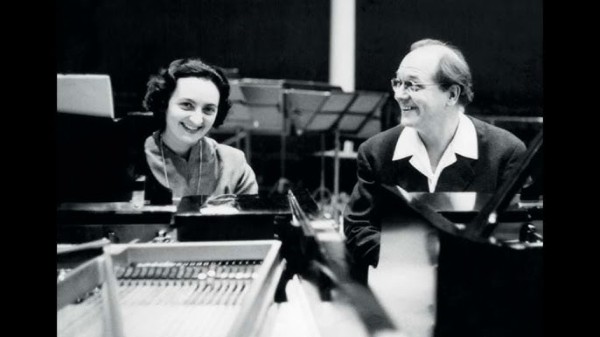
Yvonne Loriod and Olivier Messiaen
Loriod’s musical gifts were evident early. By her teens, she had mastered all 32 Beethoven sonatas, Bach’s Well-Tempered Clavier, and Standard Romantic works. At the Paris Conservatoire, she studied with luminaries of the French piano tradition as well as with Messiaen himself once he began teaching there during World War II.
Messiaen quickly recognised in her an extraordinary combination of precision, technique, and musical imagination. He wrote in glowing terms about her ability, insisting that knowing she could play anything he wrote enabled him to explore notational and pianistic frontiers few had attempted before. As he wrote, “To her, anything is possible.”
Their artistic partnership was indeed lifelong. Messiaen dedicated his major piano works to her; he composed with her technique in mind, and she premiered virtually all of them. Beyond performance, she also served as collaborator, proofreader, and editor for Messiaen’s works, helping secure the accuracy of scores and interpretations.
To pianist and critic Paul Crossley, “The musical partnership of Olivier Messiaen and Yvonne Loriod was, I am quite certain, as important as that of Robert and Clara Schumann.”
Yvonne Loriod performs Messiaen: Vingt regards sur l’Enfant-Jésus, No. XV
Reference Recordings
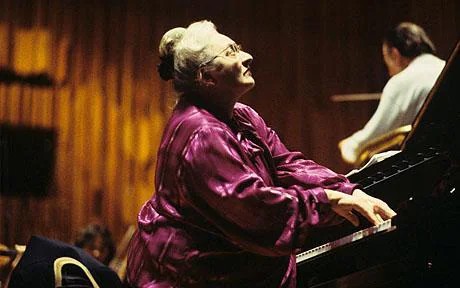
Yvonne Loriod
Loriod’s recorded legacy of Messiaen is truly expansive. Because Messiaen often wrote with her abilities specifically in mind, her recordings are widely regarded as reference performances. Two of her most influential contributions include Vingt Regards sur l’Enfant-Jésus and Catalogue d’oiseaux, but her discography covers preludes, études, and later solo works as well.
Messiaen’s Vingt Regards (1944) is one of the towering achievements of twentieth-century piano music. It is a sprawling, spiritually intense cycle of 20 movements that encompasses theological meditation, birdsong, and hyper-complex rhythmic and harmonic language. Loriod recorded Vingt Regards at least twice in studio settings (for Vega in 1956 and for Erato in 1974).
Her interpretations are distinguished by clarity of texture, rhythmic precision, and a deep understanding of Messiaen’s spiritual intentions. These recordings are often used as interpretive benchmarks. Messiaen himself consulted Loriod’s technical solutions and tempi on numerous occasions.
Critics and listeners note Loriod’s ability to balance the work’s vast architectural scope with moments of intimate reflection. In contrast, later pianists like Pierre-Laurent Aimard, himself a pupil of Loriod, adopt slightly broader conceptions by favouring a more measured pacing and detailed lyricism in different movements.
Olivier Messiaen: 20 Regards sur l’Enfant-Jésus – No. 6. Par Lui tout à été fait (Yvonne Loriod, piano)
Birdsong as Benchmark
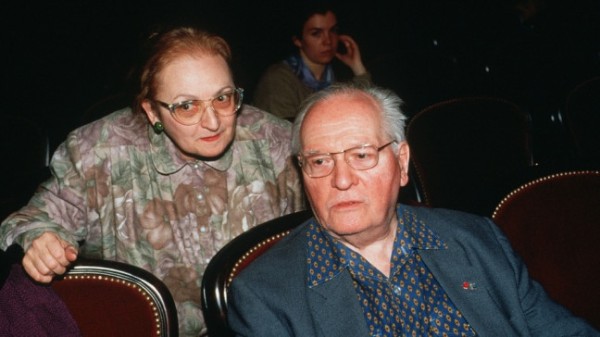
Yvonne Loriod and Olivier Messiaen
Written between 1956 and 1958 and dedicated to Loriod, Catalogue d’oiseaux is a monumental work comprising 13 pieces that evoke birds and landscapes of France. Loriod’s recordings of Catalogue (notably the 1970 Erato set) remain iconic. Her execution of the score’s rhythmic intricacies and timbral subtleties crafts a vivid acoustic world that listeners often describe as “immersive” and “breathtakingly precise.”
Her performances here are so definitive that even later recordings by pianists like Peter Hill, Anatol Ugorski, or Håkon Austbø, who all offer compelling interpretations, are often discussed relative to Loriod’s benchmark.
Where Loriod’s reading emphasises brilliant clarity and vibrant colour, others may foreground atmosphere or lyrical nuance, each approach revealing different facets of Messiaen’s language.
Olivier Messiaen: Catalogue d’oiseaux (Catalogue of Birds) – No. 1. Le Chocard des Alpes (Alpine Chough) (Yvonne Loriod, piano)
Late Style, Lasting Authority
In 1985 Messiaen wrote Petites Esquisses d’oiseaux, six short bird pieces, dedicated to and premiered by Loriod. Her recording of this set (with preludes and rhythm études on the same Erato album) captures the composer’s late style.
These bird pieces are condensed, playful, yet deeply characteristic. Later pianists such as Paul Kim, Fredrik Ullén, and Marie Vermeulin have recorded these pieces, offering fresh interpretive perspectives. Ullén’s version, for instance, highlights textural depth and modern sound aesthetics, while Loriod’s remains exemplary for capturing the work’s original idiom.
Additionally, Loriod recorded Messiaen’s Preludes and Études, further broadening her recorded representation of his piano oeuvre. These recordings consistently exhibit the hallmarks of her pianism, consisting of clarity of articulation, rhythmic poise, and a tonal palette that can range from luminous to incisive.
Olivier Messiaen: Petites esquisses d’oiseaux (Little Sketches of Birds): No. 1. Le rouge-gorge (Yvonne Loriod, piano)
Inheritance and Innovation
Because Loriod occupies such a central place in Messiaen’s performance history, it’s natural to compare her interpretations with other leading pianists who have since engaged with his music.
Pierre-Laurent Aimard was a student of both Messiaen and Loriod, and as such represents a direct artistic descendant. His recordings of Vingt Regards and other works are often compared with Loriod’s because of their intellectual rigour and structural clarity.
Where Loriod’s readings emphasise instrumental brilliance and visceral energy, Aimard often explores broader shaping and narrative continuity across movements. His typography of sound can be more contemplative and slightly less extroverted than Loriod’s, reflecting generational shifts in performance practice.
British pianist Steven Osborne brings a distinctive lyricism to Messiaen’s music. His Vingt Regards is noted for dynamic contrast and rhythmic flexibility, creating a meditative atmosphere that contrasts with Loriod’s electrifying precision.
Pierre-Laurent Aimard performs Messiaen: Catalogue d’Oiseaux (excerpt)
Many Voices, One Benchmark
Angela Hewitt, better known for Baroque and Classical repertoire, brings elegant touch and technical control to Messiaen’s pieces, offering listeners a clearer portrayal of the music’s harmonic architecture. Albeit with less of the flamboyant colour palette championed by Loriod.
There are many other accomplished Messiaen interpreters, including Roger Muraro (a direct Loriod protégé), Håkon Austbø, Peter Hill, Anatol Ugorski, and Joanna MacGregor, among them, with each exploring individual focus on lyricism, texture, or narrative pacing.
While none can match the historic authority of Loriod performing works she helped inspire, their interpretations expand the listener’s understanding of Messiaen’s piano oeuvre by approaching it with distinctive artistic personalities and modern sound aesthetics.
Olivier Messiaen: Preludes – No. 2. Chant d’extase dans un paysage triste (Song of Ecstasy in a Sad Landscape) (Angela Hewitt, piano)
An Enduring Voice
In Yvonne Loriod’s performances and recordings of Olivier Messiaen’s piano works, she forged an interpretive tradition that remains central to how audiences and pianists understand this repertoire. Her recordings of Vingt Regards sur l’Enfant-Jésus, Catalogue d’oiseaux, the Preludes, and later bird pieces are not only historical documents but interpretive ideals against which subsequent performances are measured.
Comparisons with later artists such as Aimard, Osborne, and Hewitt reveal both the continuity and evolution of Messiaen’s performance practice. While others may bring different emphases, Loriod’s recordings retain an aura of authenticity that few can surpass.
They reflect not just technical brilliance, but a lived intimacy with the music itself, born of decades of collaboration with the composer. In the ever-expanding landscape of Messiaen interpretation, Loriod’s voice remains an essential, inspiring guide.
For more of the best in classical music, sign up for our E-Newsletter