For one reason or another, I have not written nearly enough about Sir Simon Rattle. For a conductor who has shaped the sound of orchestral life in Europe for half a century, this silence is conspicuous.
On the occasion of his birthday on 19 January, I will try to rectify that omission with a portrait of a musician whose career has been defined less by authority than by curiosity, less by tradition than by his desire to keep music alive and socially engaged.
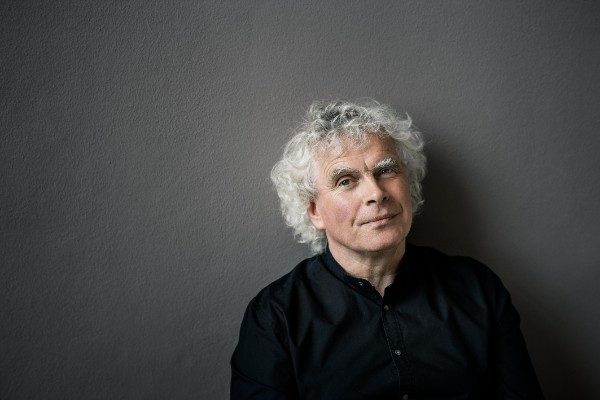
Sir Simon Rattle
Sir Simon Denis Rattle belongs to the rare category of conductors whose name is inseparable from institutions, yet never reducible to them. His career is often narrated through a sequence of prestigious posts in Birmingham, Berlin, and London.
A focus on appointments alone risks missing the deeper story. As a musician, Rattle has consistently treated orchestras as communities, programmes as arguments, and the concert hall as a place where the past must justify itself to the present.
Sir Simon Rattle conducts Mahler: Symphony No. 7, (Excerpt)
From Percussion to Partnership
Rattle’s musical origins already hint at the conductor he would become. Raised in Liverpool, he began as a percussionist, studying at the Royal Academy of Music. This background sharpened his sense of rhythm, colour, and texture, particularly in twentieth-century music.
He was still a student when he won the John Player International Conducting Competition in 1974, a success that led almost immediately to professional engagements. Yet Rattle’s early rise was not that of a wunderkind parachuted into elite orchestras.
Instead, his career developed through long-term relationships, the most formative of which began in 1980, when he was appointed Principal Conductor of the City of Birmingham Symphony Orchestra (CBSO) at the age of twenty-five.
Vision Before Glamour
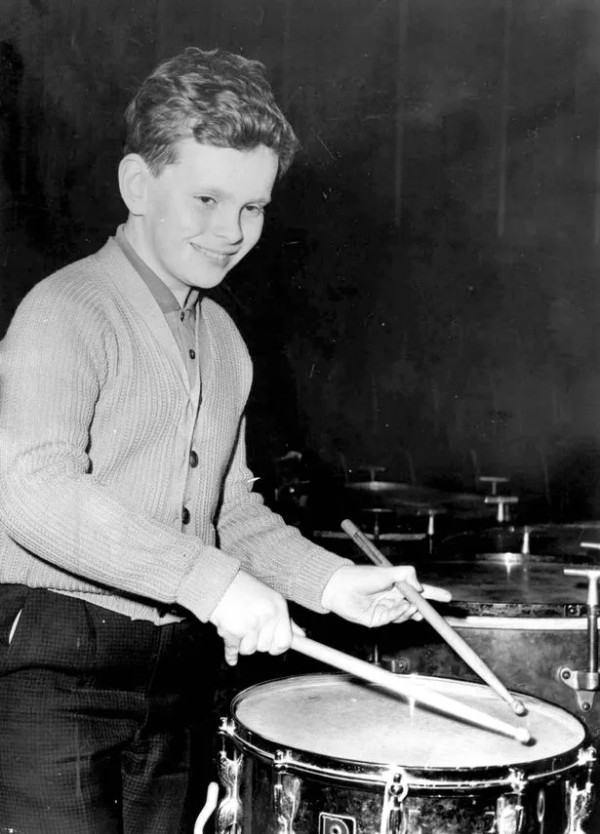
The young Simon Rattle
For a good many observers, the Birmingham years between 1980 and 1998 remain one of the most remarkable conductor-orchestra partnerships of the late twentieth century. As Norman Lebrecht has argued, “Rattle’s Birmingham project was the most important British conducting story since Beecham. It proved that vision, not glamour, builds orchestras.”
The CBSO was a competent regional ensemble when he arrived, but an internationally admired orchestra with a distinctive profile when he left. What distinguished Rattle’s leadership was not only technical improvement but conceptual ambition.
He programmed Mahler and Bruckner alongside Ligeti, Henze, and Turnage, treating twentieth-century music not as an obligation but as a living tradition. He also insisted that audiences could be educated without being patronised.
Recordings from this period announced a conductor of intellectual seriousness and emotional directness. As Andrew Porter suggested in The New Yorker, “what Rattle achieved in Birmingham was not simply a raised standard but a new expectation of seriousness, curiosity, and civic pride.”
But what is more, Sir Mark Elder opined, “Rattle changed the psychology of British orchestral life. He made ambition feel normal.”
Sir Simon Rattle conducts Sibelius: Symphony No. 7
Mahler and the Refusal of Monumentality
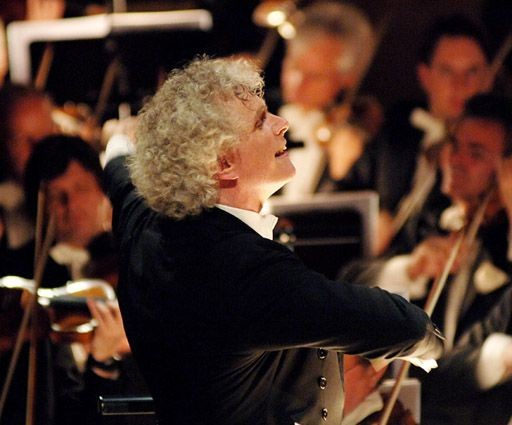
Sir Simon Rattle
Throughout his career, Rattle has been closely associated with Gustav Mahler, whose music has served as both repertoire and philosophy. Rattle’s Mahler avoids monumental heaviness and foregrounds transparency, irony, and fragility.
As Stephen Johnson suggests, “Rattle hears Mahler as a modernist first and a Romantic second. That reversal explains both the clarity and the controversy of his interpretations.”
Equally central has been Rattle’s advocacy for contemporary music. From early champions such as Messiaen and Lutosławski to later collaborations with composers including Thomas Adès, Mark-Anthony Turnage, and Georg Friedrich Haas, Rattle has consistently argued that modern music belongs at the centre of orchestral life.
This commitment has sometimes unsettled traditionalists, but it has also ensured that his concerts rarely feel like museum exhibits. For Rattle, repertoire is not a canon to be preserved intact, but a conversation to be continued.
Sir Simon Rattle conducts Ligeti: Atmosphères
Berlin and the Problem of Inheritance
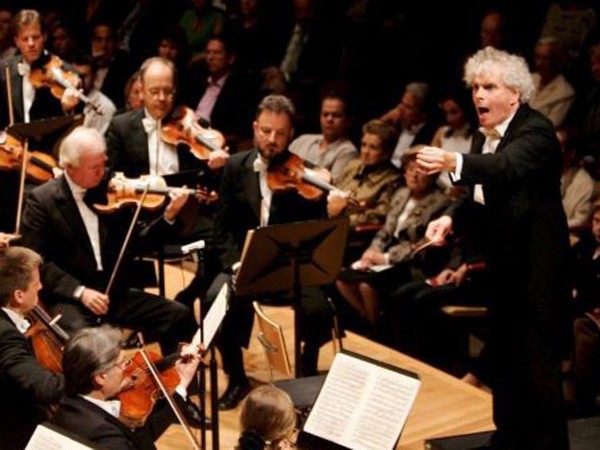
Sir Simon Rattle conducting the Berlin Philharmonic
Rattle’s appointment as Chief Conductor of the Berlin Philharmonic in 2002 marked a historic transition. He was the first British conductor to lead the ensemble, and he inherited an institution long associated with the authoritative models of Wilhelm Furtwängler and Herbert von Karajan.
From the outset, Rattle sought to redefine leadership. He renegotiated the orchestra’s governance structure, promoting greater financial transparency and collective responsibility. Artistically, he broadened the repertoire, bringing early music, contemporary works, and staged projects into an orchestra famed for its burnished Romantic sound.
His Berlin recordings ranged from Beethoven and Brahms to Haydn, Debussy, and the Second Viennese School. Not all were universally praised, but even dissent acknowledged the seriousness of the project. Alex Ross has written that “Rattle’s Berlin was never about inheriting a sound. It was about opening windows, sometimes to bracing effects.”
Beyond the concert hall, his work with the Berlin Philharmonic’s education programme set new standards for outreach, insisting that elite orchestras must engage with broader society without diluting artistic standards. As Sir Nicholas Kenyon suggested, “Rattle’s greatest legacy may be his insistence that education is not an adjunct to musical excellence but a condition of it.”
Sir Simon Rattle conducts Berlioz: Symphonie fantastique
Returning Home and Looking Forward
In 2017, Rattle returned to the UK as Music Director of the London Symphony Orchestra (LSO). The move was widely celebrated, though tinged with frustration at the ongoing absence of a purpose-built concert hall for London. Rattle made no secret of his belief that infrastructure matters, as musicianship flourishes when institutions are properly supported.
With the LSO, he has pursued a repertoire that mirrors his career-long interests. We find large-scale symphonic works, choral music, twentieth-century classics, and ambitious contemporary commissions. His performances of Berlioz, Mahler, and Janáček have been particularly admired, as have his explorations of English music beyond the usual ceremonial staples.
If Berlin represented an experiment in democratic leadership, London has felt more like a homecoming with unfinished business, framed as an attempt to apply decades of international experience to a musical culture still negotiating its own priorities.
Listening as Leadership
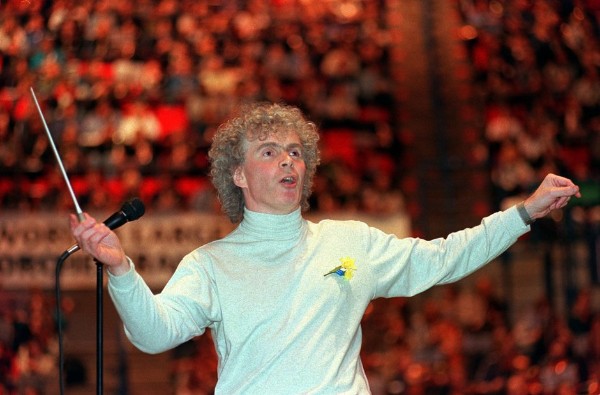
Sir Simon Rattle conducting the City of Birmingham Symphony Orchestra
Physically, Rattle is an unmistakable presence on the podium. He is animated, expressive, sometimes almost conversational in gesture. Yet his style has mellowed over time. The hyper-energetic figure of the 1980s has evolved into a conductor whose movements suggest listening as much as commanding.
This evolution reflects a deeper philosophy. Rattle has repeatedly rejected the myth of the conductor as autocrat. He speaks instead of collaboration, of shaping sound together, of creating conditions in which musicians take responsibility for the result.
Richard Taruskin suggested that “Rattle represents a post-heroic model of conducting: less command-and-control, more cultural mediation.” That this approach has succeeded with some of the world’s most formidable orchestras is itself a significant achievement.
Rattle’s discography is vast and uneven by design. He has recorded complete cycles, but has never treated the “complete cycle” as an end in itself. Many of his most enduring recordings are those that feel exploratory rather than definitive.
Franz Joseph Haydn: Symphony No. 60 in C Major, Hob.I:60, “Il distratto”, “Der Zerstreute” (City of Birmingham Symphony Orchestra; Simon Rattle, cond.)
The Long Argument
His legacy, however, extends beyond recordings. It lies in the redefinition of what a modern conductor can be, one that encompasses education, advocacy, and collaboration. If I have written too little about him in the past, it may be because his work resists easy summarisation.
Rattle has shown that authority need not be inherited, that tradition can be interrogated without being discarded, and that orchestral music remains a living art only if it continues to take risks.
To listen to Rattle at his best is to hear a convincing argument made in sound. Music matters not because it is old or prestigious, but because it remains capable of surprising us. As Kate Molleson put it in The Guardian, “Rattle understands that orchestras survive not by defending tradition but by explaining why it matters.”
For more of the best in classical music, sign up for our E-Newsletter