Composer Johannes Brahms was famous for being a prickly, sarcastic bachelor. However, despite his gruff exterior, he did harbour tender feelings for a number of women throughout his life.
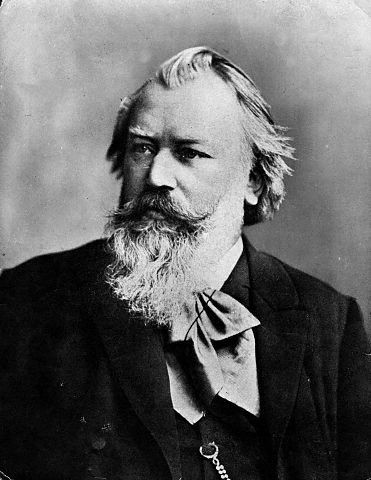
Johannes Brahms
Many of the women he fell for were musically talented. Mezzo-soprano Alice Barbi, who became a confidant of Brahms’s around 1890, was no exception.
Today, we’re looking at Alice Barbi’s art, her relationship with Brahms, and her life beyond him.
Childhood and Musical Training
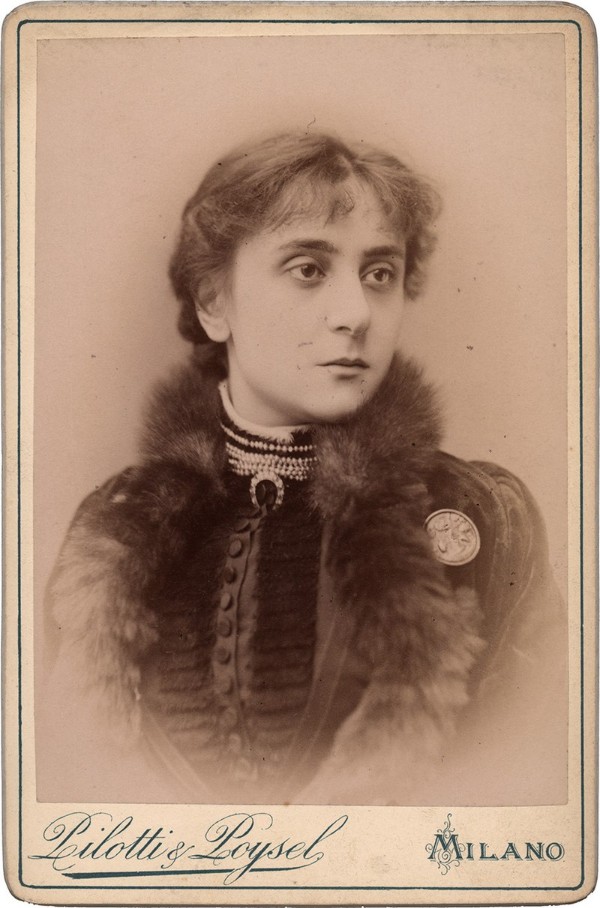
Alice Barbi
Alice Barbi was born on 1 June 1858 in Modena, in present-day northern Italy.
She showed musical promise at a young age and began taking violin lessons from her father. She made her public debut as a violinist when she was just seven years old.
Later, she studied at the conservatory in Bologna. There, she decided to focus on studying voice instead of the violin. She studied with Luigi Zamboni, the creator of the role of Figaro in Rossini’s opera The Barber of Seville, as well as Luigi Vannuccini, a violinist, conductor, composer, and professor.
Beginning Her Career
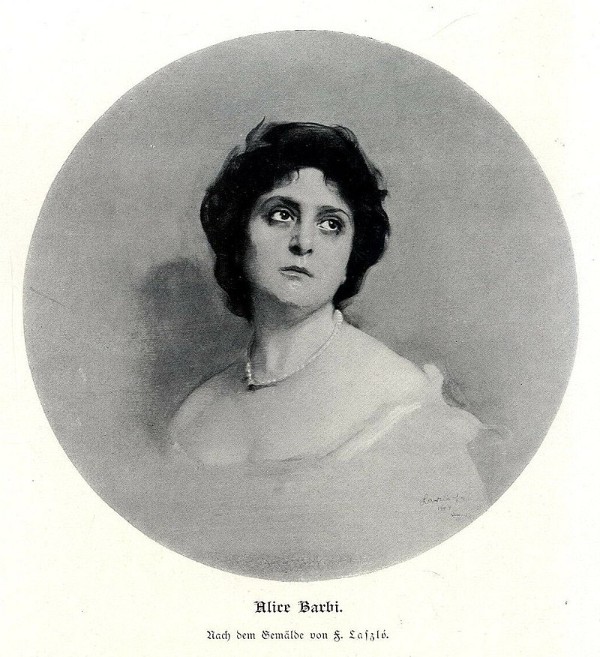
Alice Barbi
Barbi made her debut at the Quirinal Palace in Rome alongside two famous Italian musicians: Antonio Cotogni, one of the greatest baritones of his generation, and Giovanni Sgambati, a pianist, conductor, and composer who would later bring Beethoven’s symphonies to Italy.
She made her public debut in Milan at La Scala in April 1882, when she was twenty-three years old.
Beginning in the 1880s, she embarked on tours of Europe, traveling through Austria, Germany, England, and Russia. She mainly toured as a vocalist but also occasionally appeared as a violinist.
Arriving in Vienna and Connecting With Brahms
In March 1889, the year she turned thirty-one, she appeared as a vocalist in Vienna. One of the composers she sang was Brahms. She presented works from his op. 3 and op. 84.
Brahms’s Liebestreu, Op. 3, No. 1
She remarked to a pianist friend, “The more I sing him, the more I love him; he really is a special world all by himself.”
Brahms didn’t hear that particular performance, but soon the two became friendly acquaintances.
Brahms Becomes Smitten
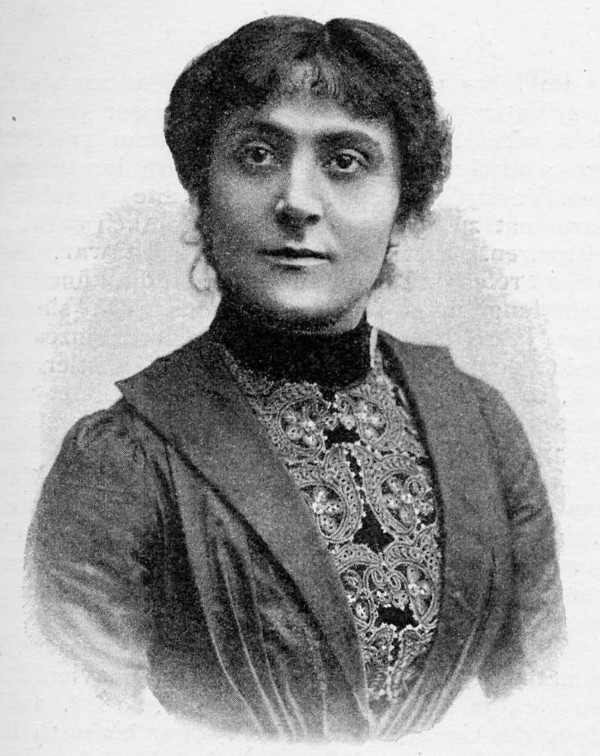
Alice Barbi
Brahms’s head was always turned by a pretty face, which Barbi undoubtedly had. But he was also taken by Barbi’s artistry.
In the fall of 1890, he wrote to a friend:
From somebody like Barbi we can all learn! Above all, the Italian lady sings supremely steadily, with a solid pulse, and…projects the structure of every piece she sings. Really, we all just fool around at the piano!
He pointed out that perhaps it takes an intelligent woman from another country to best interpret well-known German song by Schubert and Schumann, her specialities:
Most Germans make music in a dressing gown! We know all these tunes so thoroughly, we know the bass, the chords, and then we just doze off on them. From Barbi you can learn a lot, a lot!
Brahms didn’t hear Barbi sing his own works until 1892. That proved to be a watershed moment for him, both personally and professionally. He went so far as to declare, “Today I’ve heard my songs for the first time!” and “If I were still young, I would now write love songs.”
He also extended a great honour to her: a special introduction to his best friend, legendary pianist Clara Schumann. Barbi reportedly enjoyed meeting her very much, especially since she specialised in singing songs by Clara’s late husband, Robert.
A Flirtation Starts
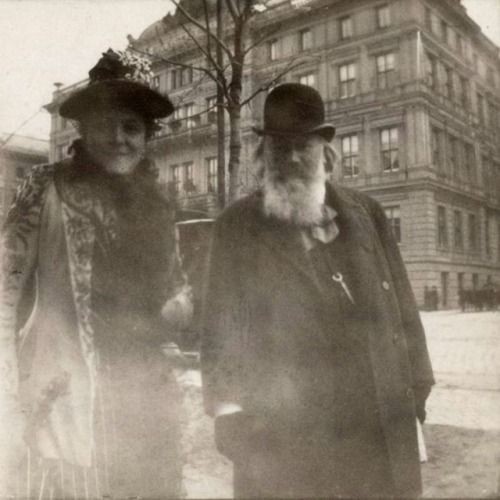
Alice Barbi and Brahms in 1892
Brahms and Barbi began appearing together in public in Vienna in the early 1890s, and people started taking note.
Austrian critic Max Graf wrote of their relationship during this time:
Brahms had come with Alice Barbi to the “Schrammeln” to show her the popular Viennese musicians and typical Viennese popular playing.
It was not difficult to see that Brahms was not merely being a polite host to Barbi; he was captivated by her.
Usually a somber man, he was in good spirits, his face wreathed in smiles and completely engrossed in this great artist and beautiful woman.
He doted upon her, and one would have had to be blind not to have seen his devotion and pleasure in her company.
Sitting at cafes in the Prater park, Vienna residents witnessed Brahms enthusiastically singing along to the chorus of the American vaudeville song “Ta-ra-ra Boom-de-ay,” accompanying the Boom in the lyric with a whack of his umbrella…to Barbi’s delight.
Was It More Than a Crush?
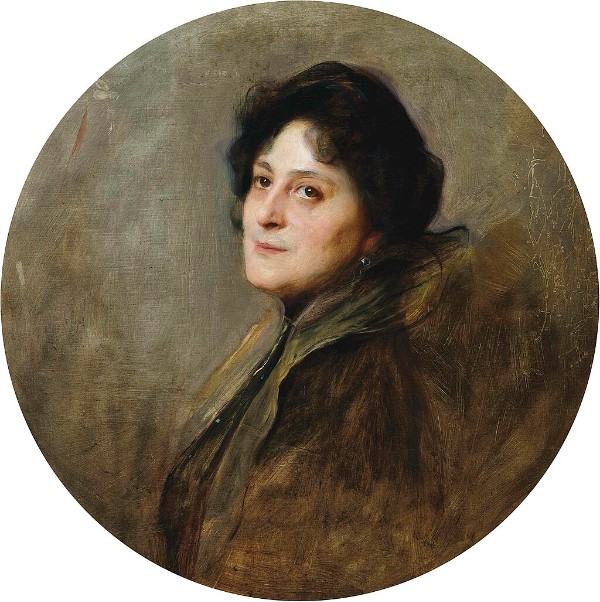
Portrait of Alice Barbi in 1901
Did Brahms’s clear attraction ever become more than a crush?
Brahms would later confess to his friend Ignaz Brüll that he thought about marrying Barbi. Brüll actually believed Brahms asked for her hand.
But according to Brüll’s wife, Barbi wanted children, and Brahms didn’t. It was a deal-breaking incompatibility.
Regardless of what happened between them, if the situation ever became awkward, they both quickly moved past it and remained friends.
Her Final Professional Appearance in Vienna
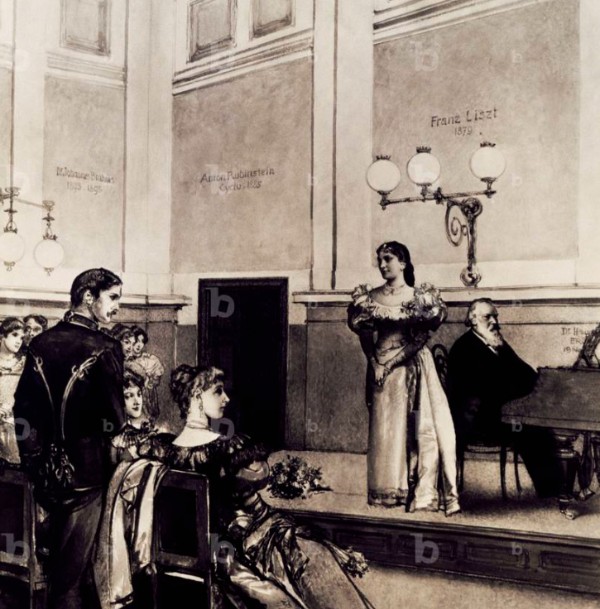
Alice Barbi and Brahms in recital
In January 1894, she married a Baltic-German nobleman named Baron Boris von Wolf-Stomersee, who had worked in the Russian Imperial Court.
Max Graf wrote of the final appearance before her marriage:
We young admirers of Alice Barbi would not have missed the…concert for anything in the world and stood waiting for her appearance.
Finally, the door to the stage opened and Barbi came out dressed in one of the simply-cut white gowns which she always wore, her black hair knotted softly, and behind her, to our surprise, and the surprise of the whole audience, in the place of the usual accompanist, came Brahms.
He was somewhat at a loss, and came on the stage with the awkwardness of a great Newfoundland dog following its mistress.
Later, we were told that Brahms appeared unannounced at the singer’s dressing room and astounded her by saying that he wished to accompany her at the piano.
That night, the audience not only heard Brahms’ most beautiful songs sung by Barbi but played by the composer himself.
They performed four together, including “Der Tod, das ist die Kühle Nacht” (“Death is the Cold Night”) from his op. 96.
Both artists’ minds were preoccupied by thoughts of death at the time. Brahms was nearing the end of his life (he would die in 1897), and this would be one of his last appearances in public as a pianist. Barbi was also facing a sobering ending: the death of her professional career. Like so many female performing artists of this era, she decided to retire after her marriage.
Brahms: “Der Tod, das ist die Kühle Nacht” Op. 96/1. Hagar Sharvit & Ammiel Bushakevitz
Fundraising for the Brahms Monument
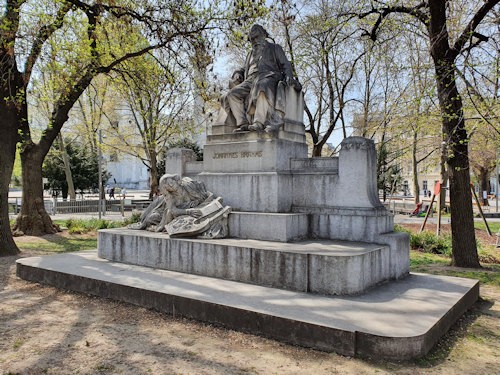
Monument of Johannes Brahms
Even after his death, Barbi didn’t forget Brahms.
Throughout the late 1890s and early 1900s, she appeared in Vienna to raise money for a monument to her old friend.
A Vienna correspondent from The Musical Times and Singing Class Circular wrote in 1902:
The good time when Brahms was still with us is recalled in a special manner by the reappearance here of a great artist and friend of his, Alice Barbi.
She is once more giving two concerts in aid of the Brahms monument fund, and enormous crowds are availing themselves of the opportunity of hearing her, for she unites in herself the superlative charms of an incomparable vocal art and of a most interesting, irresistibly attractive personality.
If, in the course of a year or two, a worthy monument should be erected to Brahms in the city where he was such a familiar figure, a conspicuous share in the realisation of it will have to be conceded to Alice Barbi.
The monument was indeed built in 1908 on the Karlsplatz, near the Musikverein concert hall. You can go visit it today.
Barbi’s Children
After her marriage, Barbi had two daughters in rapid succession.
Her eldest was Alexandra von Wolff-Stomersee, born in November 1894. She would become a well-known psychoanalyst.
Her second daughter, Olga, was born in 1896. Olga married a diplomat and had a son named Boris Bianchi, who was active in Italian and European politics in the twentieth century.
During his marriage, the Baron focused on overseeing his estates. Barbi became interested in her husband’s interests, studying sciences like cattle raising and drainage. She would later remember this time:
I went about the vast heaths and marvelous huge forests, with my head still full of song, my thoughts often turning to my own beloved, beautiful country, firmly determined to improve the lives of so many human beings, to succeed in what seemed to me a worthwhile mission…
She kept up her intellectual pursuits by regularly studying literature, including works from the Italian Renaissance.
Barbi’s Second Marriage
The baron died in 1917.
In 1920, the 62-year-old Barbi married 44-year-old politician Pietro Tomasi Della Torretta, who would become the Italian ambassador to Britain after World War I.
Torretta went on to become an opponent of fascism in Italy. In 1944, after fascism collapsed in the country, he became President of the Italian Senate for a time.
Alice died in September 1948, a few years after the end of World War II. She was ninety years old.
Remembering Alice Barbi
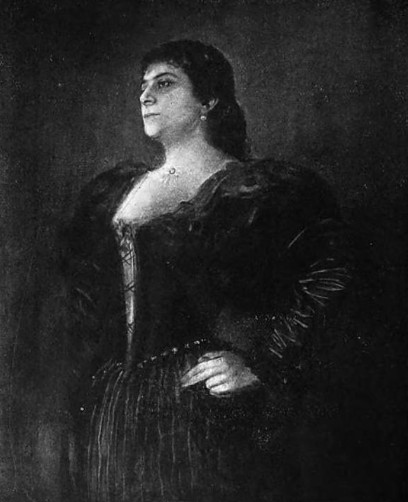
Alice Barbi
In 1914, Barbi’s agent, Albert J. Gutmann wrote of her:
There was a harmoniousness in her soul, in her heart, in her physical appearance, in her artistic performances. And this harmoniousness, which emanated from her like a magical charm, communicated itself in the concert hall also to the listener, to the entire audience.
Today, Alice Barbi is best remembered for being Brahms’s final love, but she was a fascinating artist and human being in her own right.
For more of the best in classical music, sign up for our E-Newsletter