In the world of classical music, dedications can serve as a window into a composer’s life, telling us who they cared about or who they wanted to impress…or both.
Today, we’re looking at the best piano sonatas dedicated to women and the stories behind each one.
Haydn: Piano Sonata No. 33, Hob. XVI/20 (1771)
Dedicated to Marianna Auenbrugger
This is the first work that Haydn wrote that he dubbed a sonata. It’s delightfully dynamic and dramatic.
In fact, in 2011, Gramophone went so far as to call it “one of Haydn’s best and perhaps also the first great sonata for the piano by anybody.”
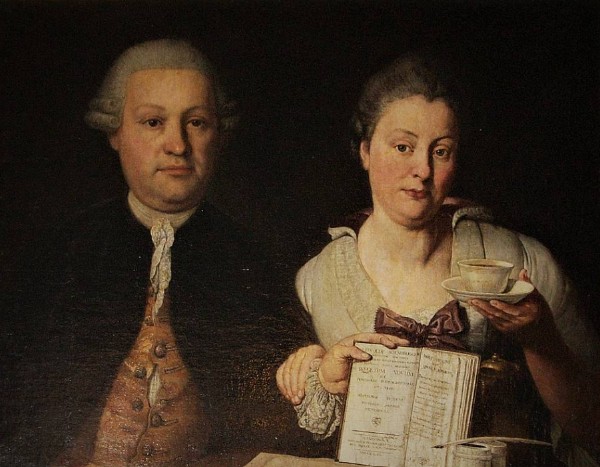
Marianna Auenbrugger and her father
When Haydn published it in 1780, he dedicated it to Marianna Auenbrugger, one of two musical sisters who lived in Vienna.
Marianna studied keyboard with Haydn and Salieri. She also composed. After her death, Salieri paid to have one of her keyboard sonatas published at his own expense.
The technical assurance and elegance required by this Haydn sonata suggest that he viewed Marianna Auenbrugger as a formidable musical force.
Mozart: Piano Sonata No. 14 (1784)
Dedicated to Theresia von Trattner
Mozart composed this stormy sonata for one of his most noteworthy students: Theresia von Trattner.
Theresia (like Mozart) was born in 1756. When she was eighteen, she married a wealthy 59-year-old printer, publisher, and landlord named Johann Thomas Trattner. She went on to have ten children with him.
Despite the demands of motherhood, she continued studying music. She became a pupil of Mozart’s in 1781. That steady income was one of the reasons he was able to establish himself in Vienna after fleeing his hometown of Salzburg.
In 1784, he moved into the building that her husband owned and received a discount on rent.
Although they were never romantically involved, they each provided invaluable support to one another.
Mozart dedicated this sonata to her, as well as his equally dramatic Fantasia in C-minor (K. 475).
Musicologist Ludwig Ritter von Köchel wrote about this sonata:
“Without question, this is the most important of all Mozart’s pianoforte sonatas. Surpassing all the others by reason of the fire and passion which, to its last note, breathes through it, it foreshadows the pianoforte sonata, as it was destined to become in the hands of Beethoven.”
Beethoven: Piano Sonata No. 14 (1802)
Dedicated to Julie Guicciardi
Like Mozart, Beethoven dedicated his fourteenth piano sonata to one of his students: Countess Julie Guicciardi.
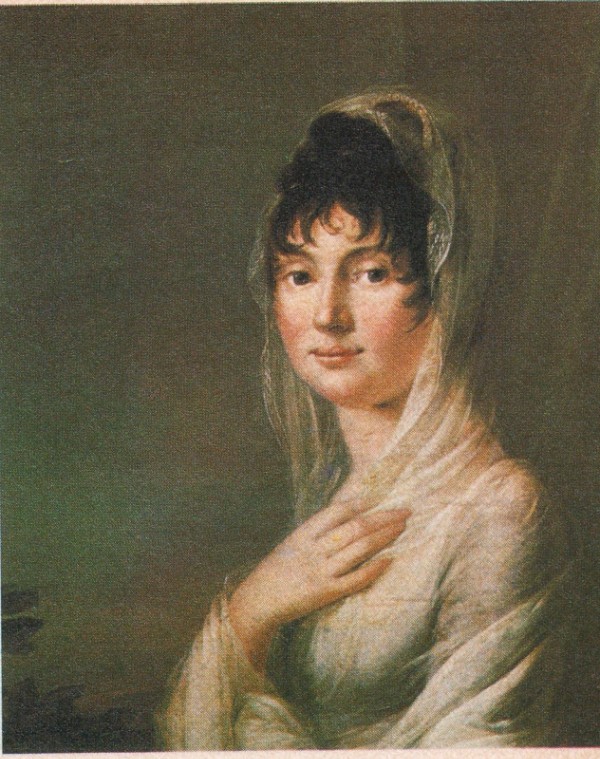
Julie Guicciardi
She was a 16-year-old aristocrat who had recently moved with her family to Vienna. Many believe that the 31-year-old Beethoven fell in love with her.
We have no way of knowing if she returned his affections. But even if she had, their difference in social class would have made their marriage scandalous.
Beethoven published the sonata in 1802. He didn’t write it with her in mind, but when it came time to publish it, he dedicated it to her.
The following year, she accepted a proposal by Count Wenzel Robert von Gallenberg, an aristocrat and amateur composer who had studied with one of Beethoven’s teachers.
Schumann: Piano Sonata No.2 (1839)
Dedicated to Henriette Voigt
Henriette Voigt and Robert Schumann befriended each other in 1834 and quickly became good friends.
That September, a 15-year-old Clara Wieck (soon to be Clara Schumann) joined the mutual admiration society, writing in her diary that Henriette was “a highly educated and amiable woman.”
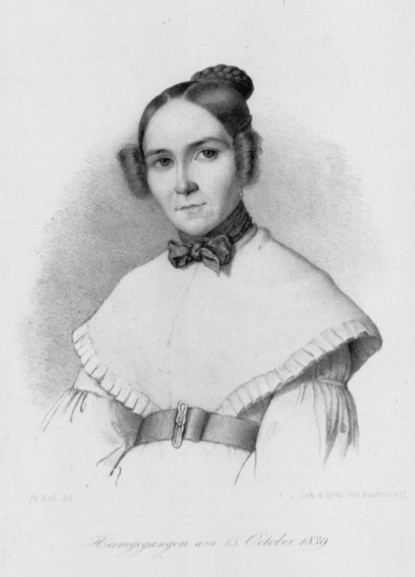
Henriette Voigt
She was a talented pianist who played Robert’s works in private settings, albeit shyly. Robert wrote of her, “She played correctly, gracefully, with obvious pleasure, but not without some fearfulness when other people were listening.”
The second sonata dates from between 1830 and 1834, but it was only published in 1839. When it was, Schumann chose to dedicate it to Henriette.
Tragically, Henriette died in October 1839 of tuberculosis. She was just thirty years old. She left behind two little daughters. She named Felix Mendelssohn as godfather to one and Robert Schumann as godfather to the other.
Brahms: Piano Sonata No. 3 (1853)
Dedicated to Ida von Hohenthal
Remarkably, Johannes Brahms was just 20 years old when he composed his monumental Third Piano Sonata.
He dedicated it to Countess Ida von Hohenthal, an aristocrat based in Leipzig.
For many years, historians were puzzled at the dedication, since the historical record didn’t seem to suggest much of a relationship between the two.
However, it has recently been discovered that the countess had hired Johannes’s 18-year-old brother, Fritz, as music master. It is now believed that this dedication is a thank-you to her for helping his family.
Unfortunately, Fritz turned out to be less musically talented than his brother. Brahms’s longtime friend Clara Schumann once wrote about him, “On the whole, though, [Fritz] possesses quite a good technique, only I find his playing so very dull.”
Bax: Piano Sonata No. 3 (1926)
Dedicated to Harriet Cohen
Harriet Cohen, born in 1893, was one of the great British pianists of her generation. She studied at the Royal Academy of Music and made her Wigmore Hall debut in 1920.
Over the course of her life, she had many romantic or flirtatious relationships, including one with Prime Minister Ramsay MacDonald.
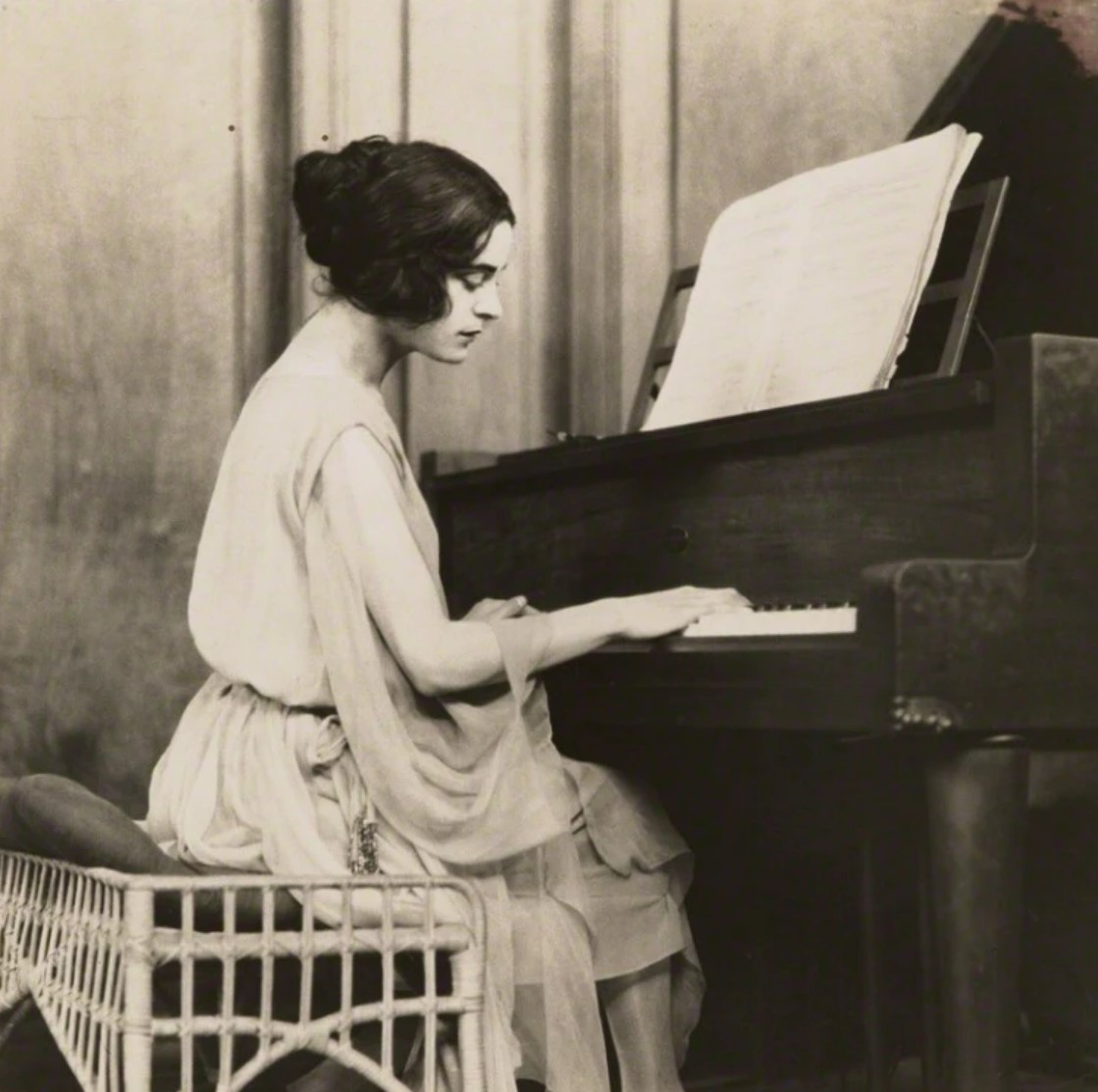
Harriet Cohen, ca 1921
However, the love of her life was composer Sir Arnold Bax. Their relationship began in 1914 when she was 19 and he was 31 (and married), and continued on-and-off for over thirty years.
Bax was deeply inspired by Cohen personally and professionally, and wrote a number of works for her. The best example of their creative partnership was arguably this piano sonata, which dates from 1926.
It’s a dark, sweeping, dramatic work, and it’s easy to imagine that Bax and Cohen’s stormy affair provided the inspiration for it.
Prokofiev: Piano Sonata No. 8 (1944)
Dedicated to Mira Mendelson
Prokofiev’s eighth piano sonata is also dedicated to a love interest: Mira Mendelson, the young poet who would soon become his second wife.
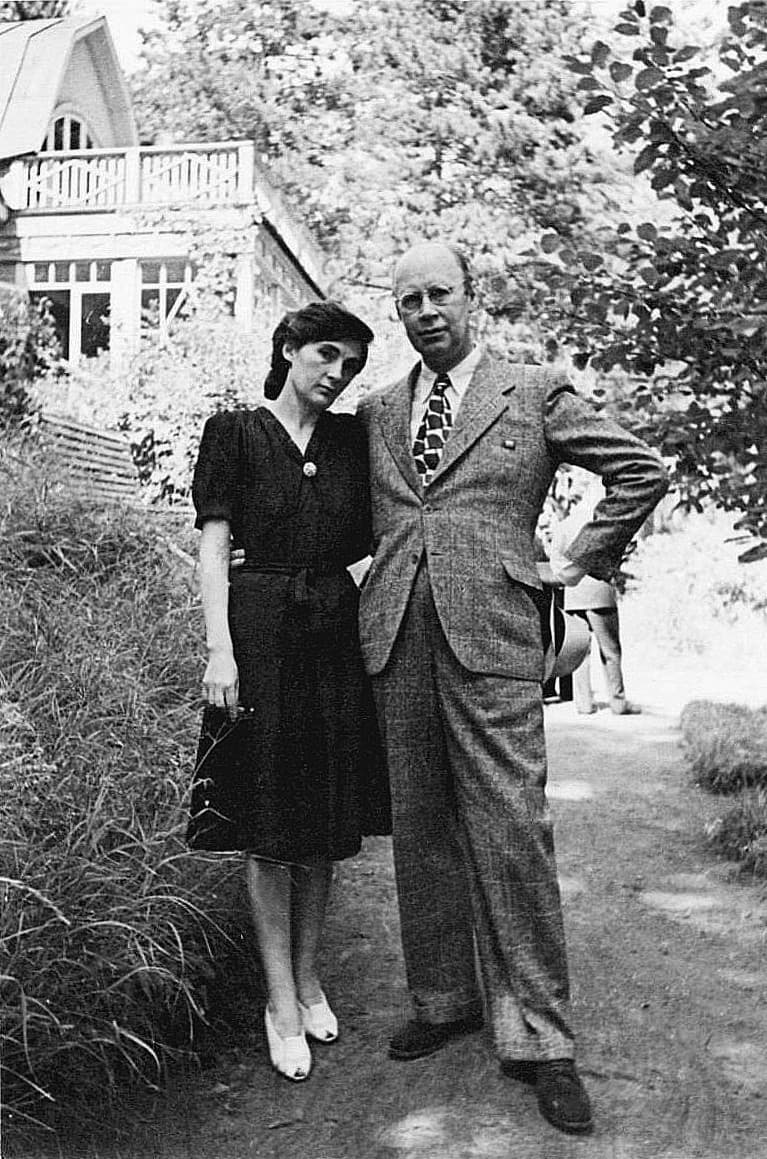
Mira Mendelson and Prokofiev
The couple had originally met in August 1938, when their families were on vacation. A year later, they were appearing in public together, much to the despair of Prokofiev’s first wife, Lina.
War interrupted the official granting of a divorce, but in the spring of 1941, Prokofiev announced to Lina that their marriage was over.
All of these stormy circumstances and emotions – deadly wartime violence combined with domestic uncertainty, the influence of new love, and the conflict leading to the end of a marriage – are reflected in the sonata.
For more of the best in classical music, sign up for our E-Newsletter