Jackson Pollock’s Autumn Rhythm Inspires Composer Camille Pépin
American artist Jackson Pollock (1912–1956) created Autumn Rhythm (Number 30) in his studio in Springs, New York, working with an unprimed canvas on the ground while he poured and scattered paint on it.
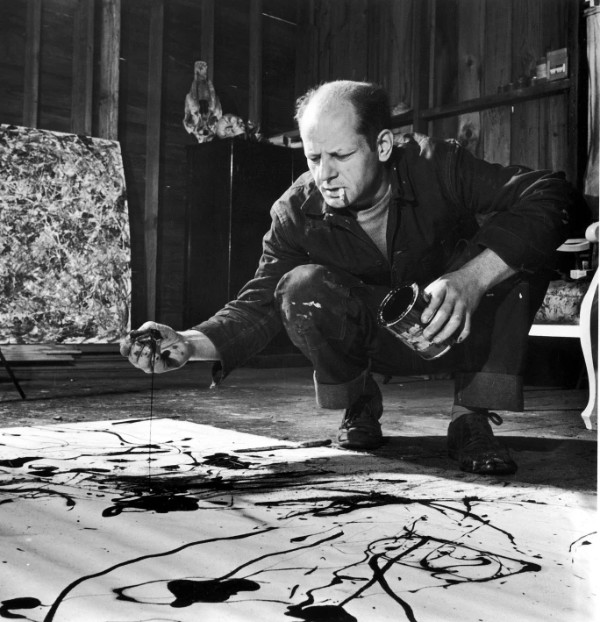
Pollock at work (Photo by Martha Holmes)
The painting is not only done in black and white but also has browns and a small amount of teal blue. He started with black in the right third of the canvas before adding the other colours. He both dripped and puddled paint. Once the right side was completed, he went on to the centre and finished on the left-hand side. Since the canvas was on the floor, he could apply paint from any direction.
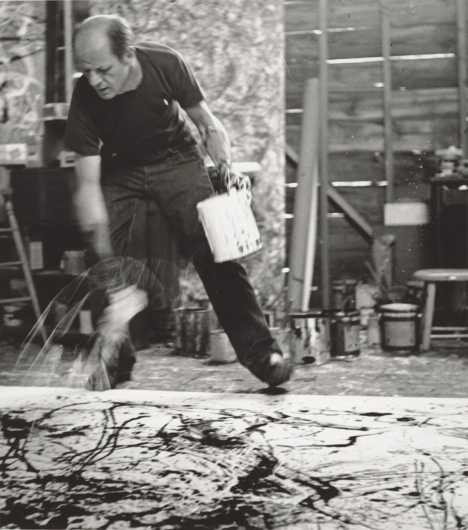
Hans Namuth: Jackson Pollock, 1950 (Center for Creative Photography, University of Arizona)
The original title of the work, at its first exhibition in 1951, was Number 30. Pollock didn’t use titles except for numbers between 1947 and 1952 so as to avoid distracting viewers with implied meanings. The numbers were not applied sequentially.
When the painting was exhibited again in 1955, it then carried the title Autumn Rhythm, which scholars believe came from Pollock.
The photographer Hans Namuth was permitted to photograph Pollock at work and documented the creation of Number 30.
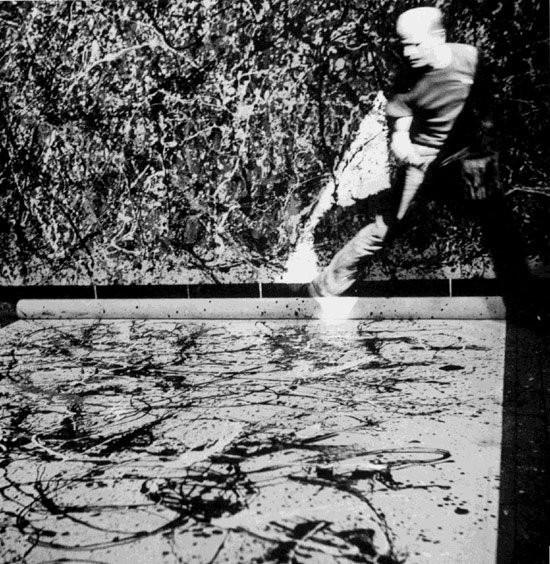
Hans Namuth: Pollock creating Number 30, 1950 (Pollock-Krasner House) (Center for Creative Photography, University of Arizona
In this 1951 film by Namuth, he documents Pollock at work, overvoiced by Pollock describing his method and beliefs. The music is by Morton Feldman. The film was shot outdoors because Namuth could not afford studio lighting to shoot indoors.
Hans Namuth: Jackson Pollock 51
The Metropolitan Museum acquired the painting in 1957, following the artist’s early death at age 44.
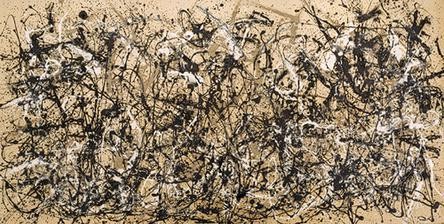
Pollock: Autumn Rhythm (Number 30), 1950 (Metropolitan Museum of Art)
The French composer Camille Pépin (b. 1990) merges French impressionism and American minimalism. Her work, Autumn Rhythm, inspired by Pollock’s work, was commissioned by the Long-Thibaud-Crespin Competition for their Concours Violin in 2018. Dmitry Smirnov was awarded the violin prize.
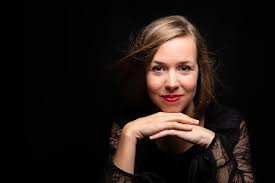
Camille Pépin
Just as Pollock intertwined the threads of paint in his image, Pépin imagines a whirlwind of autumnal colours: black, brown, ochre, and white.
Camille Pépin: Autumn Rhythm (Dmitry Smirnov, violin; Marco Scilironi, piano)
The music draws the listener inside the painting and the hypnotic and engrossing rhythms captures the listener. Light tries to penetrate the foliage and only occasionally makes a successful beam. The violin and piano intertwine in their rhythms and layers. The technique required of the violinist include sul tasto (playing on the fingerboard), flautando (another technique of playing on the fingerboard to create a flute-like tone), harmonics, and left-hand and right-hand pizzicati. The pianist makes adroit use of the pedal to soften the percussive edges. The perpetual motion of the music carries us around the painting, arching and splashing with Pollock.
For more of the best in classical music, sign up for our E-Newsletter