Between 1617 and 1621, the English writer Robert Fludd (1574–1637) produced his Utriusque Cosmi, Maioris scilicet et Minoris, metaphysica, physica, atque technica Historia (The metaphysical, physical, and technical history of the two worlds, namely the greater and the lesser). Fludd was a physician, an astrologer, a mathematician, and a cosmologist. After he left Oxford in 1598 with his M.A. in medicine, Fludd travelled the continent, touching down in France, Spain, Italy, and Germany. When he returned to England in 1604, he pursued his medical degree further and was awarded his M.D. in 1605.
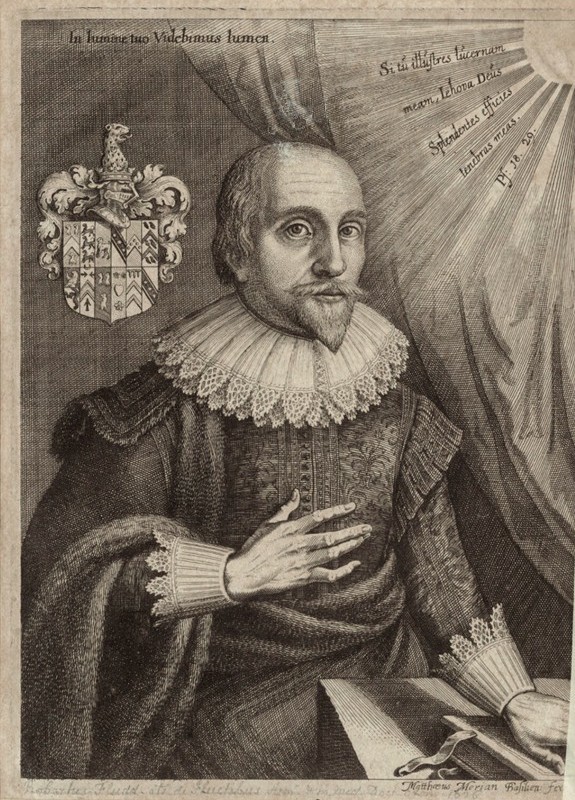
Matthäus Merian the Elder: Robert Fludd, early to mid-17th century
Moving to London, he became a prosperous physician, serving as Censor of the London College of Physicians 4 times between 1618 and 1634. He was one of the authors of the Pharmacopoeia Londinensis in 1618, the directory of standardised pharmaceutical preparations as given by the London College. One of his most important contributions was being one of the first to support, in print, William Harvey’s theory of the circulation of the blood.
Henry Purcell: Sir Anthony Love, Z. 588, “The Rambling Lady” – Overture (Aradia Ensemble, Ensemble; Kevin Mallon, cond.)
His great work was the Utriusque Cosmi, Maioris scilicet et Minoris, metaphysica, physica, atque technica Historia. In it he discusses, literally, everything under the sun: from the organisation of the heavens (with a wonderful earth-centric etching), scientific instruments, mathematics, and so on. It is in book three that he starts to talk about music. He developed a monochord (a single-stringed instrument) where he related the pitches to the design of the universe. The notes of the scale (on the right-hand side of the string) are related to the elements earth, water, air, fire, then the planets, with the Sun as the octave G above the first G (earth). The linking curves from the note names indicate intervals. Note that the monochord is being tuned by heaven itself.
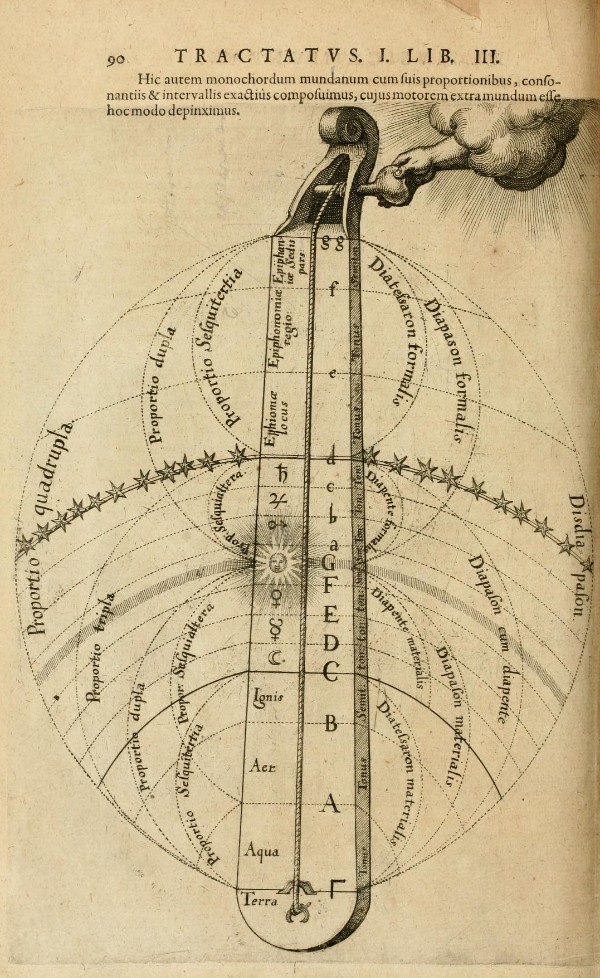
Fludd: Utriusque Cosmi…., Tract 1, Book 3, p. 90
In the second tract, he takes up the mathematics of music, starting with discussions of Pythagoras and the sounds of different-sized hammers on an anvil. This comes from Nicomachus’ story in his Enchiridion harmonices (dating from the 2nd century CE). This was Pythagoras’ discovery of tuning, which turns out to be a Middle Eastern folk tale, but with his monochord, Fludd could replicate Pythagoras’ discovery. This was part of the cosmology of discovering that the world was made of numbers.
Finally, we arrive at the second part of Tract 2: The Temple of Music (pp. 159 ff).
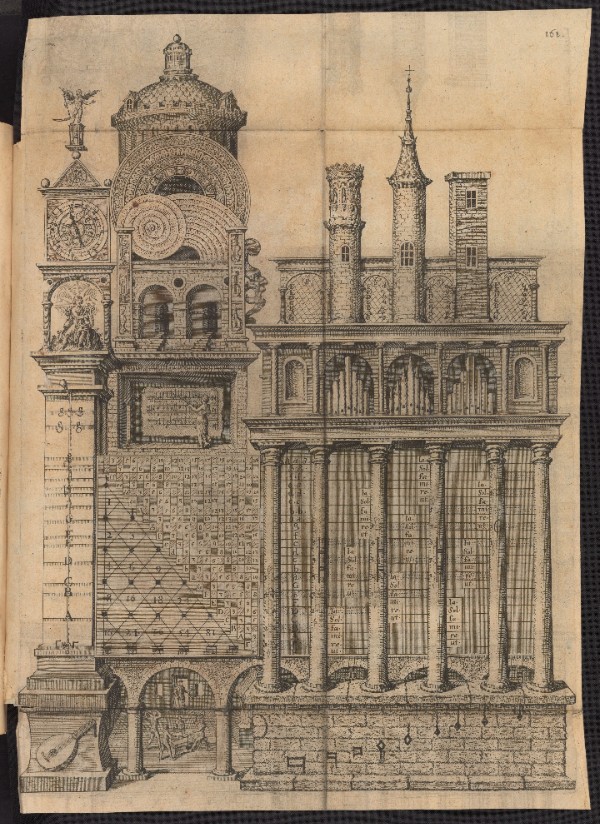
Fludd: Utriusque Cosmi…., Tract 2, Part 2, Book 1, p. 161
Here, Fludd has constructed a façade of music, where every element is telling. Starting from the bottom, on the left, we have an image of a lute, then we look into a room showing Pythagoras listening to the blows of the hammers on anvils (tuning). On the right side, we have the pitches shown by duration going up the front of the building.
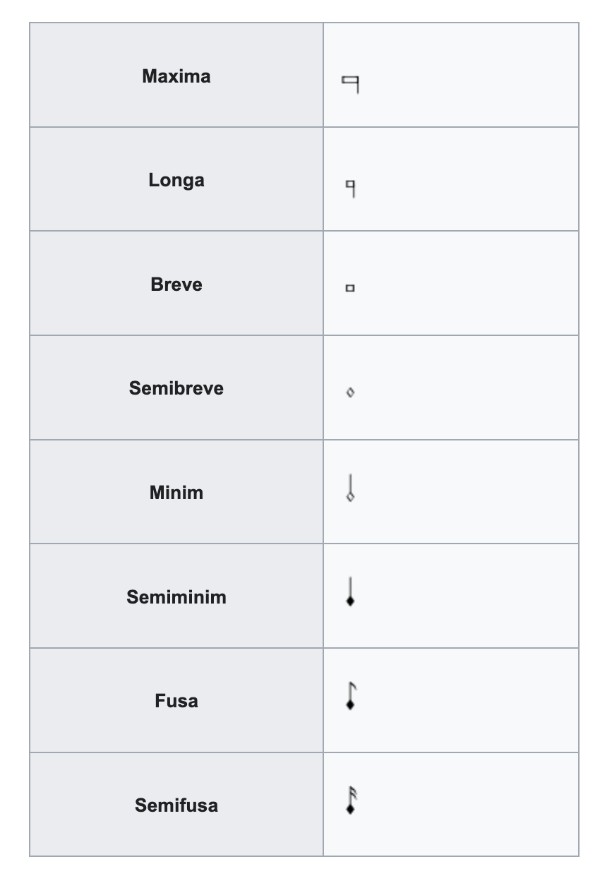
On the left side of the note values is a bass clef showing where ‘F’ would be. Above the note values are hidden a Flat sign and a natural sign.
Returning to the left side, we have a monochord with a two-octave scale, showing whole and half-steps between the notes. The lower left triangle shows the division of the note values, starting with Maxima at the bottom. The right triangle gives the distance between pitches: run your finger up the C line to E, and it says “3”, indicating that the two pitches are a third apart.
On the right side, in the middle of the columns, are clefs: F, C and G. Between the columns are the hexachords. When read across, the lowest “D” is indicated as D-la-re-sol, depending on which hexachord it is in.
Robert Johnson: Pavan No. 3 in C Minor (Nigel North, lute)
Above the checkerboard triangles, the muse Thalia gives a music lesson.
On the right side of the building, we have arches filled with organ pipes: cylindrical, pointed, and square, all matching the towers above them.
On the left side, Apollo, in his guise as the Sun God, plays the lyre. Above him, we again have the pitch values, which start with the Maxima at noon and decrease progressively as they move clockwise – it includes both notes and rests. Below them, at the centre of the clock, are time signatures/ At the top of the building is Old Man Time (i.e., rhythm), shown with his scythe and an hourglass.
In the centre building, the two doorways are surrounded by musical instruments: harp, organ, serpent, viol, cittern, and lute. The spiral curves above them represent sound. The grotesque ornaments on the side of the building seem to be singing.
It’s an amazing construction, particularly how Fludd is able to include so many different elements of music into the image, including quite complex scales in the hexachords. What’s in your temple of music?
For more of the best in classical music, sign up for our E-Newsletter