
Inspirations Behind Tracy Silverman’s Between the Kiss and the Chaos
Created initially as music for five scenes from a puppet opera, composer and electric violinist Tracy Silverman combined the idea of creation in the arts with his ideas of how those arts were created.
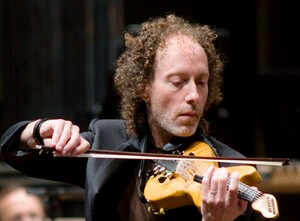
Tracy Silverman (photo by Martin Cherry)
The puppet play, Masters, was a collaboration with the puppeteer Brian Hull. Silverman says he ‘conjured up a little dramatic scene imagining how each of several iconic masterpieces was inspired or created. There is a general (historically inaccurate) suggestion of time and place for each piece.’ He thought of the works as a kind of Pictures at an Exhibition, but instead of walking from picture to picture, he was delving deep into the idea of the creation of the different images.
He opens with the most perfect man by Michelangelo, his statue of the young David. Originally commissioned as one of a series of 12 statues of the prophets to be placed along the roofline of the Florence Cathedral, it was brought down to ground level and placed in the square in front of the Palazzo della Signoria and unveiled on 8 September 1504. It remained there until 1873, when it was removed to the Galleria dell’Accademia. In 1910, a replica of the statue was returned to the original placement at the Palazzo della Signoria, where we still see it today.
In many ways, David, as a Biblical figure who defeated the larger Goliath in single combat, became a model for the defence of the smaller against a larger opponent, and for the defence of civil liberties.
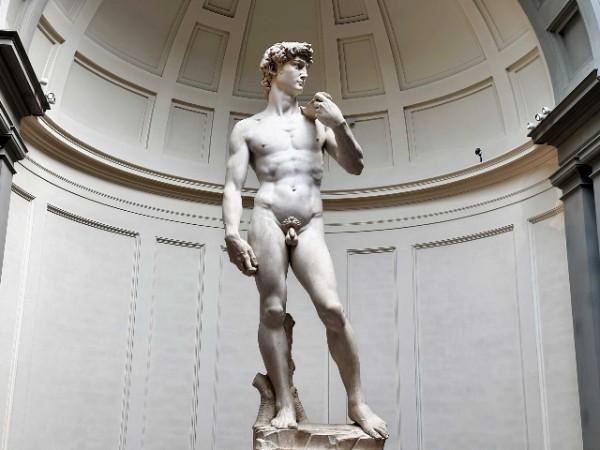
Michelangelo: David, 1501–1504 (Florence: Galleria dell’Accademia)
The history of the block of marble that became the David we know today started in 1464. Agostino di Duccio, a protégé of Donatello, brought a large piece of marble from the quarry at Carrara. Where normally a statue of this size would be made of several blocks of marble, Agostino’s acquisition of a single block meant an investment in labour and transport to get it to Florence, plus the initial price. When Donatello died in 1466, Agostino abandoned the project, leaving the work just started. The torso, legs and feet had been shaped, the drapery was roughed out, and the material between the legs had started to be removed. No further work happened until 1500, when a new artist was commissioned, and the 25-year-old Michelangelo took on the job.
The final statue weighed 8 tons, too heavy to be transported to the top of the cathedral, and so it was positioned next to the entrance to the Palazzo della Signoria.
In his music, Silverman places us in the middle of Michelangelo’s workshop as the work begins to free Michelangelo’s vision. ‘I saw the angel in the marble and carved until I set him free’, said Michelangelo in Florence in 1504. David calls to Michelangelo from within the stone, begging to be freed so he can go and conquer the world again.
Tracy Silverman: Between the Kiss and the Chaos – I. Michelangelo: David (Tracy Silverman, electric violin; Calder Quartet, Ensemble)
Now that we have a body, we can dance. In 1910, French painter Henri Matisse was commissioned by Russian businessman and art collector Sergei Shchukin for a work for his Moscow mansion. Matisse was fascinated with primitivism and Fauvism and used intense dark colours, presenting a green landscape and a dark blue sky. The dancers whirl, intent on their steps and keeping back the world around them. Links can be made with Stravinsky’s iconoclastic Rite of Spring from 1913, in which another set of circle dances result in a maiden’s death and the return of Spring.
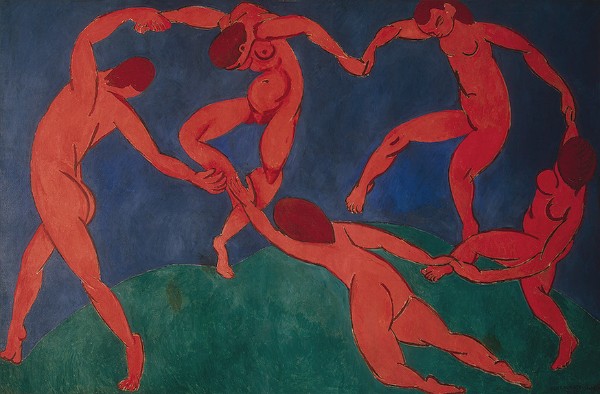
Matisse: La Danse, 1909 (St Petersburg: Hermitage)
There is, however, a previous version, done as a study of the same size. The colours are lighter, and some of the details of the final are missing, such as knees and muscles. The angles of the arms and legs are more defined, and the back arch of the left-most figure is sharper in the final work.
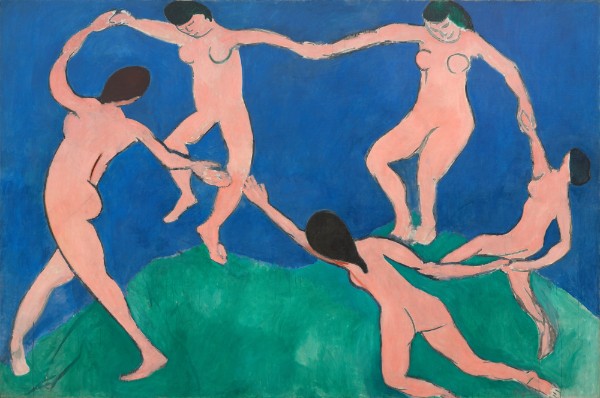
Matisse: La Danse (1), 1909 (New York: Museum of Modern Art)
In his musical version, Silverman starts with a child lost in the music and improvising a dance to its sound. Gradually, more and more dancers join in an improvised counterpoint, each with their own character. Finally, once all five dancers are in motion, the electric violin solo becomes the sixth dancer, improvising to the others’ melodies.
Tracy Silverman: Between the Kiss and the Chaos – II. Matisse: La Danse (Tracy Silverman, electric violin; Calder Quartet, Ensemble)
Painter Georgia O’Keeffe sought the world in detail. She sought to change our world to focus on the disregarded, be it an animal skull or the plain colours of the desert at the horizon. Landscapes encompassed the world, and flowers brought it into detail. She said, ‘In a way – nobody sees a flower – really – it is so small – we haven’t time – and to see takes time’. In her flower paintings, she gives us the time to appreciate the colours and folds of a petal of an otherwise unregarded poppy, the shifting from the light edges to the dark centre of life.
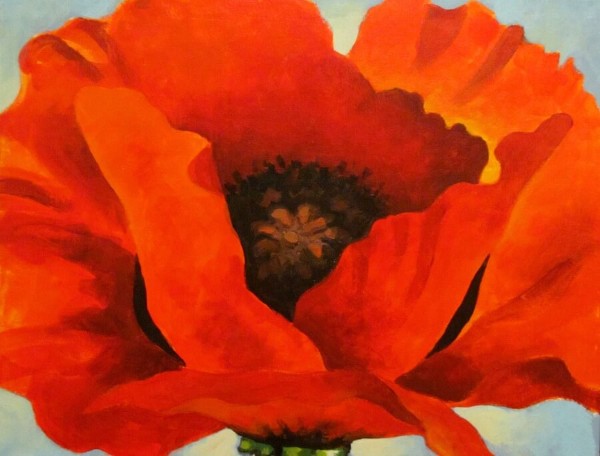
O’Keeffe: Red Poppy, 1927
In another view of the flower, she looks straight down into its heart. The colours spring from a dark centre and take us to the frilled edges.
In a beige desert landscape, a poppy is a point of colour, a bright spark against a dull background. In her paintings, she makes the whole world a poppy. Is it a detailed image of a flower or an invitation to a mysterious, unknown world?
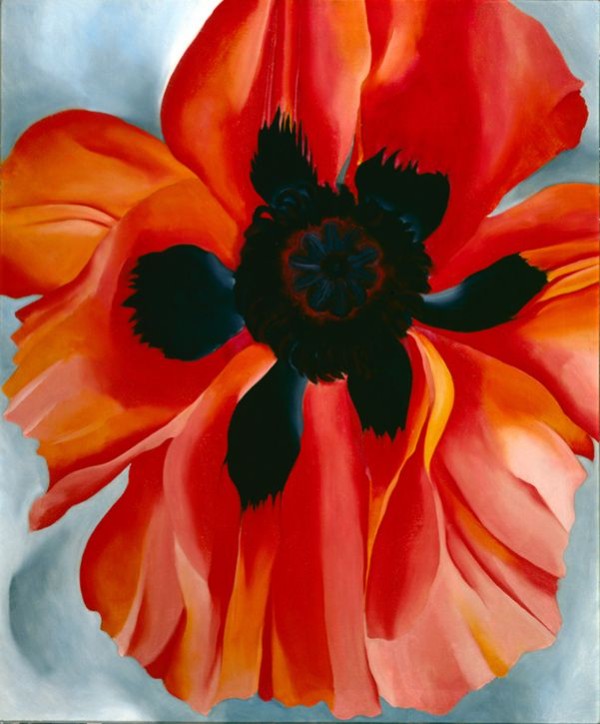
O’Keeffe: Red Poppy, 1928 (private collection)
In the music, we follow our artist from morning to night as she ventures out into the New Mexico desert. The sun is high, and her world is full of insects and animals and plants, all reaching toward the light. The red of a poppy catches her eye, as does the life it supports. As the dark comes to the desert, Silverman imagines O’Keeffe dancing to the setting sun. As the moon rises, the flower closes its petals for the night and sings its own song to its light.
Tracy Silverman: Between the Kiss and the Chaos – III. O’Keeffe: Red Poppy (Tracy Silverman, electric violin; Calder Quartet, Ensemble)
The Starry Night, painted by Vincent Van Gogh in June 1889 from the window of his room in the asylum at Saint-Rémy-de-Provence. It is just before sunrise, and van Gogh populates his scene with an imaginary village and a huge cypress tree. In the sky, the planet Venus takes a central place while the moon occupies the right side. Clouds spin in the wind, or are those vortices from the stars themselves? For Van Gogh, this was work filled with aesthetic values, rather than symbolic elements. He regarded it as a failure when discussing it in letters to his brother Theo, but we regard it as one of the principal works of post-Impressionism.
This view from his bedroom window was a favourite of Van Gogh’s in the year he spent in the asylum, painting it no fewer than 21 times. It was part of Van Gogh’s search for style and how to occupy the middle ground between painting from nature and painting from the imagination.
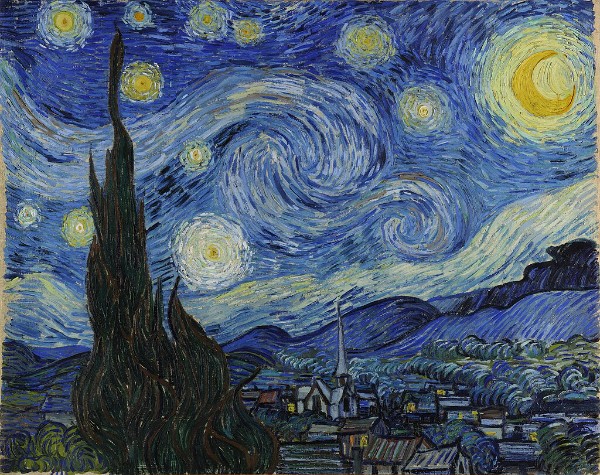
Van Gogh: The Starry Night, 1889 (New York: Museum of Modern Art)
Silverman constructs a day in the life of Van Gogh, first sending him out for a day of painting in the fields before imagining the view from his window as the tired painter comes home. Looking out the window and eating a piece of bread as he gazes, he finds that the stars are singing to him.
Tracy Silverman: Between the Kiss and the Chaos – IV. Van Gogh: The Starry Night (Tracy Silverman, electric violin; Calder Quartet, Ensemble)
One of the outstanding works held in the Museum Reina Sofia in Madrid is Pablo Picasso’s monumental (349.3 cm × 776.5 cm (137.4 in × 305.5 in)) oil painting Guernica. On 26 April 1937, the little town of Guernica in northern Spain was bombed by the joint Axis forces of Germany and Italy in support of the fascist General Francisco Franco. The painting was exhibited at the 1937 Paris International Exposition. Just like a photograph, the image is done only in black and white.
The city was bombed from above for more than three hours, and the citizens who sought refuge in the fields were strafed by fighter planes. Hundreds of people died, with the true count unknown
Picasso completed the work in just 36 days, finishing it on 4 June 1937. He used a special matte house paint so there would be no glare on the final image. Dead animals, dead soldiers, and screaming figures fill the work. The nostrils of the central horse and its teeth from a human death’s head.
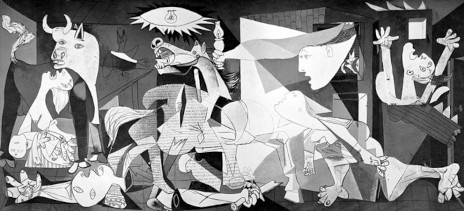
Picasso: Guernica, 1937 (Madrid: Museo Reina Sofía)
In Silverman’s vision, man’s capacity for evil is matched by man’s capacity for beauty and good. Even in the midst of death and destruction, it takes an artist to make us look beyond the blood and fallen houses to see the spark of life that drives all of us. The music is full of unexpected drops and drones, screaming violin and cello explosions. As a final movement, it places the final nail in the artistic coffin.
Tracy Silverman: Between the Kiss and the Chaos – V. Picasso: Guernica (Tracy Silverman, electric violin; Calder Quartet, Ensemble)
The title for Silverman’s piece, Between the Kiss and the Chaos, comes from a song lyric he wrote some two decades ago. He sees it as a metaphor for the creative process. When he was a student spending his hours in the practice room, he tried to imagine how a composer might have created a work, thereby trying to gain an insight into a composer’s personality and music. In the same way, he’s created imaginary worlds for his artists, placing O’Keeffe in the desert and Michelangelo at work in his studio yard. Their products are indicative of their creative talents, but are all expressed in different ways. Van Gogh could never have portrayed the destruction of Guernica as Picasso did, but then we can’t imagine Matisse creating the perfect stillness of Michelangelo’s David. Each artist brought us a vision of their personal world.
The creative act is a way to organise the chaos, to struggle to get what you want to say on canvas or on paper. It’s how to get someone else to see the world through your eyes. And through your ears.
Eventually, the music from the original puppet opera became Silverman’s second concerto for electric violin, but this version for electric violin and string quartet was the original.
For more of the best in classical music, sign up for our E-Newsletter






Thanks for this beautiful description of my work and the connection between music and the visual arts!