Eric Montalbetti’s Trio Inspired by Suprematism, Orphism, and Futurism
French composer Eric Montalbetti (b. 1968) designed his Trio for violin, cello, and piano around three modernist artistic styles: Suprematism, Orphism, and Futurism.
Suprematism was developed by the Soviet artist Kazimir Malevich (1879–1935), who worked his way through Impressionism, Symbolism, Fauvism, and Cubism before simplifying his style to pure geometric forms. His 1915 work, Black Square, laid down the gauntlet for the new style and defined the line between old and new art, according to Tatiana Tolstaya in The New Yorker. Consisting of a black square on white, it was the purest example of radical abstract painting of its time.
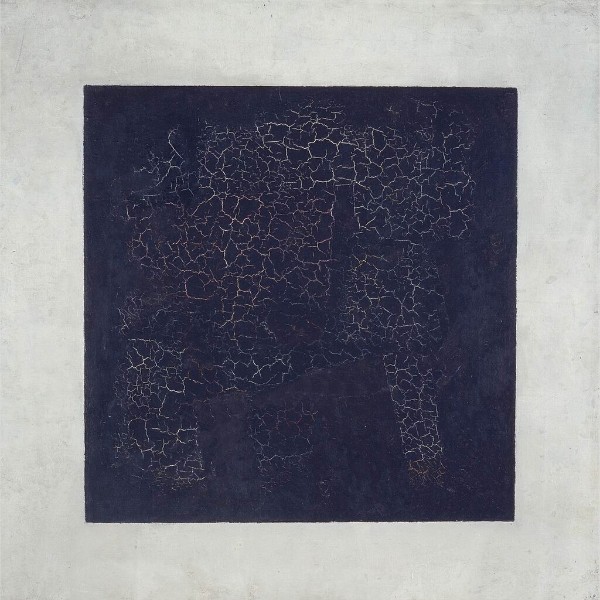
Kazimir Malevich: Black Square, 1915 (Moscow: Tretyakov Gallery)
A photograph of an exhibition of Supremacist works by Malevich in 1915 shows the variety of ways in which he used his geometric forms. Black Square is hung at the top of the room in the corner.
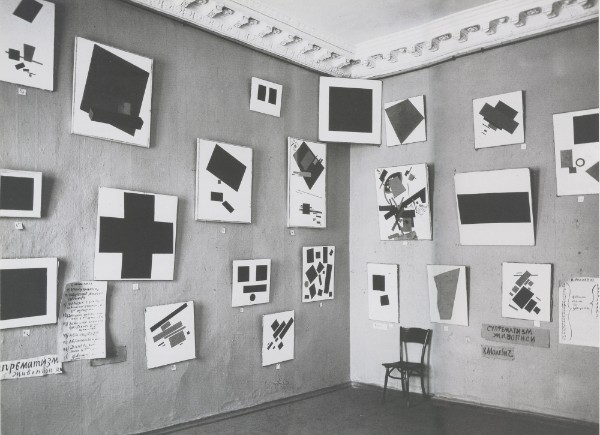
Suprematist works by Malevich at The Last Futurist Exhibition 0,10 Exhibition, Saint Petersburg, 1915
In his movement in honour of the Suprematists, Montalbetti instructs the performers to ‘present the material with great strictness, but avoiding dryness’, so that they can build up a rigorous but dynamic discourse between the instruments.
Eric Montalbetti: Trio – I. Composition suprématiste (Hae-Sun Kang, violin; Éric-Maria Couturier, cello; Hideki Nagano, piano)
The next movement takes up the Orphism of Sonia and Robert Delaunay. Orphism, a term created by Guillaume Apollinaire in 1912, was inspired by Cubism, influenced by Fauvism, and the use of bright colours. As a subset of Cubism, the style is instantly recognisable, but the more familiar washed-out colours of Picasso’s Cubism are replaced by bright colours.
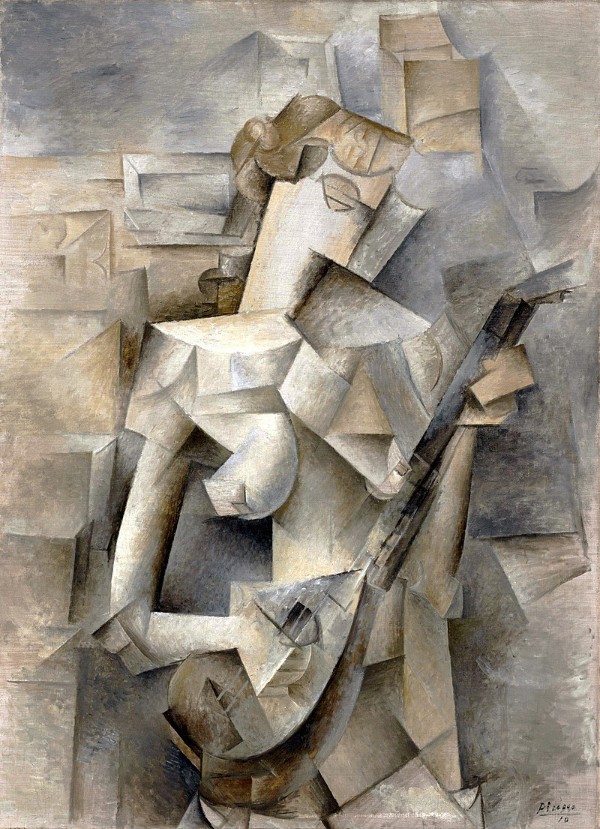
Pablo Picasso: Girl with a Mandolin (Fanny Tellier), 1910 (New York: Museum of Modern Art)
Compare this with Delaunay’s work of only two years later.
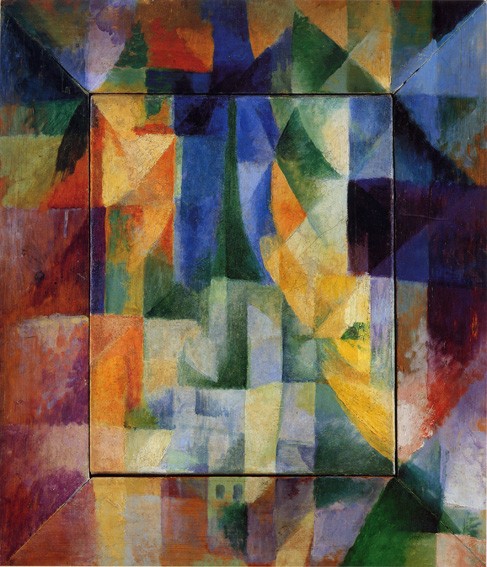
Robert Delaunay: Simultaneous Windows on the City, 1912 (Kunsthalle Hamburg)
When we get to Sonia Delaunay’s work of 1914, we can see the inspiration for the title of this movement.
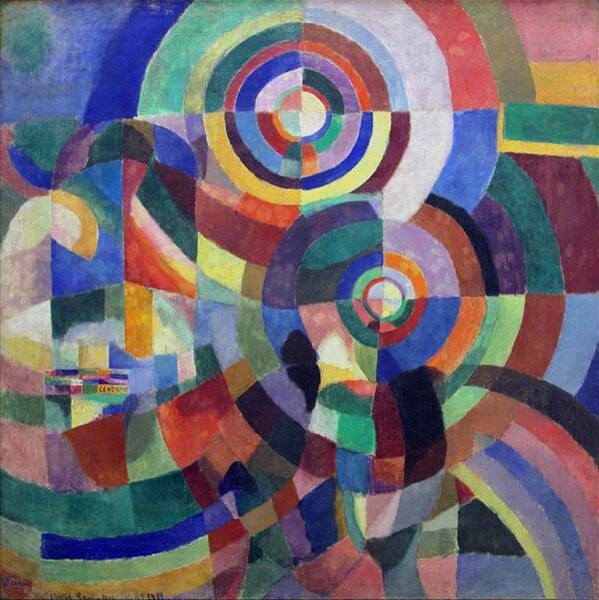
Sonia Delaunay: Prismes électriques, 1914 (Paris: Musée National d’Art Moderne, Centre Pompidou)
One of the key members of Orphism was the dye chemist Michel Eugène Chevreul (1786–1889). His work with chemical and organic compounds makes us consider him one of the founders of modern organic chemistry. His studies of textile dyes led to the colour theories that lay behind Impressionist and Neo-Impressionist painting, and so to Orphism’s use of colours.
The name ‘Orphism’ comes from the god of music, Orpheus. Following a 1913 exhibition of Orphism, Apollinaire wrote, ‘If Cubism is dead, long live Cubism. The kingdom of Orpheus is at hand!’ The movement was dead before WWI started, but continued to exert an influence through the works of American artists such as Patrick Henry Bruce and Arthur Burdett Frost Jr., who had been students of Delaunay’s.
Montalbetti starts his Orphic movement with a circular form initially presented in the violin. The following motifs are ‘constructed as series of greater or lesser length on a non-octave scale’.
Eric Montalbetti: Trio – II. Formes circulaires (Hae-Sun Kang, violin; Éric-Maria Couturier, cello; Hideki Nagano, piano)
One of the principal figures in Futurism was Umberto Boccioni (1882–1916). The short-lived but influential Italian painter and sculptor had an ‘approach to the dynamism of form and the deconstruction of solid mass’ that was influential on other artists for decades.
His Futurist bronze sculpture Formes uniques de la continuité dans l’espace (1913) is a work of movement and fluidity. Futurism had an emphasis on ‘dynamism, speed, technology, youth, violence, and objects such as the car, the airplane, and the industrial city’. If the triumphant stance and the torso without arms evoke images of sculptures from earlier times, it’s the polished bronze that makes it modern. This striding figure isn’t a portrait of any one person but synthesises the entire idea of walking into a single object.
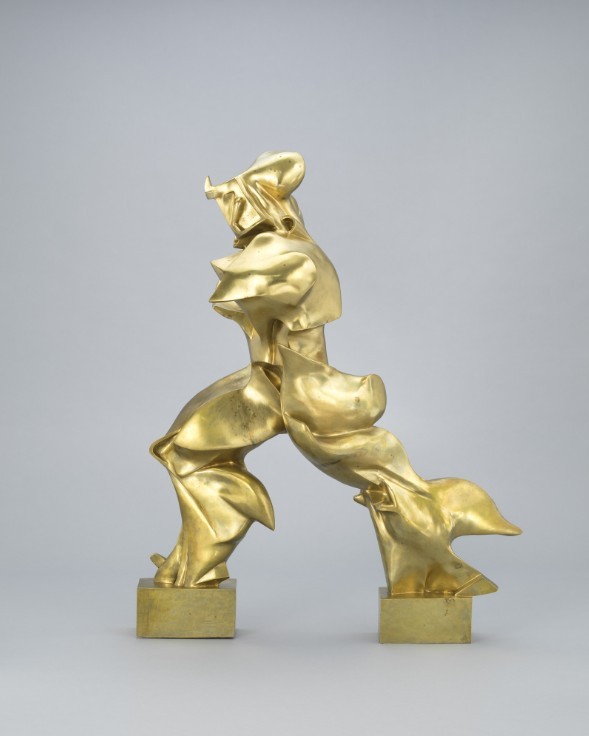
Boccioni: Formes uniques de la continuité dans l’espace, 1913 (New York: MOMA)
Montalbetti takes the sculpture’s idea of walking at speed and transforms it into motion in the trio: we’re making progress in a certain direction, but not in a straightforward manner.
Eric Montalbetti: Trio – III. Formes uniques de la continuité dans l’espace (Hae-Sun Kang, violin; Éric-Maria Couturier, cello; Hideki Nagano, piano)
Montalbetti composed the work in the mid-1990s and then revised it at the request of the violinist Hae-Sun Kang for its premiere.
For more of the best in classical music, sign up for our E-Newsletter